
Geography skills Normal Geography Worksheets for Ages 4-8
3 filtered results
Difficulty Level
Grade
Age
-
From - To
Subject
Activity
Standards
Unlock your child's potential with our "Geography Skills Normal Geography Worksheets" designed for ages 4-8! Our engaging worksheets introduce young learners to essential geography concepts through fun and interactive activities. From identifying continents and countries to understanding maps and landmarks, these resources build a strong foundation for future learning. Each worksheet encourages critical thinking, problem-solving, and observation skills while making learning enjoyable. Perfect for home or classroom use, these printable materials support early education in an accessible and entertaining way. Explore the world together as your child develops confidence in their geography skills, setting them on the path to academic success!
Favorites
With answer key
Interactive
 Assign to My Students
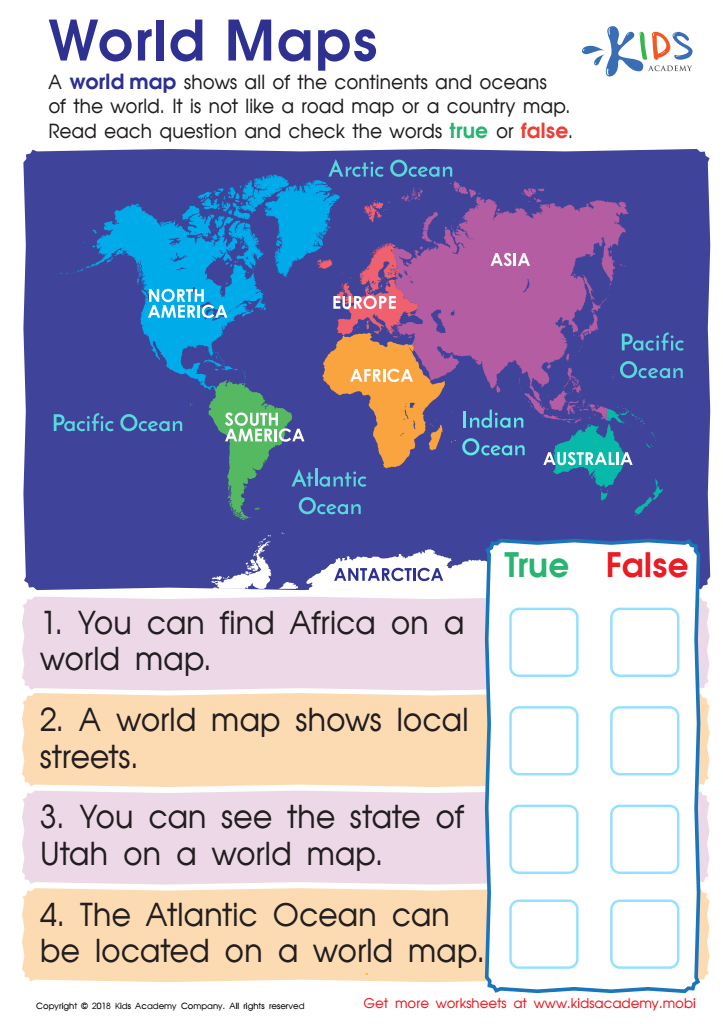
World Maps Worksheet
Help your young geographer learn about world maps. Show them that it displays all the oceans, continents and is distinct from other maps. Challenge them to answer the true/false questions on this free worksheet, and help them become a global citizen who understands the purpose of world maps.
World Maps Worksheet
Worksheet
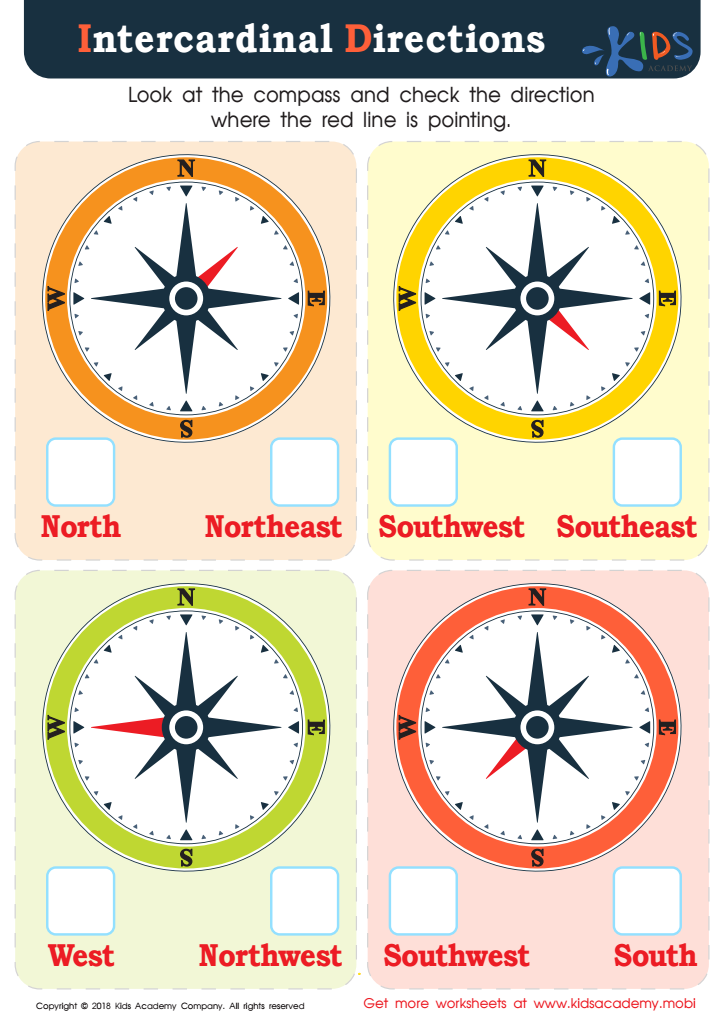
Intercardinal Directions Worksheet
Young students often don't get to practice cardinal and intercardinal directions in the digital age, but it's an important social studies and geography concept to learn. This PDF provides colorful compasses for them to practice with, giving them a real-world skill for common curriculum and independent living.
Intercardinal Directions Worksheet
Worksheet
Join Kids Academy for Free
Who is primarily going to use this learning content?






Parents and teachers should prioritize geography skills for children aged 4-8 because such skills lay the foundation for their understanding of the world. At this young age, children are naturally curious and eager to learn about their environment; thus, geography offers them a concrete way to make sense of the spaces they inhabit.
Understanding basic geographic concepts helps children develop critical thinking and spatial awareness. By learning about maps, locations, and landmarks, children can enhance their ability to navigate the world around them, increasing their independence and confidence. Exposure to different cultures and places through geography fosters empathy and awareness, encouraging children to appreciate diversity and nurture a global perspective as they grow.
Geography also supports interdisciplinary learning as it connects to science through natural environments and to literature through stories set in different locations. Early geography skills serve as a building block for more advanced subjects in later years, helping students excel academically.
Lastly, incorporating geography into everyday life, such as discussing family travel or local community features, strengthens the connection between classroom learning and the real world, making education not only informative but also meaningful and engaging.








