Understanding fact families Normal Math Worksheets for Ages 5-6
3 filtered results
-
From - To
"Understanding Fact Families Normal Math Worksheets for Ages 5-6" are designed to introduce young learners to basic arithmetic in a fun, engaging way. These worksheets help children grasp essential mathematical concepts by exploring the relationships between numbers in a fact family. Perfect for kindergarten and first-grade students, these exercises aid in developing addition and subtraction skills. Featuring colorful illustrations and interactive problems, these activities enhance problem-solving abilities and build a solid understanding of number families. Ideal for parents and teachers, our resources make learning math enjoyable and effective for children aged 5-6.
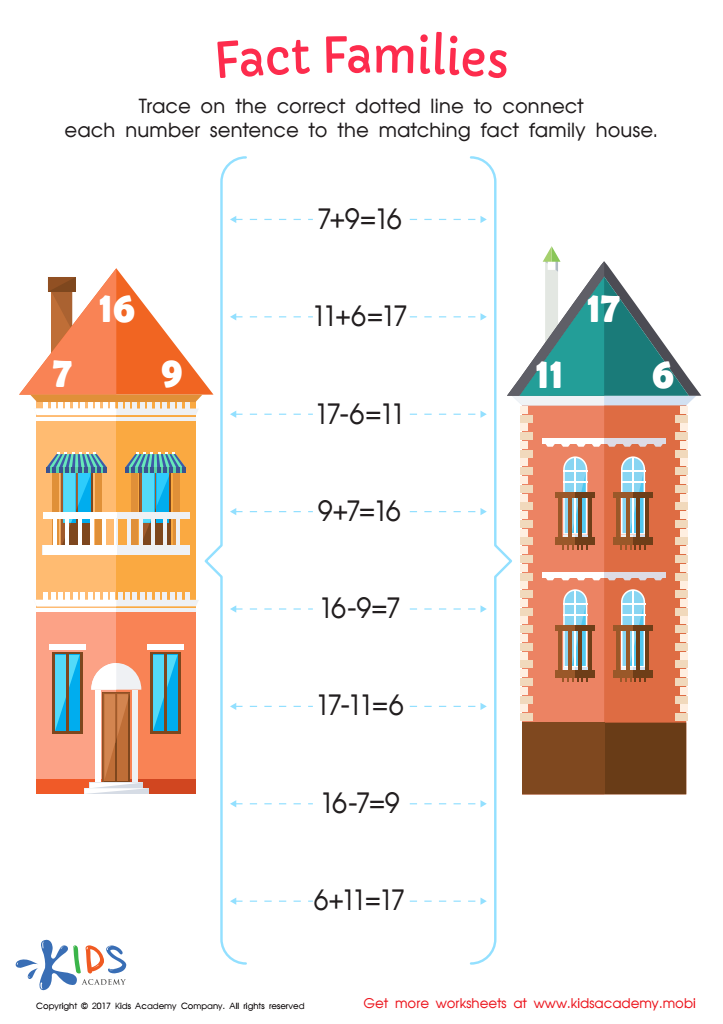
Fact Families — Add and Subtract Worksheet
 Assign to My Students
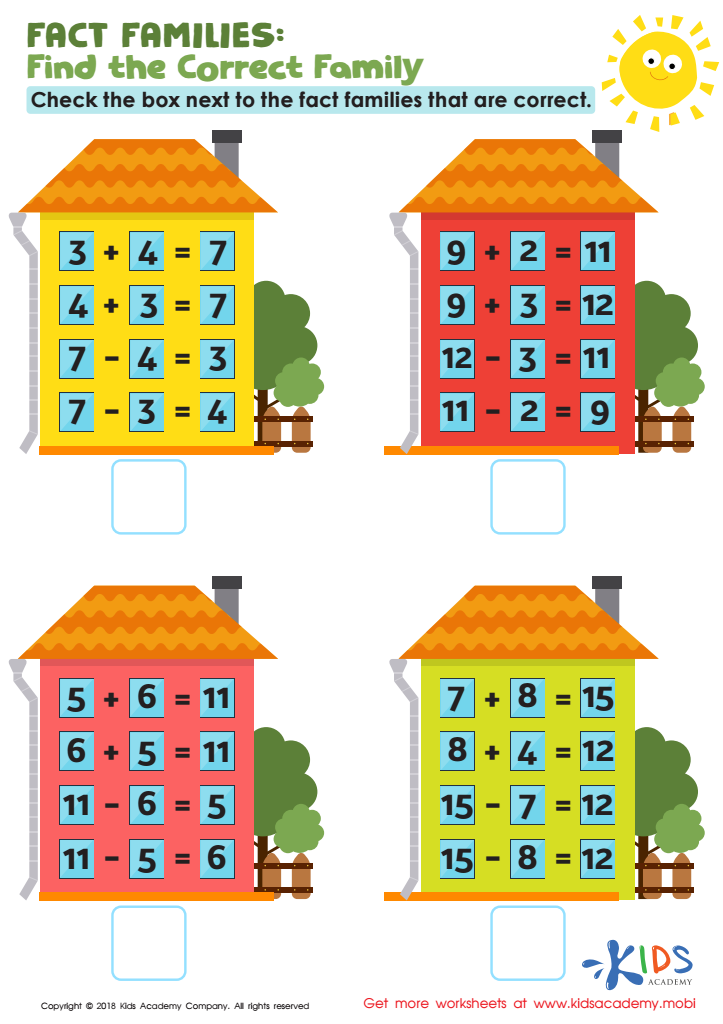
Fact Families: Find Correct Family Worksheet
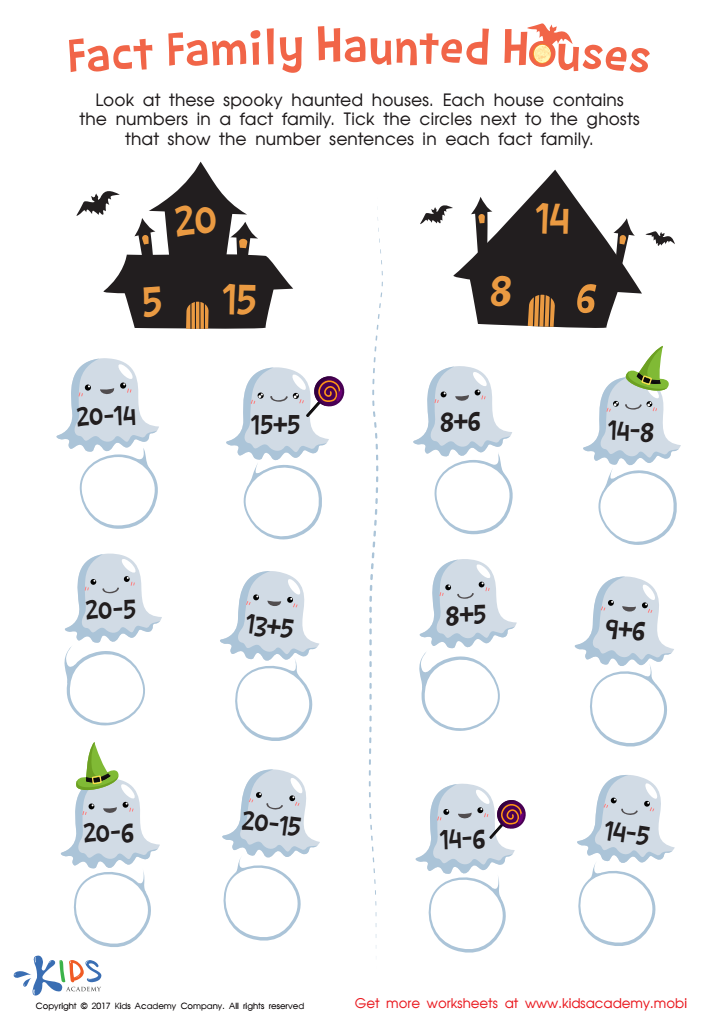







.jpg)
Understanding fact families is crucial for young children, particularly those aged 5-6, as it forms the foundation for their mathematical learning. Fact families are sets of related mathematical facts using the same numbers. For example, knowing that 2 + 3 = 5 helps children understand that 3 + 2 = 5, 5 - 2 = 3, and 5 - 3 = 2. This concept strengthens mental arithmetic skills and number sense, which are essential for more complex math later on.
When parents and teachers emphasize fact families, they help children recognize patterns and relationships between numbers, making math less abstract and more accessible. It nurtures their problem-solving abilities and builds confidence as they master basic addition and subtraction, enabling them to tackle more advanced topics with ease.
Furthermore, understanding fact families aids in developing both cognitive and critical thinking skills. It enables children to approach problems logically, anticipate answers, and link their existing knowledge to new concepts. For instance, if they know 4 + 3 = 7, they can deduce that 7 - 4 = 3 without extra steps.
In conclusion, incorporating fact families into early math education is fundamental for building a solid mathematical foundation, fostering cognitive development, and instilling lasting confidence in young learners.








