Fine Motor Skills Normal Letter W Worksheets for Ages 5-7
3 filtered results
Difficulty Level
Grade
Age
-
From - To
Subject
Activity
Standards
Enhance your child's learning journey with our "Fine Motor Skills Normal Letter W Worksheets for Ages 5-7." Tailored specifically for young learners, these engaging activities focus on mastering the letter "W" while developing essential fine motor skills. Perfect for pre-K and early elementary students, our worksheets offer a delightful mix of tracing, writing, and creative exercises to keep them motivated and entertained. Each worksheet is designed to build dexterity, control, and confidence, ensuring a solid foundation for future handwriting success. Explore our range of fun, educational printables today and support your child's growth effortlessly!
Favorites
With answer key
Interactive
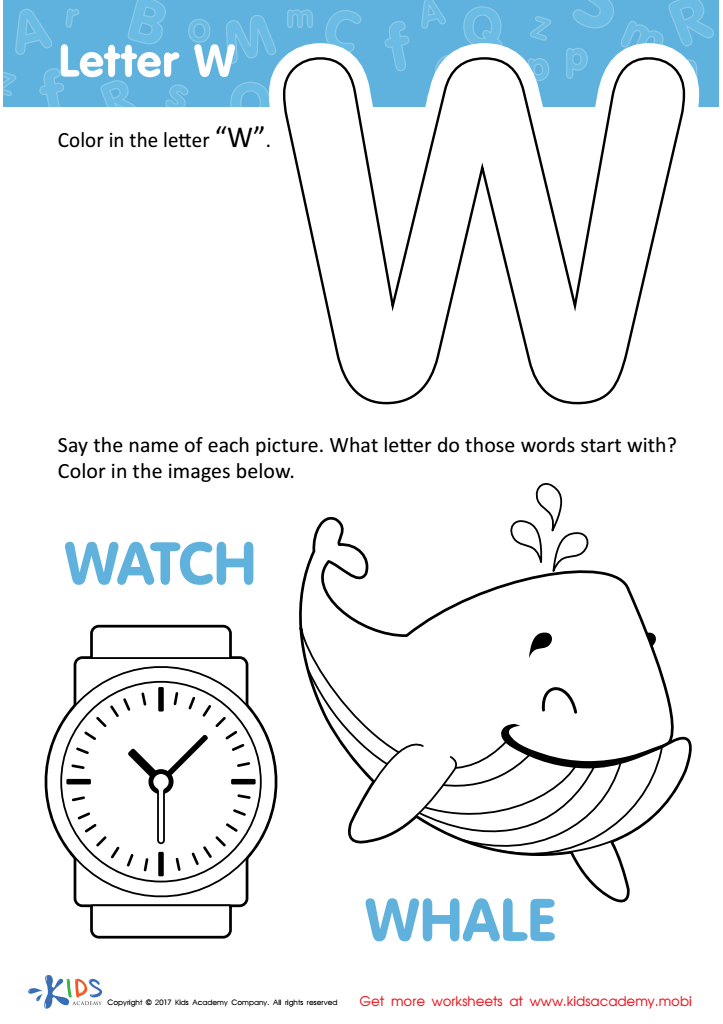
Letter W Coloring Sheet
Let your child have fun with this letter "W" coloring page! They can use their imagination to color the whale and discover the letter and its sound. Give them a helping hand to make it a whale of a time!
Download (PDF)
 Assign to My Students
Assign to My Students
Letter W Coloring Sheet
Worksheet
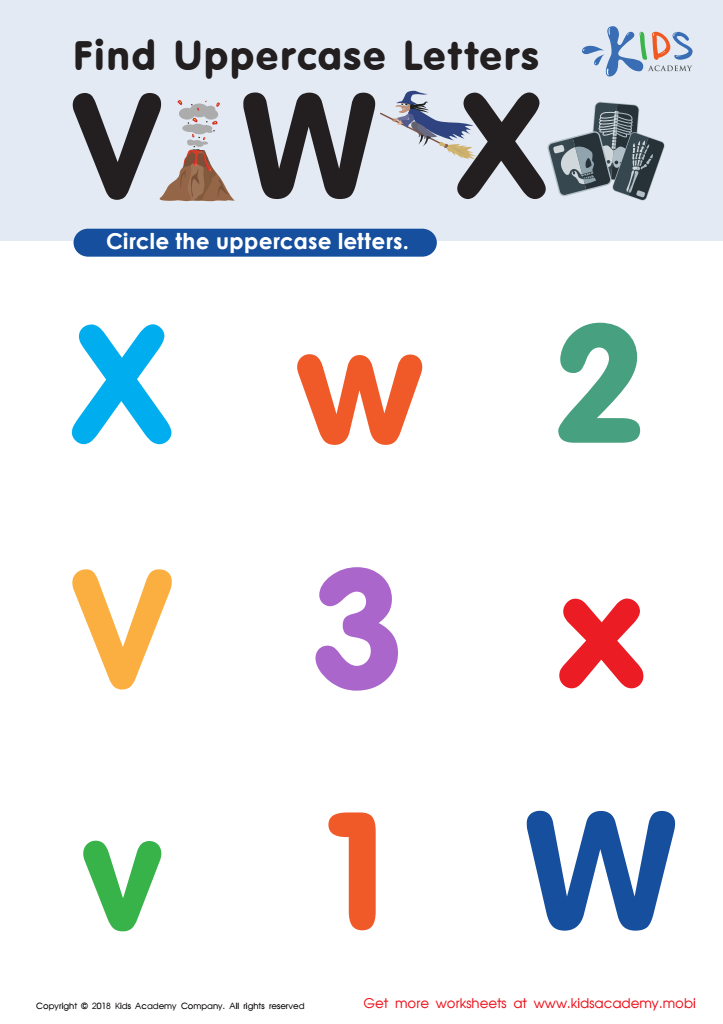
Find Uppercase Letters V, W, X Worksheet
Ask your kids if they can spot the uppercase letters V, W and X hidden in the lowercase letters and numbers, then have them circle them. After that, ask them to give you examples of words beginning with those letters. This worksheet will help them get started.
Find Uppercase Letters V, W, X Worksheet
Worksheet

Uppercase Letters V, W, and X Worksheet
This worksheet is perfect for kids struggling to write uppercase letters V, W, and X. Warm up their brains first by having them name words starting with these letters. Then, help them trace and write each letter from the big red dot. With your assistance, they will quickly sharpen their writing skills.
Uppercase Letters V, W, and X Worksheet
Worksheet
Join Kids Academy for Free
Who is primarily going to use this learning content?




Fine motor skills are critical for young children, particularly in the age range of 5-7, as they play a significant role in their overall development and ability to perform essential tasks. These skills involve the coordination of small muscles, mostly in the hands and fingers, with the eyes and rely on hand-eye coordination. As children learn to form letters, such as the normal letter "W," they enhance their dexterity, control, and precision.
Developing fine motor skills allows children to complete everyday tasks independently, such as buttoning clothes, tying shoelaces, and using utensils. In the classroom, good fine motor skills facilitate better handwriting, which is crucial for academic success and self-esteem. Poorly developed fine motor skills can lead to frustrations, impacting a child's confidence and enthusiasm for learning.
For instance, mastering how to write the letter "W," which involves a series of straight lines and angle formations, can significantly boost a child's ability to tackle other letters and words, cementing foundational literacy skills. Parents and teachers should therefore integrate activities that promote fine motor development, such as drawing, cutting with scissors, and manipulatives like playdough. This focused attention nurtures a child’s growth, ensuring they are on par with their peers and ready for subsequent academic challenges.