
Understanding fact families Normal Worksheets for Ages 5-7
3 filtered results
Difficulty Level
Grade
Age
-
From - To
Subject
Activity
Standards
Discover our "Understanding Fact Families Normal Worksheets" designed for children aged 5-7! These engaging and interactive worksheets help young learners grasp foundational math concepts by exploring the relationship between addition and subtraction. Through fun activities, children will discover how numbers work together in fact families, enhancing their problem-solving skills and number fluency. With colorful illustrations and age-appropriate exercises, our resources make learning math enjoyable and accessible. Ideal for homeschooling or classroom use, these worksheets support early math development and lay the groundwork for future success. Perfect for educators and parents seeking to strengthen their child's understanding of basic math relationships.
Favorites
With answer key
Interactive
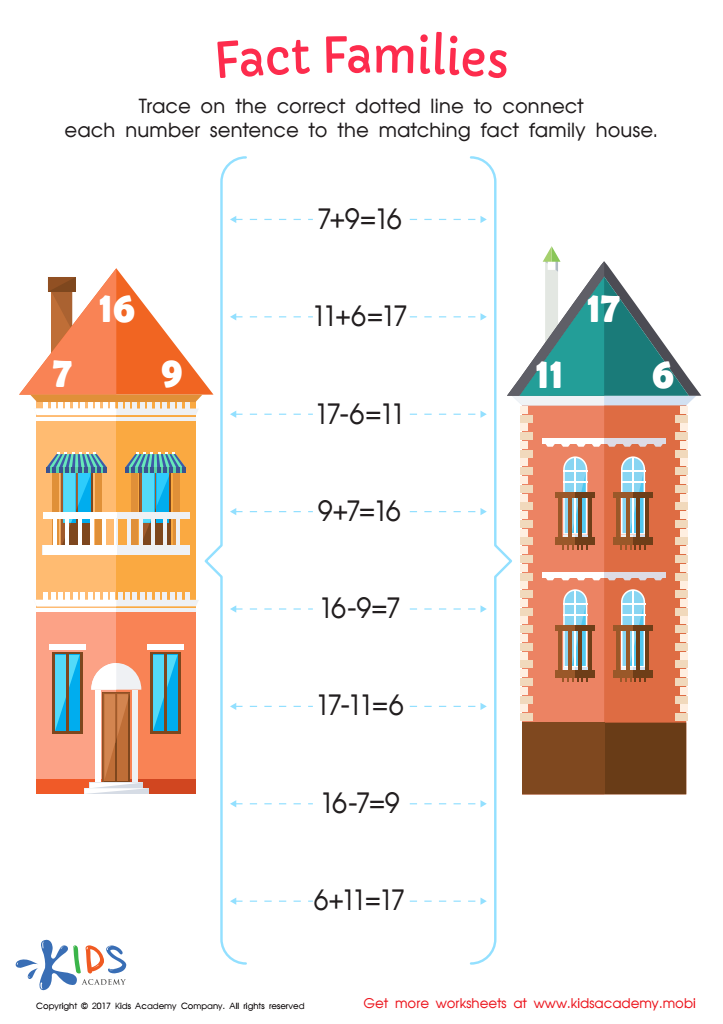
Fact Families — Add and Subtract Worksheet
Kids will love seeing how families of numbers "live" in their own houses!
 Assign to My Students
Fact Families — Add and Subtract Worksheet
Worksheet
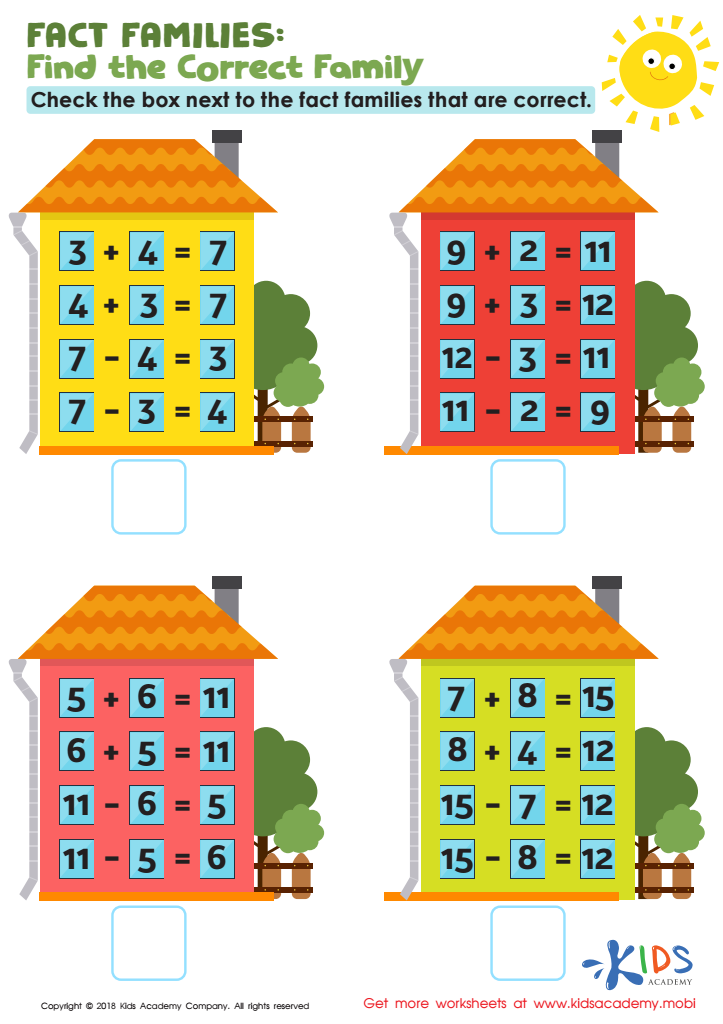
Fact Families: Find Correct Family Worksheet
Test your students' math and reasoning skills with this worksheet. It features 4 houses, each with a group of fact families on it. Some are correct, some are wrong - help students identify which are correct and circle the box next to them. This will help them progress in school.
Fact Families: Find Correct Family Worksheet
Worksheet
Join Kids Academy for Free
Who is primarily going to use this learning content?







Understanding fact families is essential for children aged 5-7 as it lays the foundation for their mathematical learning. A fact family consists of related addition and subtraction (or multiplication and division) equations that involve the same numbers. For example, in the fact family of 3, 4, and 7, the equations 3 + 4 = 7 and 7 - 4 = 3 illustrate these relationships.
Parents and teachers should care about teaching fact families because they promote numerical fluency, helping children recognize the connections between operations. This understanding can enhance their problem-solving skills, enabling them to approach math in a more versatile manner. By mastering fact families, young learners also develop strategies for mental math, reducing reliance on counting and promoting confidence and independence in their abilities.
Furthermore, introducing fact families early on fits seamlessly with learning outcomes in early elementary grades, supporting Common Core Standards. Not only does this concept make math more logical, but it also helps children see the beauty of patterns in numbers. Positive early experiences with math can foster a lifelong love for the subject, resulting in improved academic performance and attitudes towards learning as children progress through their education.








