
Understanding Simple Machines Normal Worksheets for Ages 5-7
3 filtered results
Difficulty Level
Grade
Age
-
From - To
Subject
Activity
Standards
Unlock the wonders of physics with our "Understanding Simple Machines Normal Worksheets" designed for children ages 5-7. These engaging, age-appropriate worksheets introduce young learners to the basic concepts of simple machines, including levers, pulleys, and inclined planes. Through fun exercises, kids will build foundational skills in problem-solving and critical thinking while exploring how these machines make work easier. Each worksheet is thoughtfully crafted to stimulate curiosity and creativity, making learning an enjoyable adventure. Perfect for classroom activities or home learning, our printable resources provide interactive, hands-on experiences tailored to sustain the interest of young minds. Start your discovery today!
Favorites
With answer key
Interactive
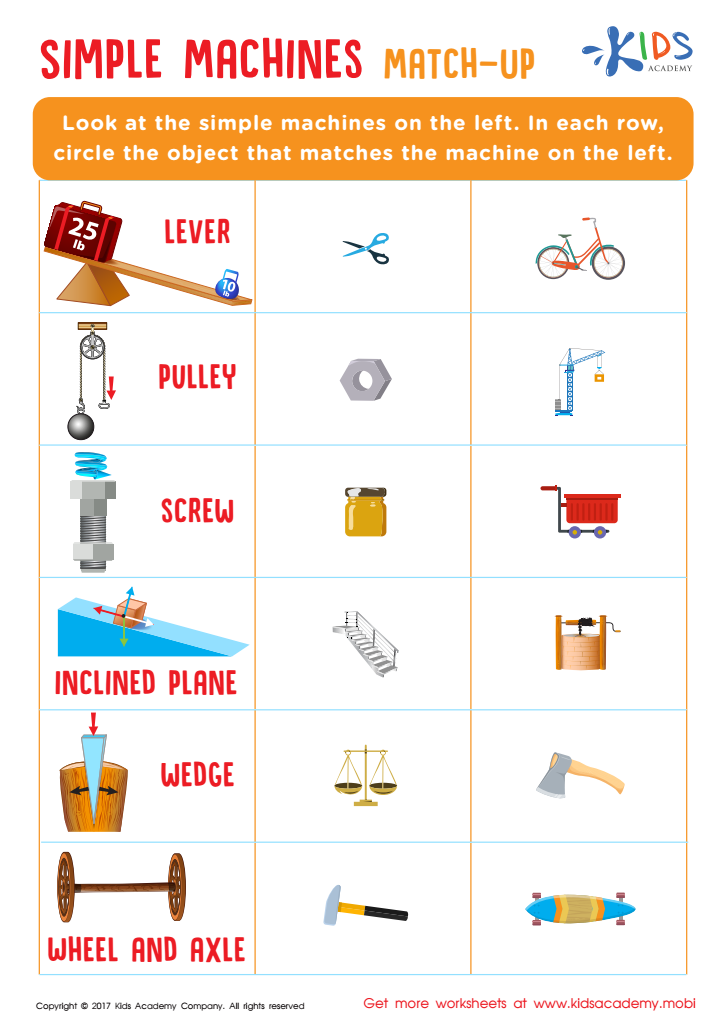
Simple Machines Worksheet
Let this colorfully illustrated PDF introduce your child to the physical science behind everyday tools and objects. Learn about simple machines like levers, pulleys, and screws – helping make our daily lives easier!
 Assign to My Students
Simple Machines Worksheet
Worksheet
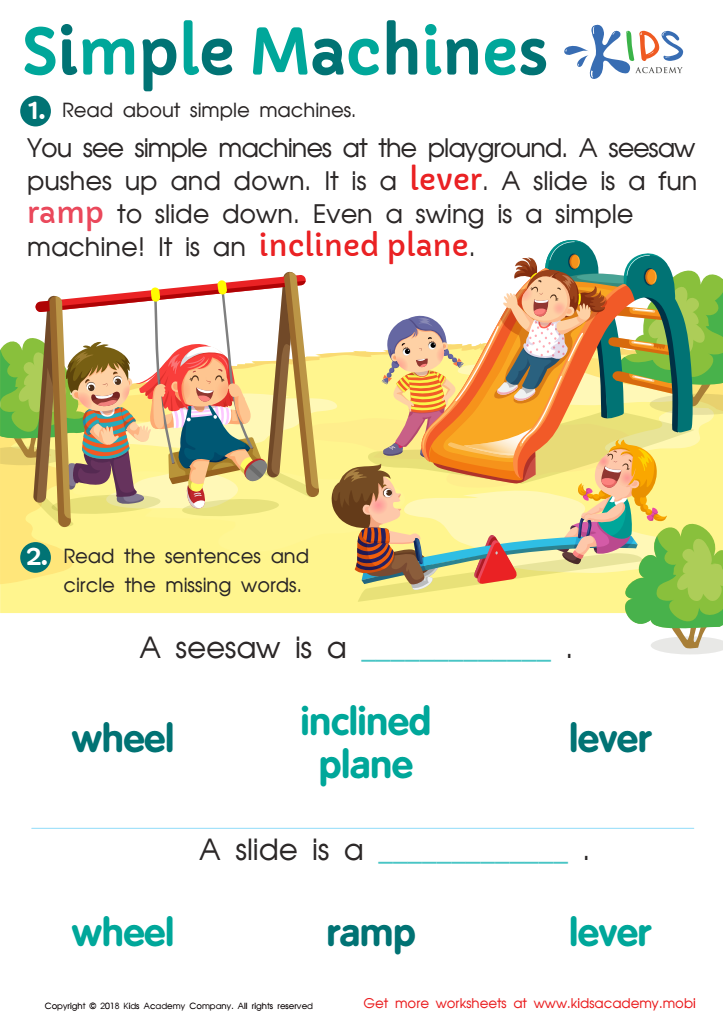
Simple Machines Worksheet
At the playground, your kids likely love to play and swing. Swings are simple machines – they work by using force to move something. Read the following sentences to them, with some words missing - help them fill in the blanks. Simple machines make work easier by __changing__ the size or __direction__ of a force. Swings use a _fulcrum_ and a _lever_ to move.
Simple Machines Worksheet
Worksheet
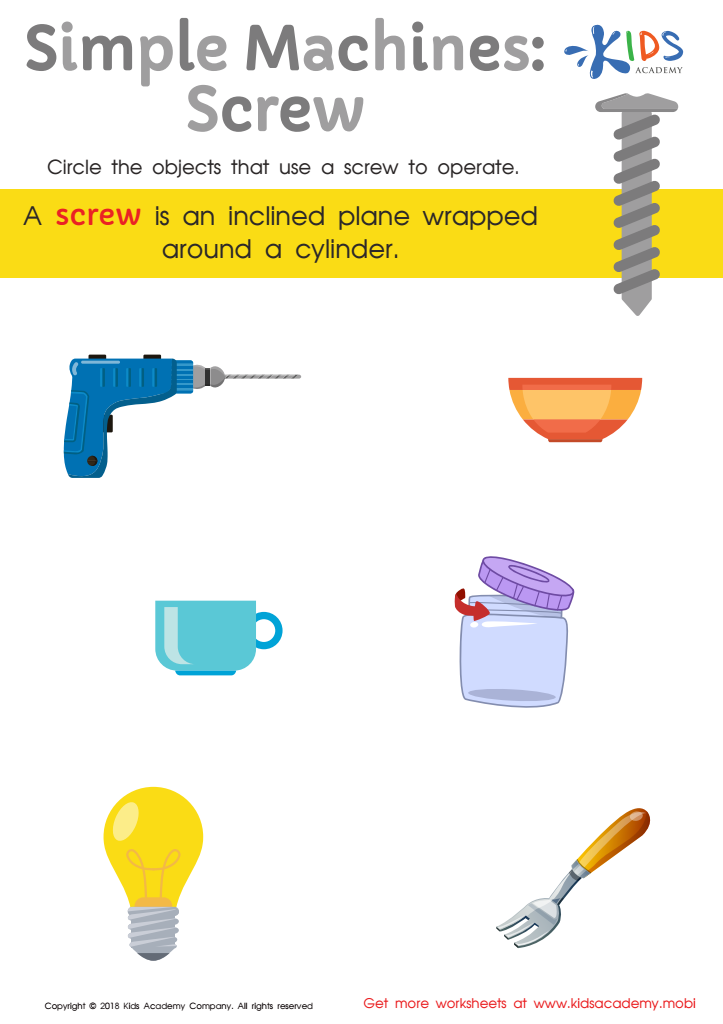
Simple Machines: Screw Worksheet
Explain to your kids that learning about simple machines can be fun - like the swings they love on the playground. Ask them to name some of their favorites. Point out that screws are used to connect simple machines. Then, look at pictures together and have your kids circle the objects that use a screw.
Simple Machines: Screw Worksheet
Worksheet
Learning Skills
Join Kids Academy for Free
Who is primarily going to use this learning content?








Understanding simple machines is crucial for children aged 5-7 as it lays a foundational knowledge of how the world around them works. At this early stage of development, students exhibit natural curiosity, making it the perfect time to introduce core concepts of mechanics and engineering. Learning about simple machines—such as levers, pulleys, inclined planes, wheels, axles, and screws—encourages critical thinking and problem-solving skills.
Parents and teachers should care about this subject because it enhances children's observational abilities and encourages questions about their environment. Simple machines can be easily demonstrated using everyday objects, which makes learning both relatable and enjoyable for young learners. Engaging in hands-on activities or experiments not only reinforces scientific principles but also fosters creativity and independent thinking.
Moreover, understanding simple machines can spark an interest in science, technology, engineering, and mathematics (STEM) fields, which is essential in a rapidly evolving world. By nurturing these foundational skills early on, educators and parents help to build the confidence and curiosity necessary for lifelong learning. Ultimately, introducing simple machines in a fun and engaging way can inspire future innovators and problem-solvers, setting the stage for academic success and a deeper appreciation for the mechanics of their daily lives.








