
Normal Arrays Worksheets for Ages 5-7
3 filtered results
Difficulty Level
Grade
Age
-
From - To
Subject
Activity
Standards
Discover engaging and educational Normal Arrays Worksheets tailored specifically for children ages 5-7 at Kids Academy! Our carefully designed worksheets help young learners grasp the concept of arrays through fun and interactive activities. Enhance their math skills by building a solid foundation in early multiplication and addition. Each worksheet is crafted to be visually appealing and easy to understand, encouraging self-paced learning and boosting confidence. Perfect for classroom use or home practice, these printables make learning math enjoyable and effective. Visit Kids Academy today to download our free, high-quality apsispopally aligned resources for your child’s mathematical journey.
Favorites
With answer key
Interactive
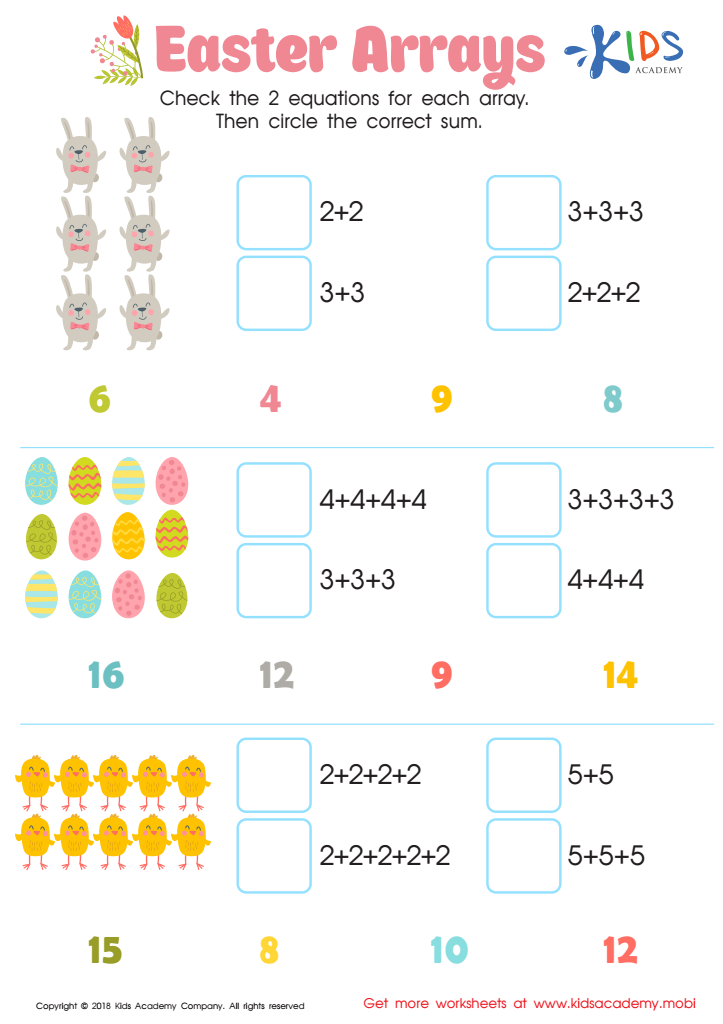
Easter Arrays Worksheet
Does your child love Easter? Do they adore the Easter bunny and egg hunts? Help them have fun with this worksheet! Go through it with them and check the equations for each array. Then, have them circle the correct sum. It's a great way to make the holiday extra exciting!
 Assign to My Students
Easter Arrays Worksheet
Worksheet
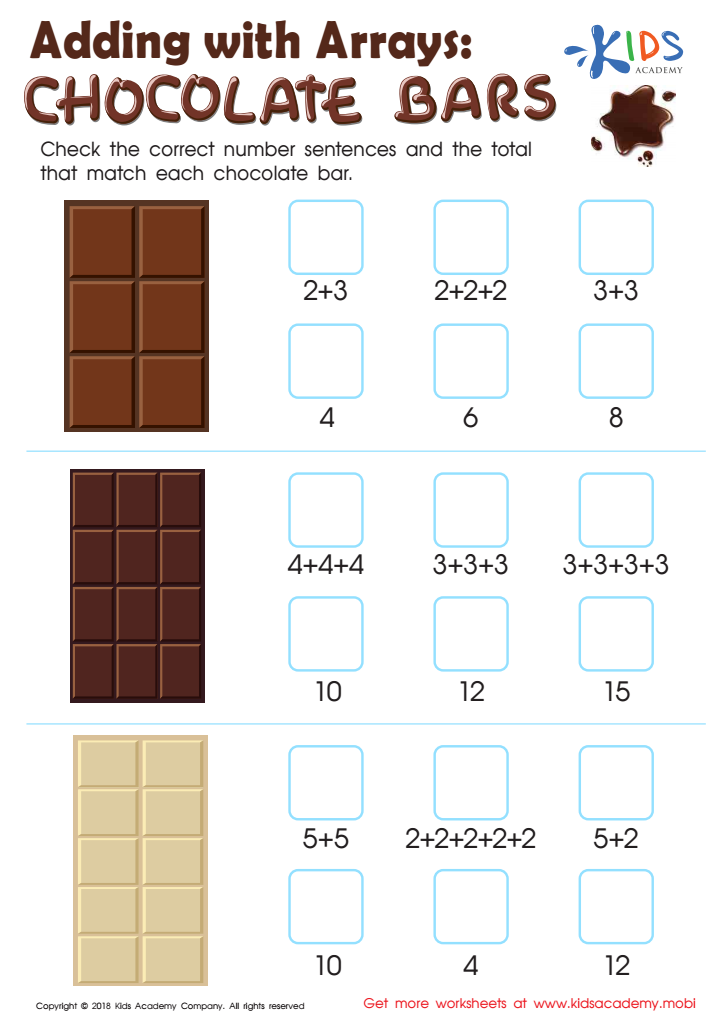
Adding with Arrays: Chocolate Bars Worksheet
Kids love chocolates! Gauge how enthused your kids get when you mention them. This worksheet is a fun exercise about chocolates - get your kids to check the correct number sentences and totals for each chocolate bar. Reward their hard work with some chocolates - extra incentive for a job well done!
Adding with Arrays: Chocolate Bars Worksheet
Worksheet
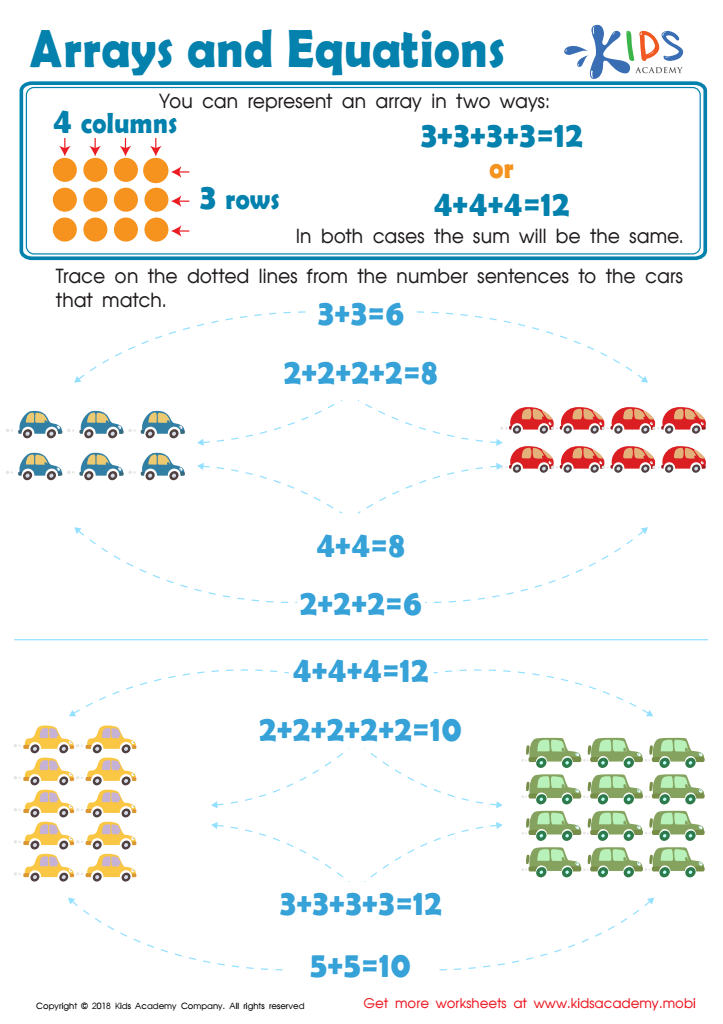
Arrays and Equations Worksheet
An array is objects, pix, or numbers organized in rows and columns. Show kids two ways to interpret this: 3 rows in 4 places = 12 and 4 columns in 3 places = 12. Help your child trace the number sentences to the matching cars. All equations always add up to the same amount.
Arrays and Equations Worksheet
Worksheet
Join Kids Academy for Free
Who is primarily going to use this learning content?








Normal Arrays refer to organized, structured arrangements of objects, numbers, or pictures in rows and columns. They serve as a foundational learning tool for young children ages 5-7, crucially fostering early mathematical understanding and skills.
For parents and teachers, focusing on Normal Arrays is significant because it helps children visualize and comprehend concepts critical to higher mathematics such as addition, multiplication, and the associative properties of these operations. Arrays offer a way to concretely see how numbers work together, facilitating a smooth transition from simple counting to more complex arithmetic.
By engaging with arrays, children develop spatial reasoning and problem-solving capabilities. It sharpens their ability to organize and categorize items, enhancing both logical thinking and attention to detail. Moreover, arrays integrate seamlessly into daily learning activities, making math both approachable and engaging.
Arrays also cultivate a sense of symmetry and pattern recognition, foundational skills that support broader intellectual development, including in non-mathematical areas. Numeracy skills gained early can impact children’s confidence and success in STEM topics throughout their academic journey.
Therefore, prioritizing Normal Arrays for young learners lays crucial groundwork, making abstract concepts tangible and spreading a ripple effect on overall cognitive development, problem-solving abilities, and academic enthusiasm.








