Multiplication practice Normal Arrays Worksheets for Ages 5-9
3 filtered results
-
From - To
Welcome to our Multiplication Practice Normal Arrays Worksheets designed for children ages 5-9! These engaging and interactive worksheets help young learners master multiplication concepts through visual arrays, making math fun and accessible. Each worksheet features colorful designs that support step-by-step problem solving, allowing children to visualize multiplication in an effective way. Teachers and parents can easily download and print these resources to enhance math lessons at home or in the classroom. Foster a strong foundation in multiplication with our carefully crafted worksheets, designed to boost confidence and skills in young mathematicians. Start practicing today and watch your child's math abilities grow!
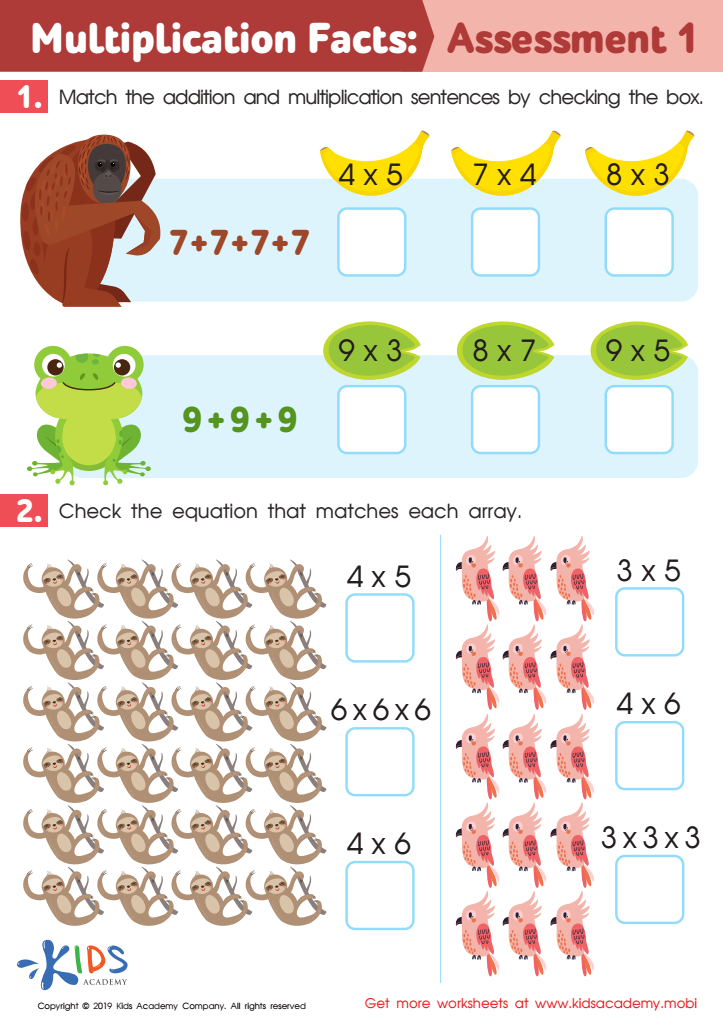
Multiplication Facts: Assessment 1 Worksheet
 Assign to My Students
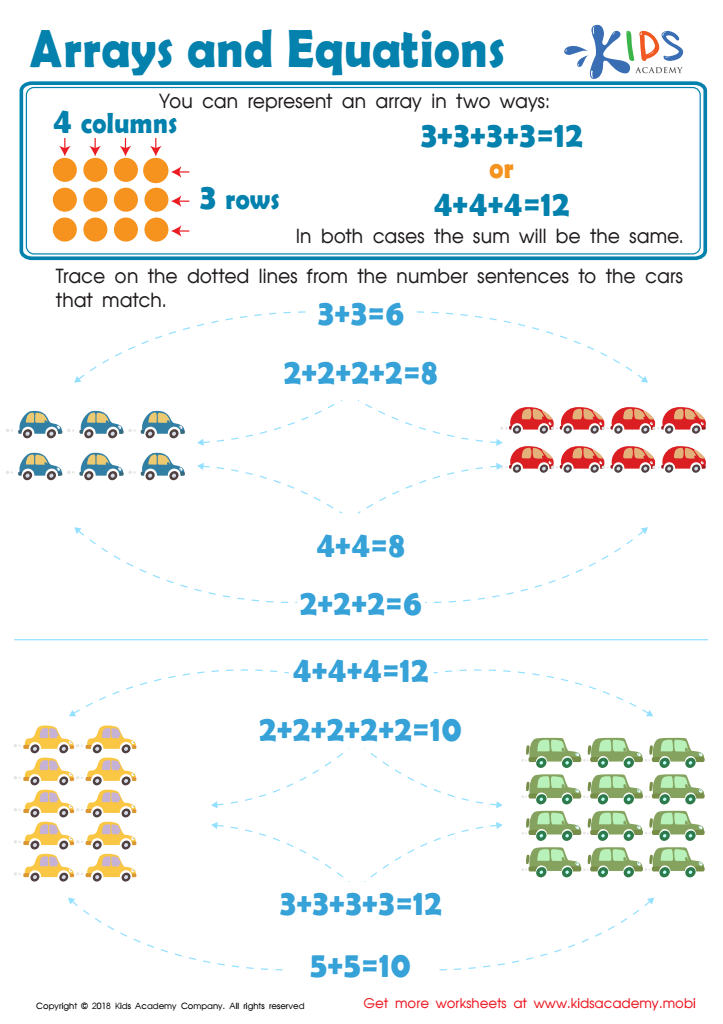
Arrays and Equations Worksheet
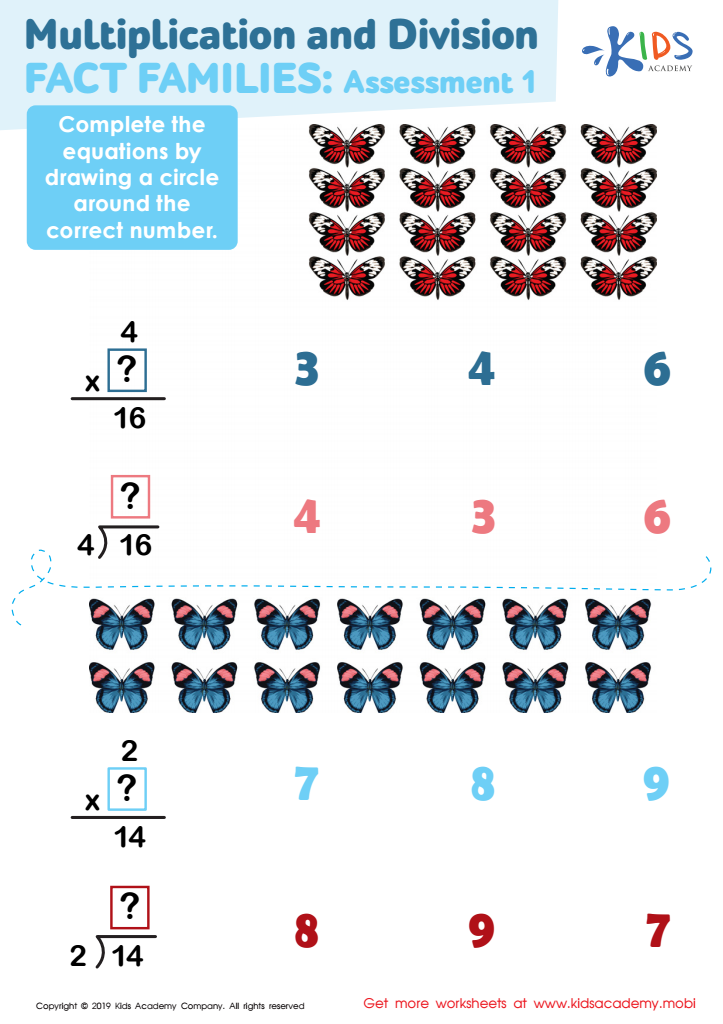
Multiplication and Division Fact Families Assessment 1 Worksheet








Parents and teachers should care about multiplication practice with normal arrays for children ages 5-9 because it fundamentally enhances the students' mathematical understanding and fluency. Normal arrays visually represent multiplication concepts, allowing young learners to grasp the relationship between the numbers involved. By organizing numbers into structured rows and columns, students can easily see how multiplication is a form of repeated addition, making the concept more relatable and intuitive.
Furthermore, mastering multiplication at a young age lays a strong foundation for future mathematical learning. When children understand multiplication through arrays, they develop problem-solving skills, improve critical thinking, and build confidence in their abilities. It also prepares them for more advanced topics, such as area and perimeter calculations, fraction operations, and algebraic thinking.
Engaging with normal arrays cultivates a positive attitude toward math, making it a more accessible and enjoyable subject. Parents can support this learning at home, reinforcing classroom activities with hands-on experiences involving real-life quantities. Consequently, implementing regular multiplication practice using normal arrays not only enriches children's educational journey but also fosters a lifelong appreciation for mathematics, equipping them for successes in higher-level math encounters.








