
Spatial awareness Normal Geometry Worksheets for Ages 6-8
5 filtered results
Difficulty Level
Grade
Age
-
From - To
Subject
Activity
Standards
Enhance your child's spatial awareness skills with our engaging Geometry Worksheets designed for ages 6-8! Perfect for young learners, these printable resources focus on developing a solid understanding of shapes, sizes, and the relationships between objects in space. Our worksheets offer a variety of fun activities that encourage critical thinking and problem-solving. From identifying shapes to understanding spatial relationships, each activity paves the way for a foundational grasp of geometry concepts. These expertly crafted worksheets not only support learning at home but also enrich classroom experiences. Foster curiosity and confidence in math with our user-friendly and interactive geometry resources!
Favorites
With answer key
Interactive
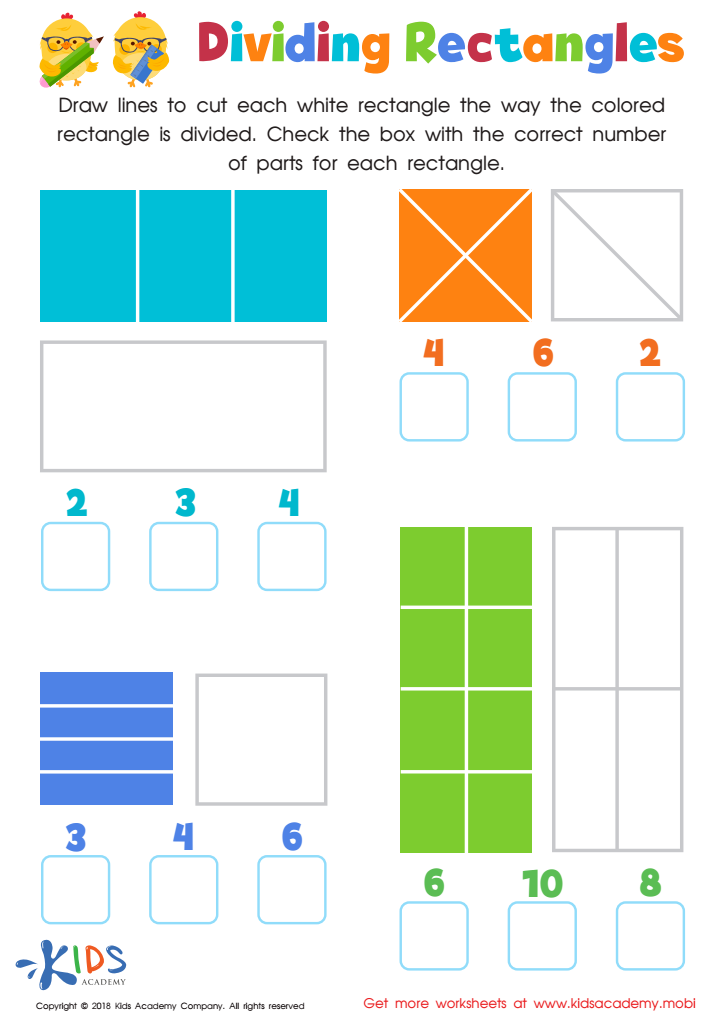
Dividing Rectangles Worksheet
Ask your child to draw lines to divide the white rectangles like the colored ones. Then, have them count the parts in each and choose the correct number. This worksheet will help them practice counting and dividing.
 Assign to My Students
Dividing Rectangles Worksheet
Worksheet











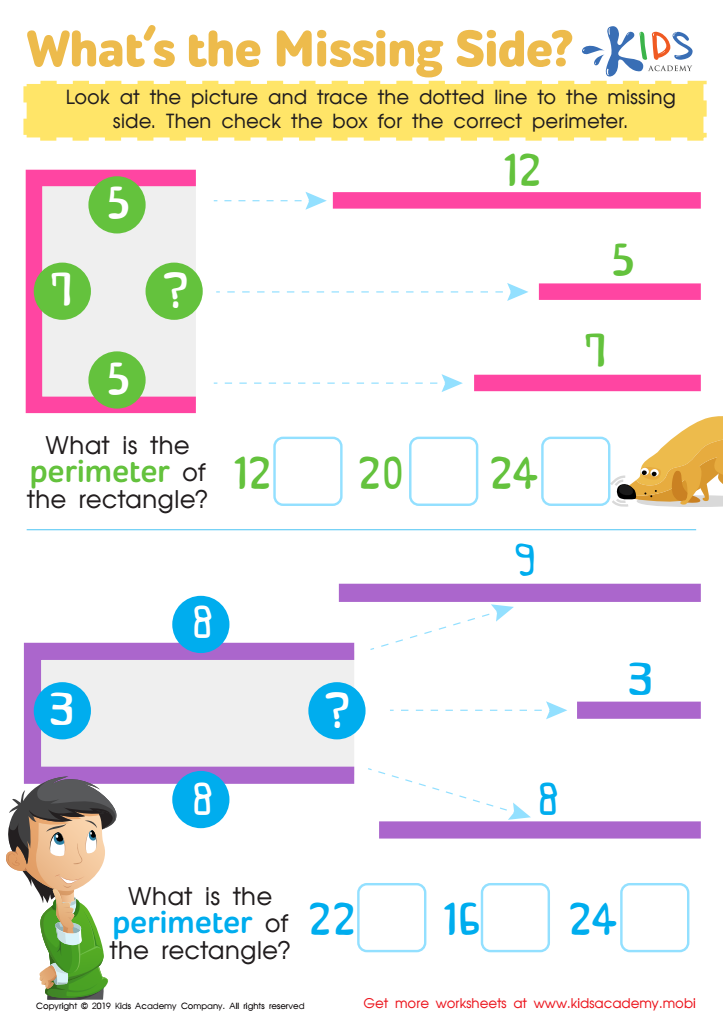
What's the Missing Side Worksheet
Assist your pupils in improving math skills with fun exercises like the tracing sheet. Show them the picture and guide them to trace the missing side. Ask them to check the box of the right perimeter afterwards. Doing this regularly can help them to enjoy and appreciate the subject more.
What's the Missing Side Worksheet
Worksheet
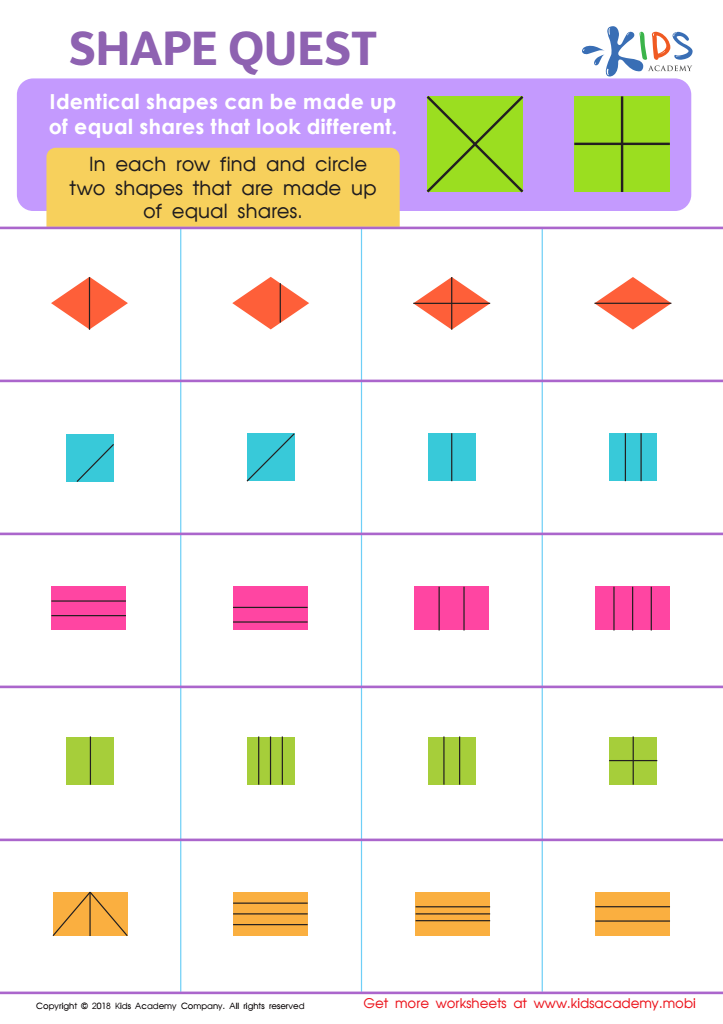
Shape Quest Worksheet
Help your child identify shapes by having them find shapes made up of equal parts. This colorful worksheet challenges them to look through each row and circle two matching shapes. It's a great way to teach them the unique features of each shape, while also helping them understand that identical shapes can look different.
Shape Quest Worksheet
Worksheet
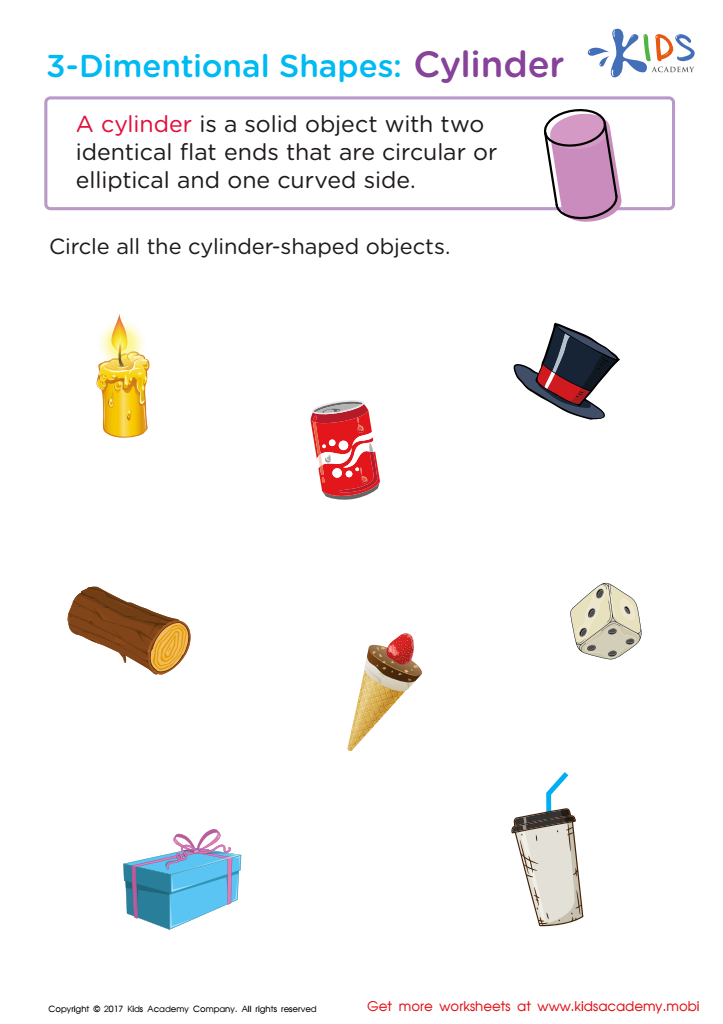
Three–Dimensional Shapes: Cylinder Worksheet
Introduce your toddler to geometry and 3D cylinders with this printable and watch their knowledge grow. It will help them recognize, define, and identify cylinders, as well as differentiate between 3D objects.
Three–Dimensional Shapes: Cylinder Worksheet
Worksheet
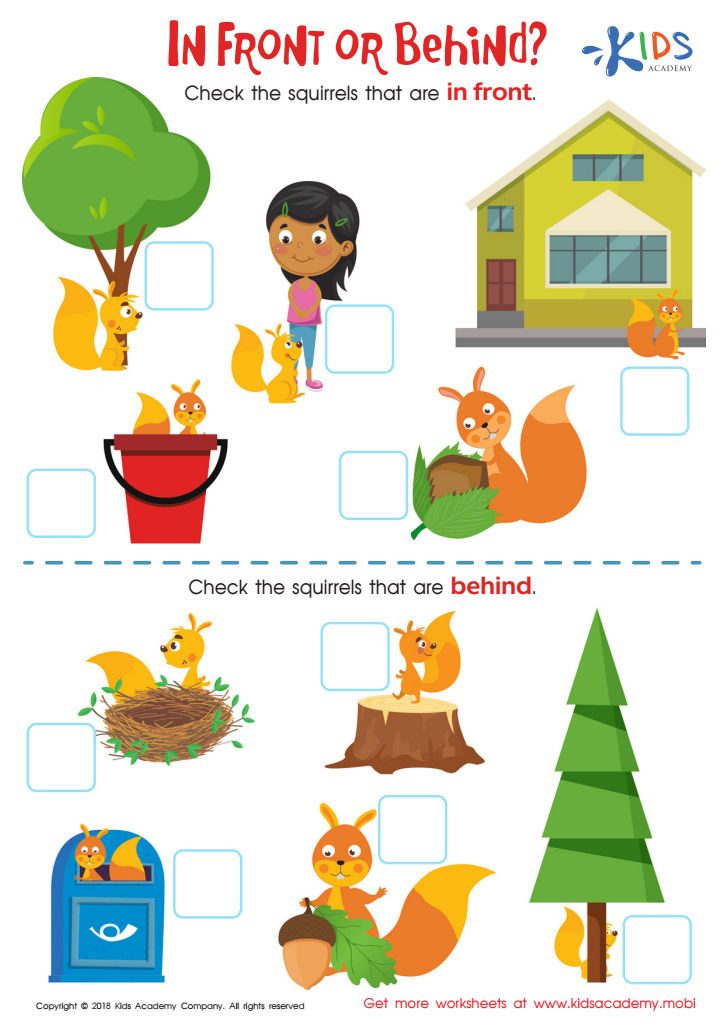
In Front or Behind: Part 2 Worksheet
Teach positional words "front" and "behind" with this fun worksheet! Students identify where the squirrel is in relation to the object - in front or behind. It's a great exercise to practice early geometry skills and understanding object movement.
In Front or Behind: Part 2 Worksheet
Worksheet
Join Kids Academy for Free
Who is primarily going to use this learning content?








Spatial awareness and understanding of basic geometry are crucial for children aged 6-8, as they lay the foundation for both academic success and practical life skills. During these formative years, children begin to develop critical thinking, problem-solving abilities, and a sense of positional relationships—all of which come from grasping spatial concepts.
Parents and teachers should care because spatial awareness enhances cognitive development: it improves memory, boosts creativity, and enriches a child’s ability to visualize concepts. Early geometry education helps children make connections between their rich environments and mathematical ideas, facilitating their understanding of shapes, sizes, locations, and the relationships between them.
Moreover, these skills have broad applications; they are essential not only in mathematics but also in the arts, sciences, and everyday life. Children with strong spatial awareness are better equipped to tackle subjects such as geometry, physics, and engineering later on, as they will have already developed the necessary skills to analyze and complement their learned knowledge.
Investing time in fostering spatial awareness and geometry can lead to improved academic performance, increased confidence in learning, and greater engagement in STEM activities, helping nurture the next generation of innovative thinkers and problem-solvers.








