
Time recognition Normal Math Worksheets for Ages 6-8
5 filtered results
Difficulty Level
Grade
Age
-
From - To
Subject
Activity
Standards
Discover our engaging Time Recognition Normal Math Worksheets, specially designed for children aged 6-8. These worksheets provide a fun and interactive way for young learners to grasp essential concepts of time, including reading clocks, understanding AM and PM, and organizing schedules. Each worksheet is crafted to enhance mathematical understanding while aligning with educational standards. With vibrant illustrations and clear instructions, students will improve their time-telling skills and develop critical thinking. Ideal for homework or classroom activities, our worksheets foster independent learning and boost confidence. Explore our versatile collection today, and watch your child excel in time recognition!
Favorites
With answer key
Interactive
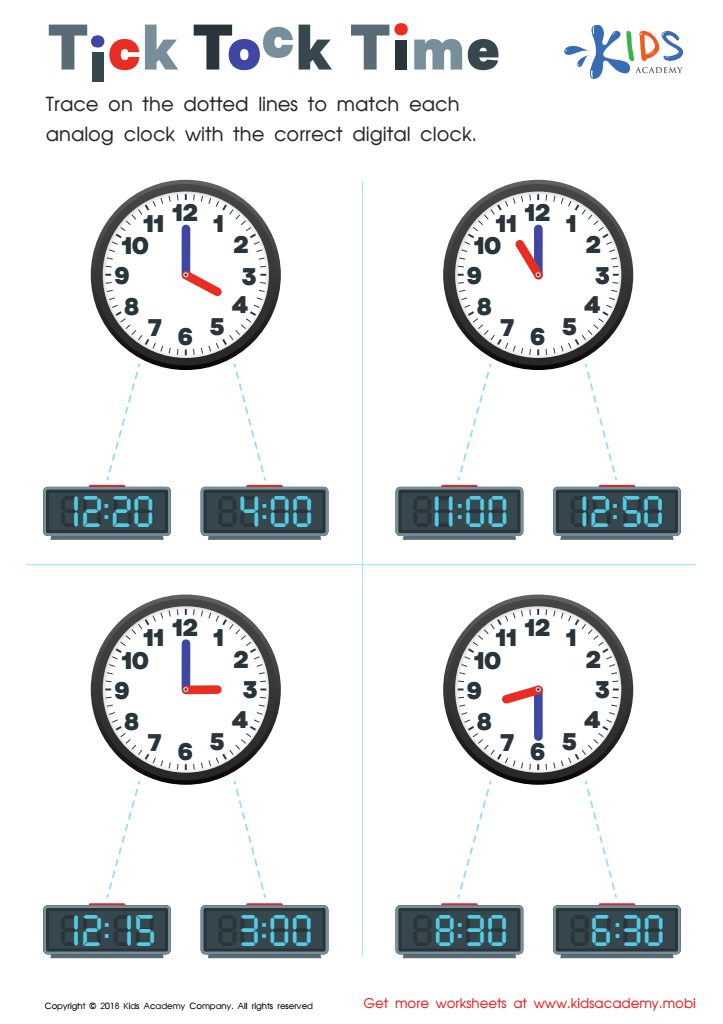
Tick Tock Time Worksheet
Trace the dotted lines on this worksheet to match analog and digital clocks! It's a great way to help your kids learn time-telling. They'll get better at converting analog to digital, and vice versa. Get your children to try it - it's a fun way to practice!
 Assign to My Students
Tick Tock Time Worksheet
Worksheet
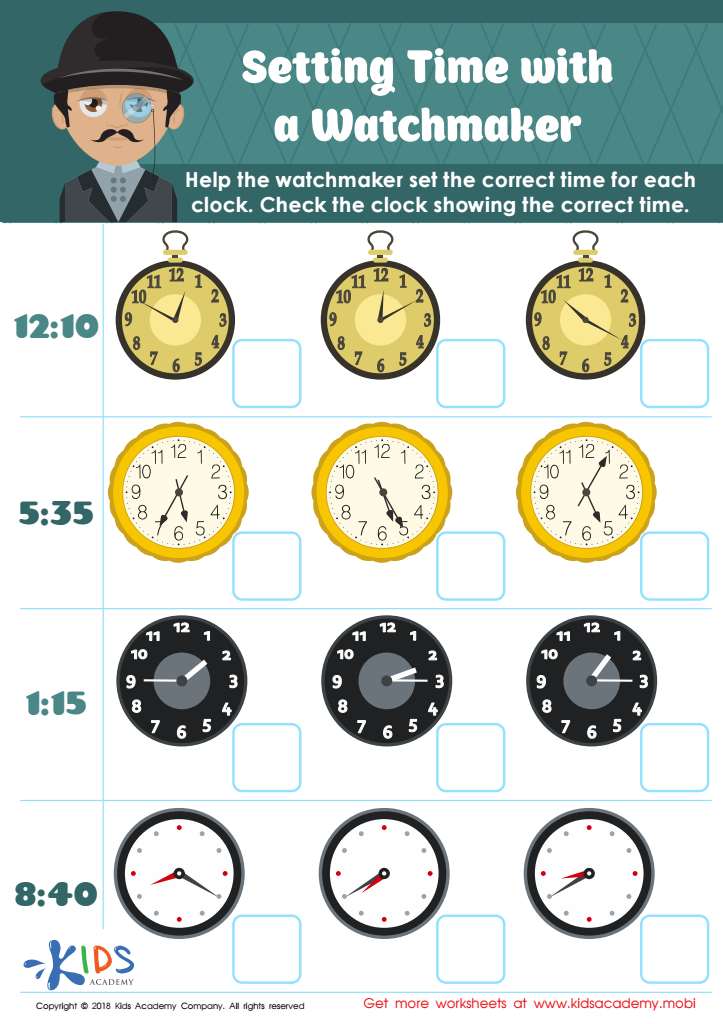
Setting Time with Watchmaker Worksheet
Can your kids tell the time? If so, this worksheet should be easy. Help them set the time for each clock: look at the time written on the left side and find the clock on the right side that matches.
Setting Time with Watchmaker Worksheet
Worksheet
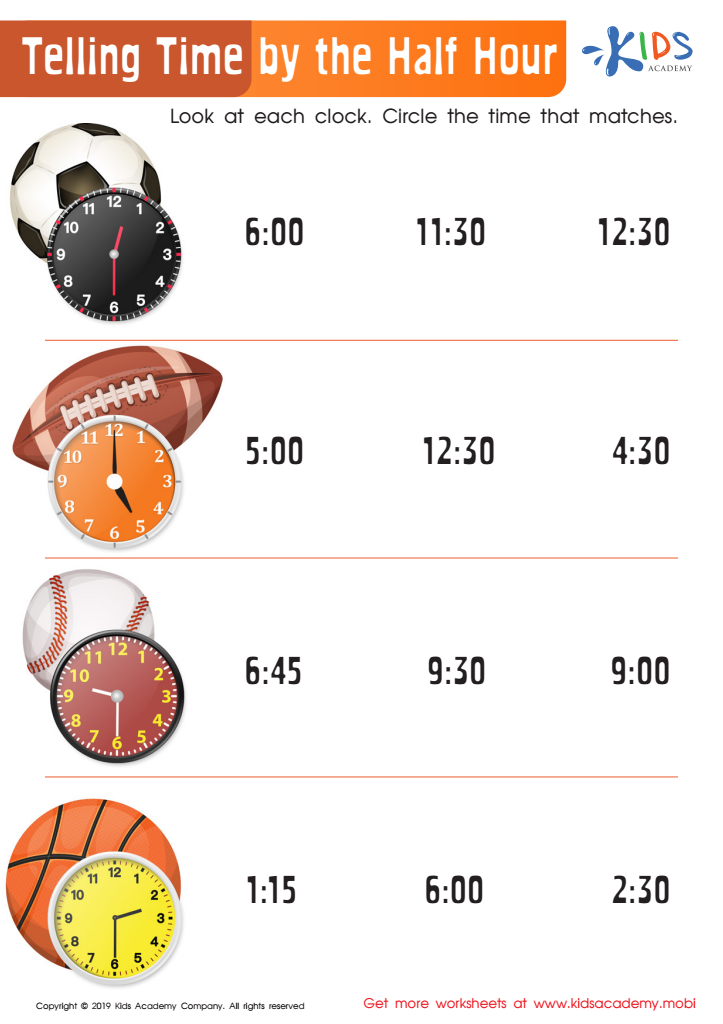
Telling Time by the Half Hour Worksheet
Teach kids to tell time with this worksheet! Four clocks are labeled with different times; help your child circle the right one. It's a great way to teach them to read analog and digital clocks, watches, and written times. Easy and fun learning!
Telling Time by the Half Hour Worksheet
Worksheet
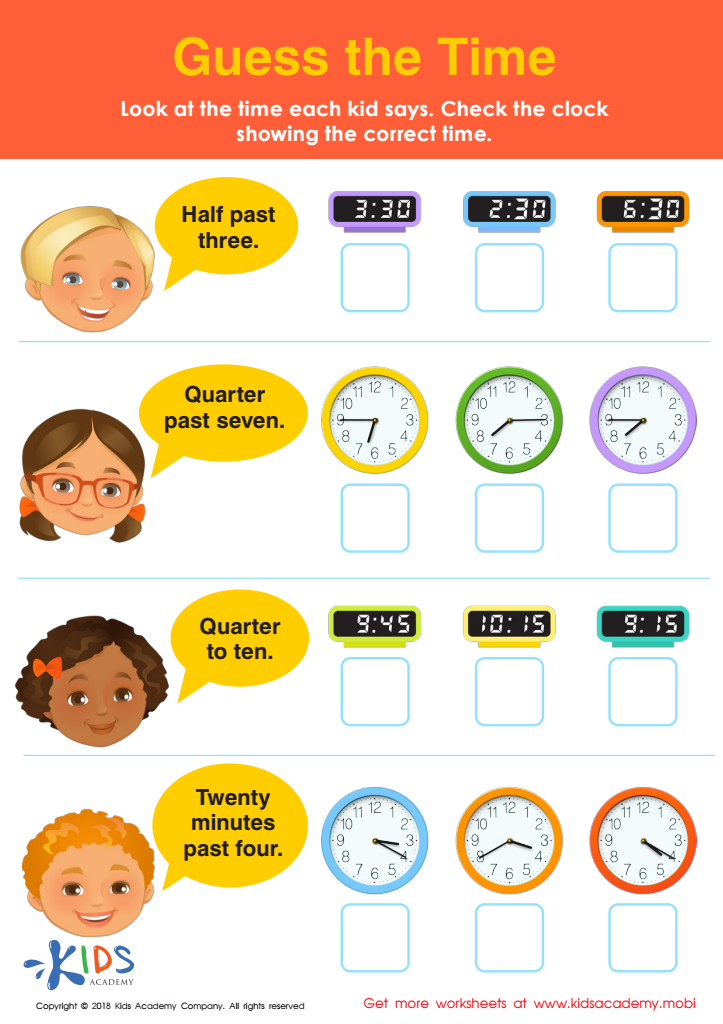
Guess the Time Worksheet
Help students tell the time accurately with this fun exercise. Read the time each person says and find the corresponding clock. Check the options on the left and have students guess the right time. This worksheet is sure to sharpen their time-telling skills.
Guess the Time Worksheet
Worksheet
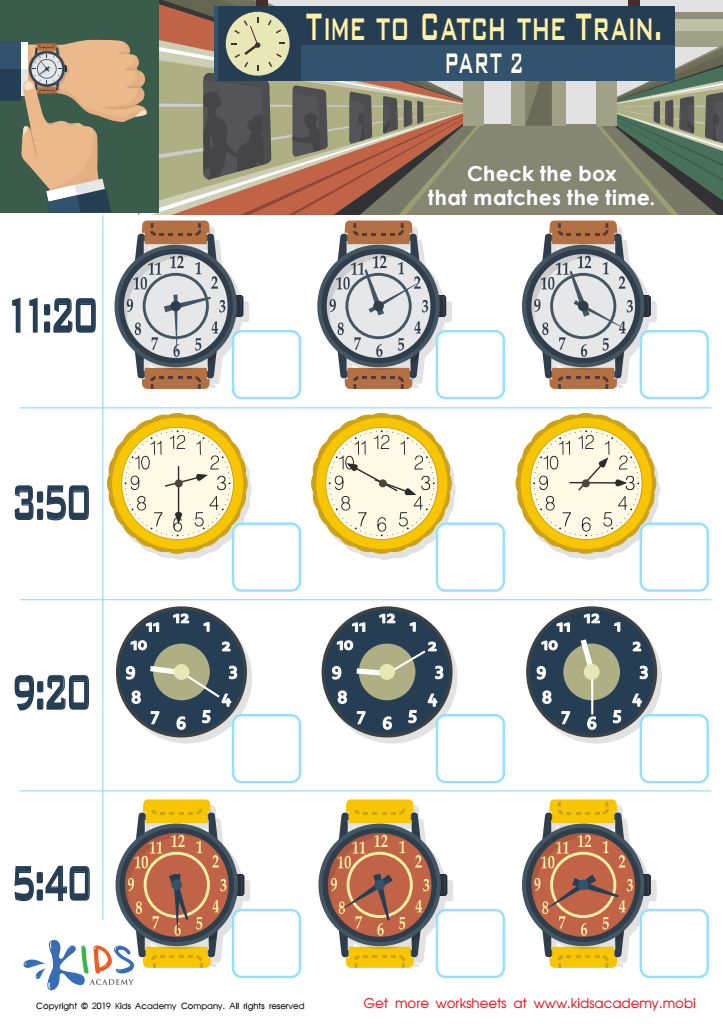
Time to Catch the Train Part 2 Worksheet
Teach your kids the importance of telling time and how to do it. Explain that there are multiple ways to show the time, such as written on the left side or watches in the picture. Guide them to check the box that matches the time. Knowing the time is essential to get things done and create order. Ensure your kids understand this and they will reap the benefits.
Time to Catch the Train Part 2 Worksheet
Worksheet
Join Kids Academy for Free
Who is primarily going to use this learning content?








Time recognition is a vital skill for children aged 6-8, significantly impacting their everyday lives. Parents and teachers should prioritize this skill because it lays the foundation for responsible time management, independence, and academic success. Understanding time helps children follow routines, in turn fostering a sense of security and stability.
When students grasp basic time concepts, such as telling time on an analog or digital clock, they can better manage their schedules. This skill enhances their ability to meet deadlines, understand daily activities, and participate in group tasks effectively — all crucial for social development. Moreover, mastering time concepts supports mathematical understanding, as it interlinks with concepts like addition, subtraction, and fractions (half-past, quarter-to).
In this digital age, where distractions are abundant, teaching time management becomes even more crucial. Children equipped with time-recognition skills can navigate their days with confidence. Additionally, as they gain proficiency, they feel a sense of accomplishment, boosting self-esteem and motivation.
Ultimately, investing in time recognition education empowers children to lead disciplined, organized lives, enriching their learning experiences and personal growth. Parents and teachers play a fundamental role in this developmental process, shaping well-rounded, accountable individuals.








