Shape Recognition Normal Community Worksheets for Ages 6-8
3 filtered results
-
From - To
Introducing our "Shape Recognition Normal Community Worksheets for Ages 6-8"! These engaging and educational worksheets are specially designed to enhance shape recognition skills in young learners while exploring community themes. Perfect for kids aged 6-8, each activity combines fun illustrations with practical exercises that teach children about different shapes found in everyday community environments. Through matching, tracing, and identifying shapes, children develop essential cognitive and fine motor skills. Ideal for classroom or at-home learning, our worksheets ensure that mastering shapes is both entertaining and educational. Encourage your child’s shape-learning journey today with our expertly crafted worksheets!
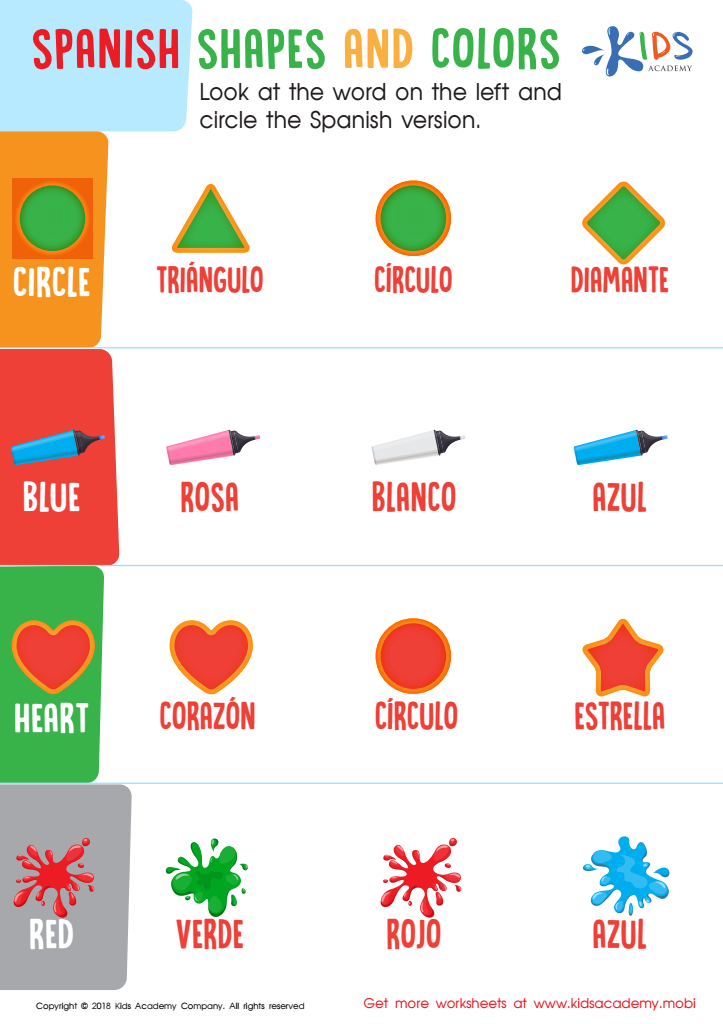
Spanish Shapes and Colors Worksheet
 Assign to My Students
Playground Worksheet
Take a Look - Part 1 Worksheet








Shape recognition is a foundational skill crucial for children aged 6-8, and parents or teachers should understand its importance for several reasons. First, recognizing shapes enhances cognitive development. Children learn to discern and categorize different geometric forms, which enhances their problem-solving and critical-thinking abilities. Second, shape recognition supports math skills. Many mathematical concepts, such as geometry, symmetry, and spatial understanding, directly relate to shapes. Early familiarity with shapes can make more complex math less intimidating.
Third, shape recognition is essential for reading and writing. Letters and numbers are, in essence, a combination of various shapes. Understanding shapes improves children’s ability to distinguish these symbols, aiding in literacy and numeracy skills. Additionally, shape-based activities can develop fine motor skills, such as drawing and tracing shapes, which are vital for handwriting.
Moreover, recognizing shapes in different orientations helps children better understand their environment. It strengthens visual-spatial intelligence, leading to better navigation and understanding of the physical world. Lastly, learning shapes fosters creativity and artistic expression, contributing to a well-rounded education.
By focusing on shape recognition, parents and teachers can provide children with a robust, integrated educational foundation that supports future academic success and everyday life skills.