
Understanding fact families Normal Worksheets for Ages 6-9
5 filtered results
Difficulty Level
Grade
Age
-
From - To
Subject
Activity
Standards
Discover the essentials of fact families for ages 6-9 with our engaging worksheets! Understanding fact families helps young learners grasp the relationship between addition and subtraction or multiplication and division, reinforcing their math skills. Our normal worksheets are designed with colorful visuals and interactive exercises that make learning fun and effective. Each worksheet guides children through the process of creating and analyzing fact families, building their confidence in math. Perfect for classroom or home use, these resources ensure that children develop a strong foundation in mathematical concepts. Explore our collection today and watch your young mathematicians thrive!
Favorites
With answer key
Interactive
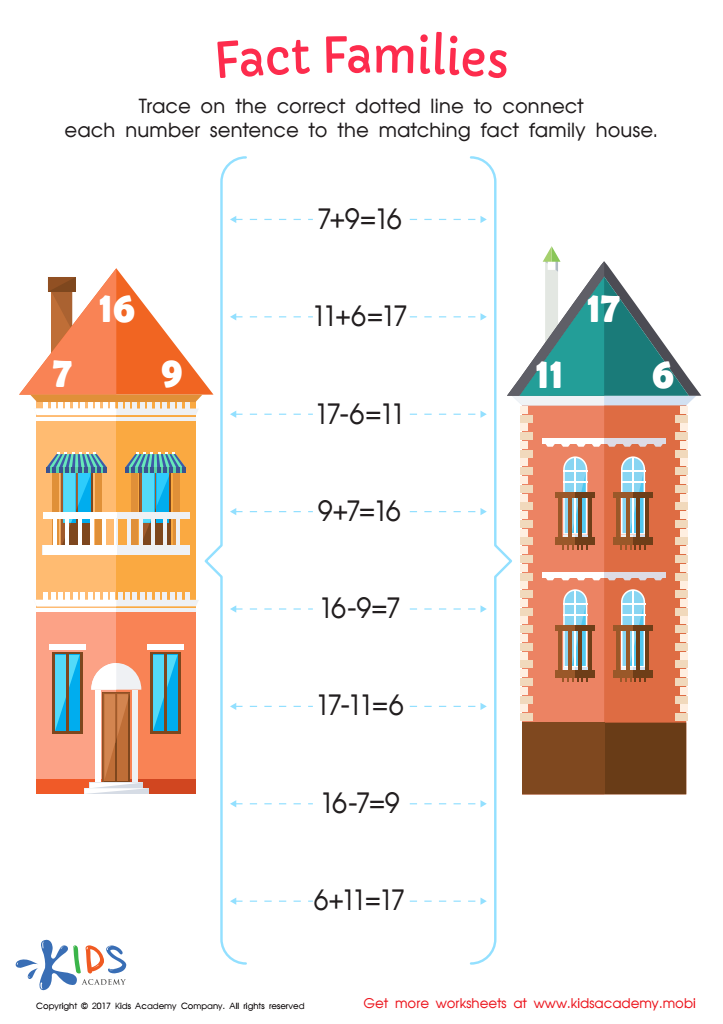
Fact Families — Add and Subtract Worksheet
Kids will love seeing how families of numbers "live" in their own houses!
 Assign to My Students
Fact Families — Add and Subtract Worksheet
Worksheet
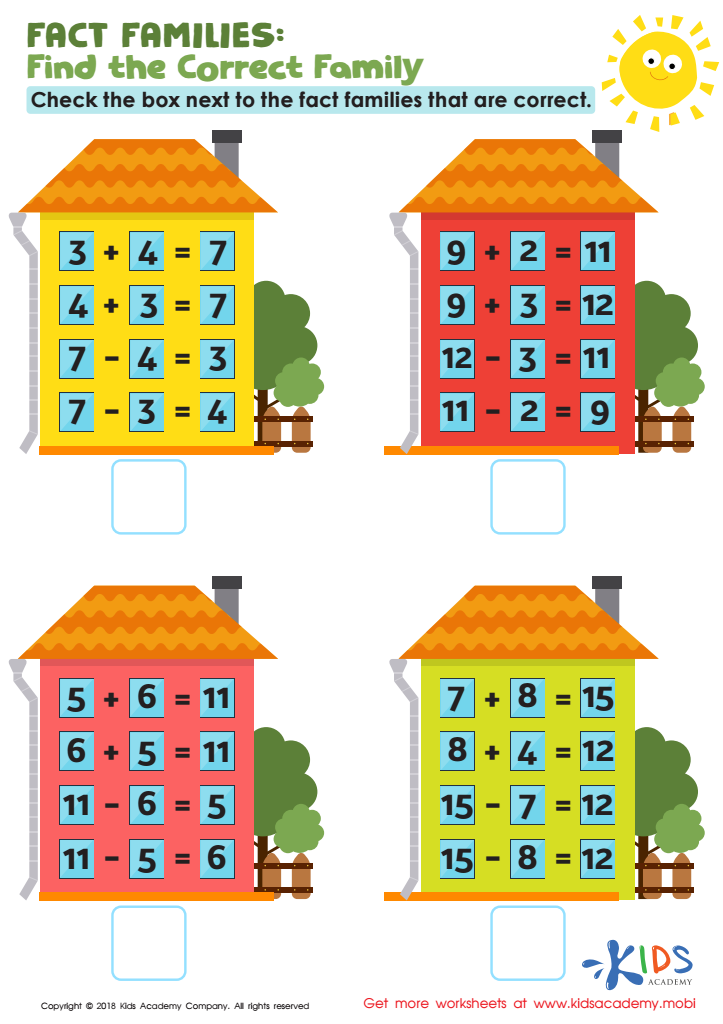
Fact Families: Find Correct Family Worksheet
Test your students' math and reasoning skills with this worksheet. It features 4 houses, each with a group of fact families on it. Some are correct, some are wrong - help students identify which are correct and circle the box next to them. This will help them progress in school.
Fact Families: Find Correct Family Worksheet
Worksheet
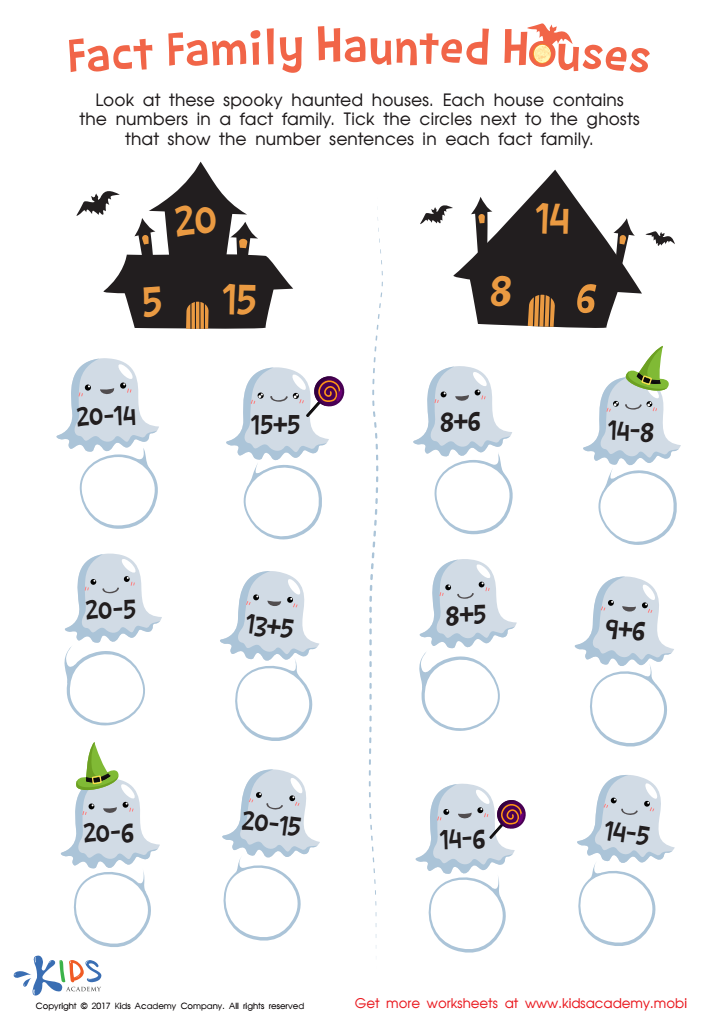
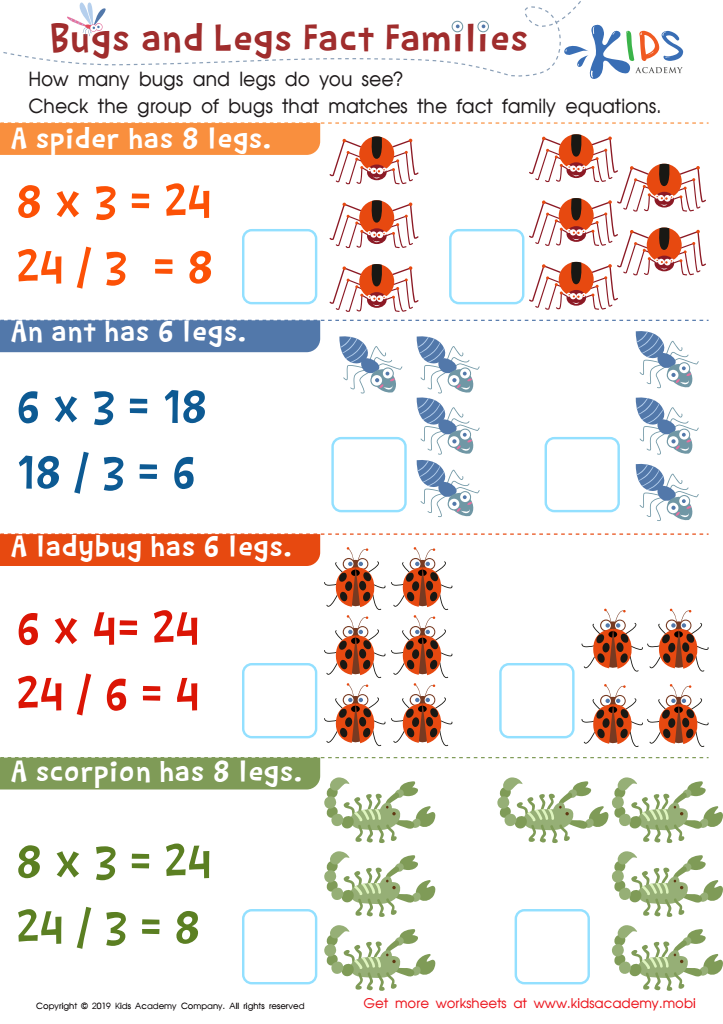
Bugs and Legs Fact Families Worksheet
This free worksheet uses bugs and insects to help young math students learn about fact families and recognize patterns in multiplication and division. It's a fun and colorful way to gain automaticity and efficiency in computation skills, without even realizing it's math!
Bugs and Legs Fact Families Worksheet
Worksheet
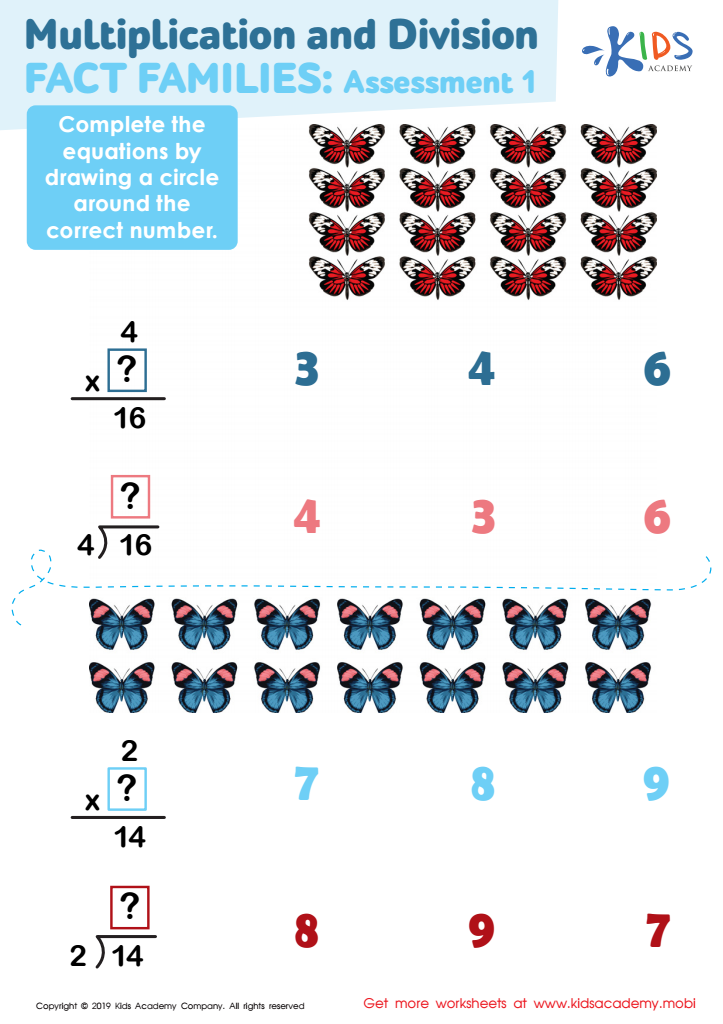
Multiplication and Division Fact Families Assessment 1 Worksheet
When it comes to multiplication and division, automaticity and efficiency are key. Test your child's understanding of fact families with this free butterfly worksheet. They'll practice equations, picture concepts and fact families to arrive at the correct number. Repetition will help them develop strong skills and confidence.
Multiplication and Division Fact Families Assessment 1 Worksheet
Worksheet
Join Kids Academy for Free
Who is primarily going to use this learning content?








Understanding fact families is crucial for children ages 6-9, and parents or teachers should prioritize this concept in early mathematics education. A fact family is a group of related math equations that use the same numbers, highlighting the relationships between addition and subtraction, or multiplication and division.
Firstly, mastering fact families helps solidify basic mathematical operations, which are essential building blocks for more complex math skills. By understanding the connection between addition and subtraction, for example, children begin to see how math works as a logical system rather than isolated facts. This fosters critical thinking and problem-solving skills.
Additionally, engaging with fact families enhances children's number sense, giving them greater confidence in handling numbers and mathematical problems. This foundational understanding can help decrease math anxiety and foster a positive attitude towards math, encouraging a lifelong love of learning.
Moreover, incorporating fact family exercises into homework and daily activities allows parents and teachers to gauge student comprehension, ensuring that they are on track. Ultimately, fact families not only help children succeed in math but also lay the groundwork for future academic achievements. Therefore, parents and teachers should be invested in ensuring they grasp this fundamental concept.








