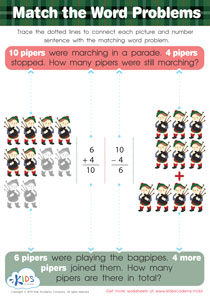
Mathematical reasoning Normal Addition Worksheets for Ages 6-9
4 filtered results
Difficulty Level
Grade
Age
-
From - To
Subject
Activity
Standards
Enhance your child’s mathematical abilities with our Normal Addition Worksheets designed for ages 6-9. These engaging and easy-to-follow worksheets help young learners develop essential addition skills while reinforcing their mathematical reasoning. Each worksheet is meticulously crafted to build confidence and foster a love for numbers. Whether your child is a beginner or looking to sharpen their skills, our printable resources provide endless practice opportunities. Perfect for classroom or at-home learning, these worksheets make mastering addition fun and effective. Visit our webpage to download and start your child's journey to mathematical success today!
Favorites
With answer key
Interactive
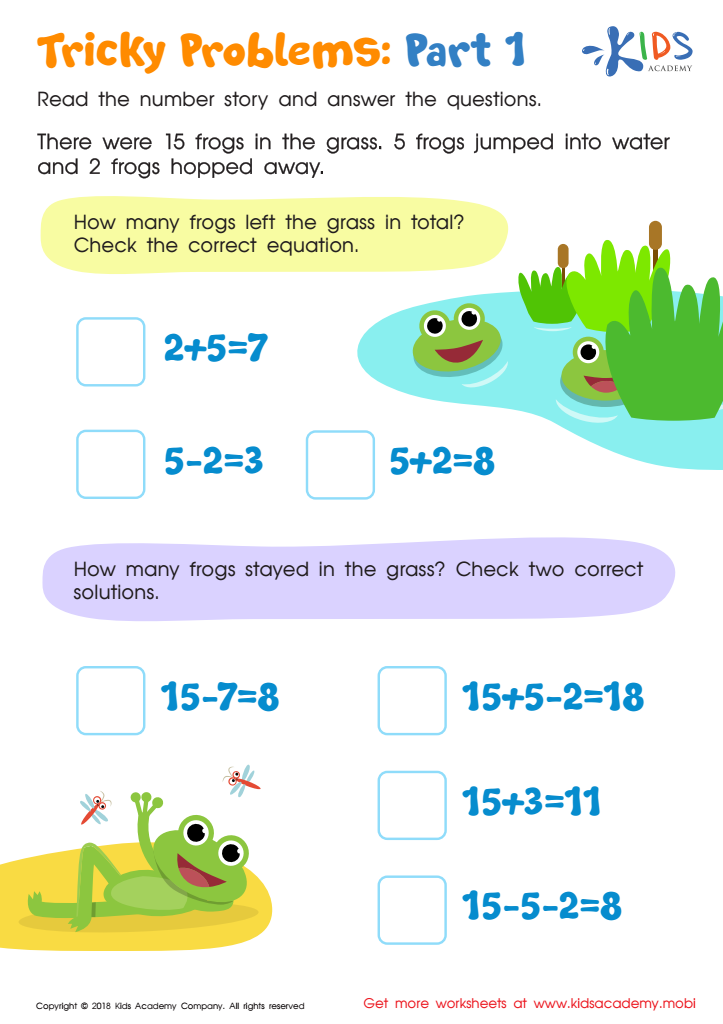
Tricky Problems Worksheet: Part 1
Visualizing word problems can help students solve them. This fun PDF worksheet encourages students to create mental images using math facts, then check boxes to match the equations for basic addition problems. It's a great way to build confidence in solving math.
 Assign to My Students
Tricky Problems Worksheet: Part 1
Worksheet
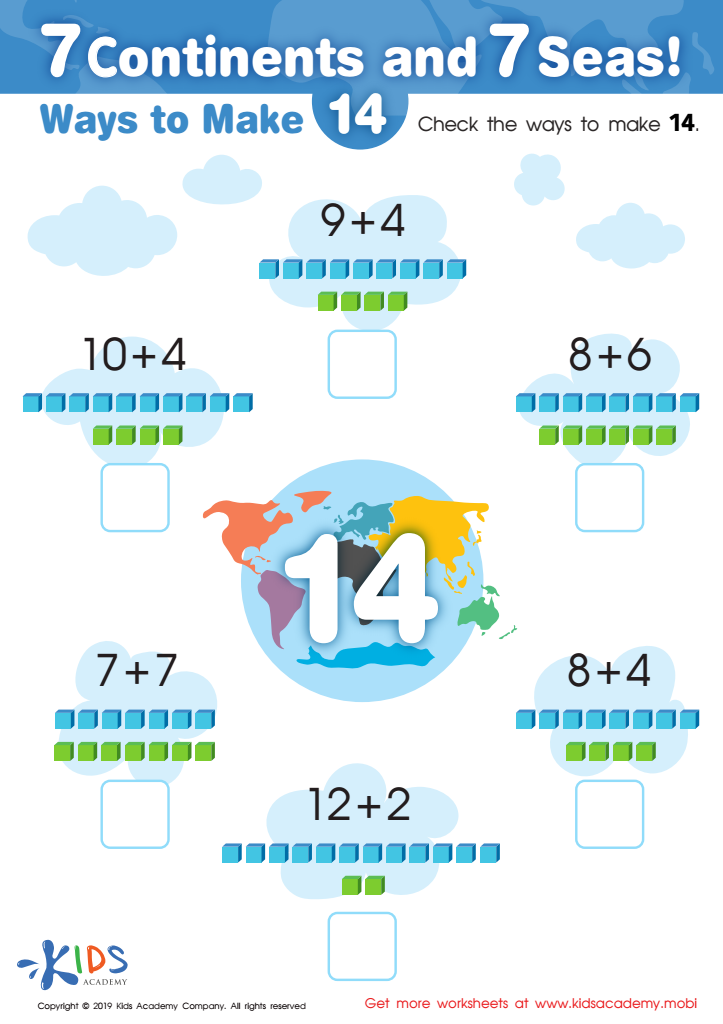
7 Continents and 7 Seas Worksheet
Remind kids of the continents and show them how different numbers can add up to the same figure. Give examples, like 2+2 =4, and 3+1 =4. Ask if they can provide other examples, then work through the simple additions in this worksheet with them. Ask them to circle all equations that make 14.
7 Continents and 7 Seas Worksheet
Worksheet
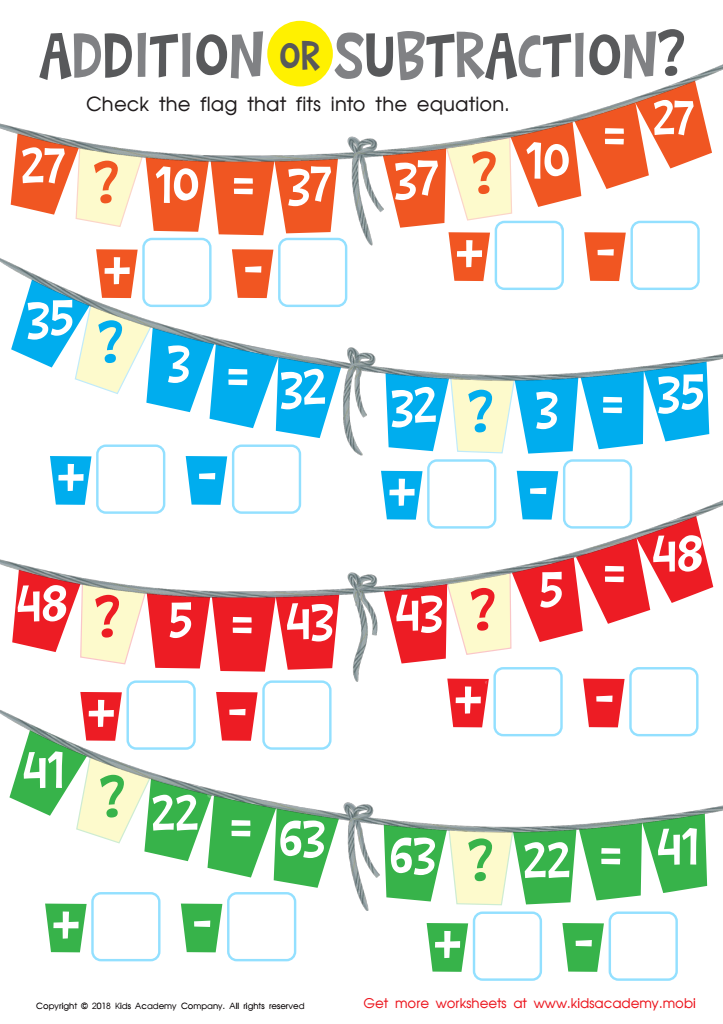
Addition or Subtraction? Worksheet
Help your math whiz's number skills advance with these colorful flag equations! With the free PDF, they'll learn to solve addition and subtraction facts by following the correct orders of operation. And the best part? They'll develop a deeper understanding of how the different operations work together within equations. Give it a try and watch their skills soar!
Addition or Subtraction? Worksheet
Worksheet
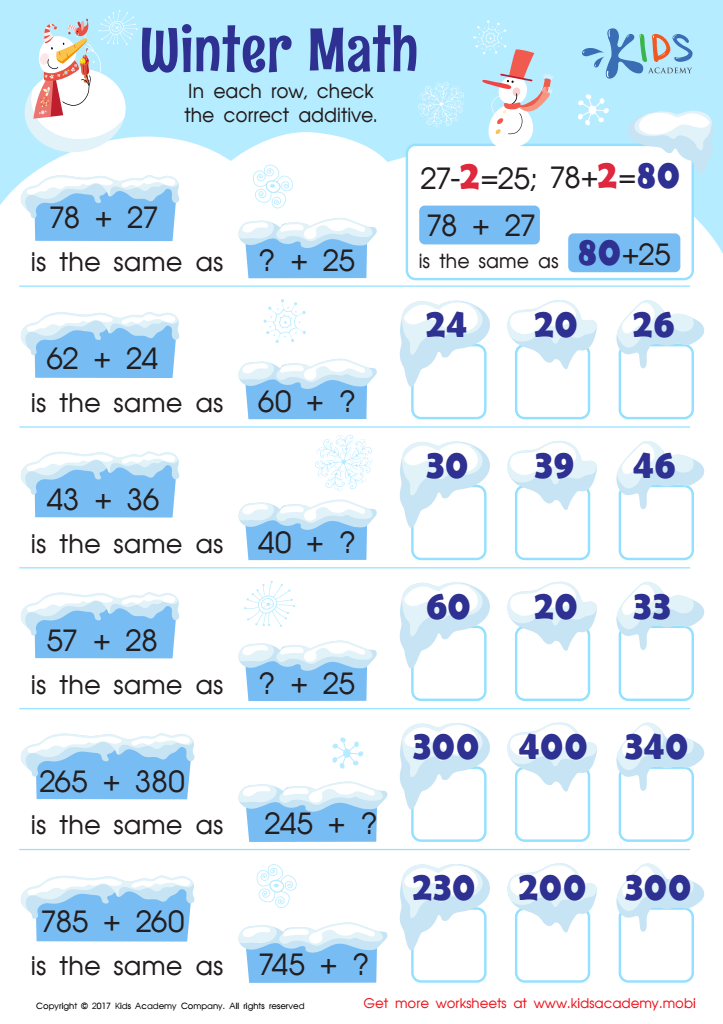
Free Addition Worksheet
Perfect for a wintry day, challenge your 3rd grader to compare addition equations and fill in the missing numbers in the PDF.
This winter-themed worksheet is sure to bring a smile while your 3rd grader practices their addition skills. Perfect for a blustery day, challenge your child to compare addition equations and complete the missing numbers in the PDF.
Free Addition Worksheet
Worksheet
Join Kids Academy for Free
Who is primarily going to use this learning content?







.jpg)
Mathematical reasoning builds the foundation for future problem-solving skills and critical thinking, making it immensely valuable for children aged 6-9. During these formative years, children transition from simple arithmetic to more complex concepts. Focusing on normal addition helps them develop core competencies in mathematics.
For parents and teachers, emphasizing normal addition provides a robust framework for children to understand the relationships between numbers. Unlike rote memorization, which can be easily forgotten, mathematical reasoning requires comprehension, encouraging deeper cognitive engagement.
Adding numbers teaches children to recognize patterns, make connections, and develop strategies for problem-solving. These skills are transferable and benefit overall academic performance, not just in mathematics but also in subjects like science, technology, and even reading, where logical sequencing is essential.
Engaging children with normal addition exercises also boosts their confidence and improves their perseverance in tackling challenges. It lays the groundwork for more advanced operations such as subtraction, multiplication, and division, paving the way for algebraic thinking later on.
Overall, mathematical reasoning and aptitude in normal addition offer crucial life skills. For these reasons, parents and teachers should make concerted efforts to integrate mathematical reasoning into daily learning, ensuring that children build a solid foundation early on.