Alphabet tracing Normal ABC Order Worksheets for Ages 7-8
4 filtered results
-
From - To
Unlock your child's potential with our Alphabet Tracing Normal ABC Order Worksheets, tailored for children ages 7-8! These engaging, printable worksheets are designed to strengthen your child's understanding of the alphabet sequence while enhancing their handwriting skills. By combining fun tracing activities with practicing the correct order of letters, our worksheets help children to effortlessly develop fine motor skills and literacy. Perfect for home and classroom settings, these resources provide an excellent foundation for reading and writing proficiency. Explore the Alphabet Tracing collection today and support your young learner's journey towards academic excellence!

Letter P Tracing Page
 Assign to My Students









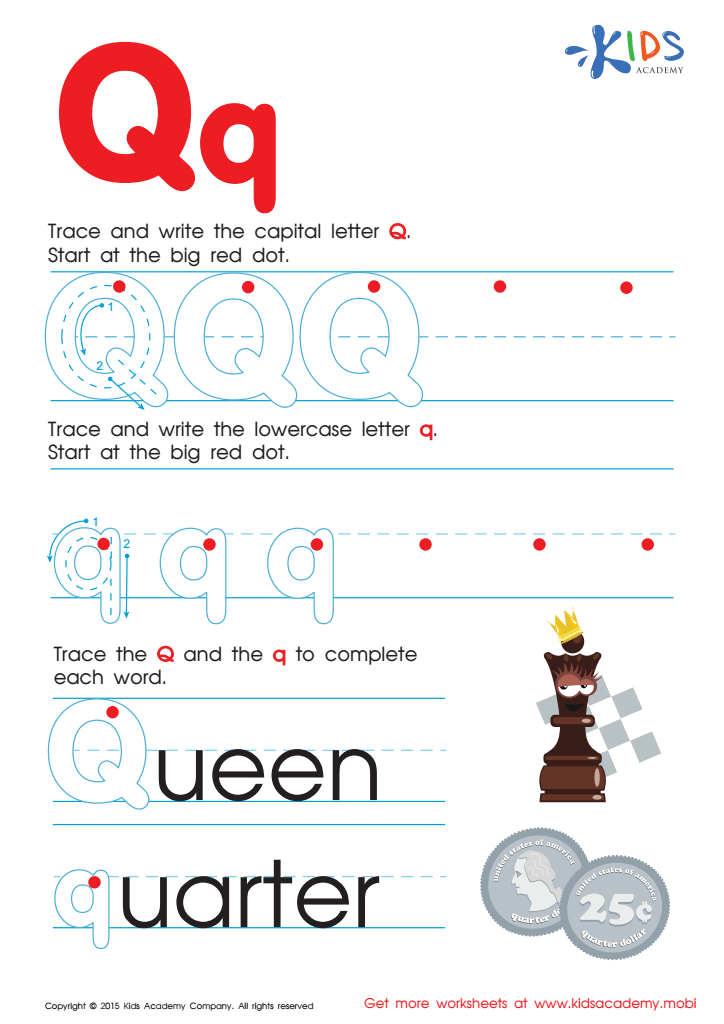
Letter Q Tracing Page

Letter H Tracing Page

Letter D Tracing Page







Alphabet tracing in its normal ABC order is a foundational skill that significantly impacts literacy development for children ages 7-8. Parents and teachers should prioritize this activity as it paves the way for a variety of essential skills including reading, writing, and overall academic success.
Firstly, alphabetical order aids in cognitive organization, enabling children to efficiently categorize and retrieve information. Learning to trace letters in sequence solidifies their understanding of the alphabet’s structure, which is crucial for tasks such as using dictionaries, indexes, or digital databases — all of which rely on alphabetical sorting.
Secondly, the physical act of tracing letters enhances fine motor skills and hand-eye coordination, critical for writing legibility. The repetitive motion involved in tracing engrains muscle memory, ensuring that children can write letters accurately and effortlessly over time.
Additionally, familiarity with the alphabet in its normal order boosts phonemic awareness — the ability to recognize and manipulate the distinct sounds that letters make — a key component of fluent reading. Phonemic awareness, in turn, supports spelling skills and vocabulary expansion, setting a sturdy foundation for more complex language tasks.
In summary, by investing time in alphabet tracing activities, parents and educators can support comprehensive language acquisition, promote efficient information processing, and encourage fine motor skill development, all of which are imperative for academic growth and lifelong learning.