Counting practice Normal Worksheets for Ages 7-8 - Page 2
25 filtered results
-
From - To
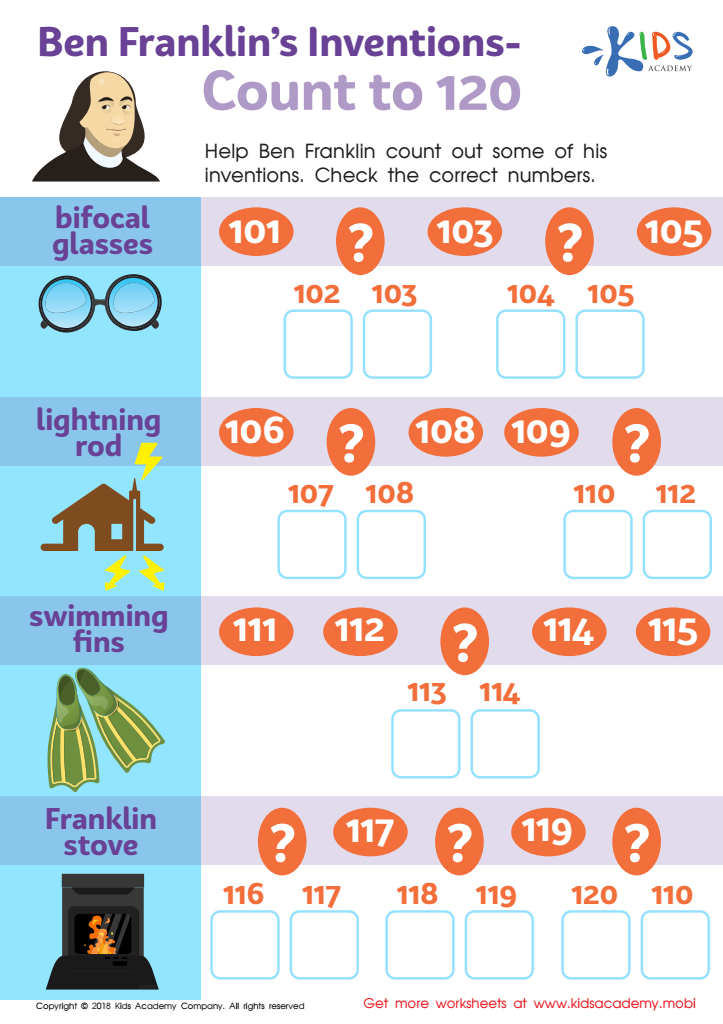
Ben Franklin’s Inventions – Count to 120 Worksheet
 Assign to My Students






Counting practice for children aged 7 to 8 is crucial for their mathematical development and overall cognitive growth. At this stage, children typically transition from basic number recognition to more complex mathematical concepts, including addition, subtraction, and place value. Regular counting practice reinforces their understanding of numbers and helps solidify foundational skills essential for more advanced math in later years.
Moreover, counting practice enhances critical thinking and problem-solving abilities. As children engage with numbers—whether it's counting objects, working with number lines, or solving simple word problems—they learn to analyze and organize information, fostering a growth mindset about learning.
Additionally, counting practices can improve a child’s confidence in their mathematical abilities. When parents and teachers incorporate games, interactive sessions, or real-life counting scenarios, they make learning enjoyable and relevant, which enforces a positive attitude towards math.
Lastly, consistent engagement with counting helps with developmental milestones related to attention and perseverance. This focus on counting lays the groundwork not only for individual academic success but also instills a lifelong love for learning. In summary, encouraging counting in early elementary years is a vital investment in a child's educational journey and future success.








