
Historical Knowledge Normal Multiplication Worksheets for Ages 7-8
4 filtered results
Difficulty Level
Grade
Age
-
From - To
Subject
Activity
Standards
Discover an engaging collection of Historical Knowledge Normal Multiplication Worksheets designed specifically for ages 7-8. These carefully crafted worksheets not only help young learners master essential multiplication skills but also integrate fascinating historical facts. Each worksheet offers fun multiplication exercises along with intriguing snippets about significant historical events and figures, promoting a love for both math and history. By connecting multiplication practice with historical context, children will enhance their cognitive skills while enjoying the learning process. Perfect for teachers, parents, and homeschoolers, these worksheets provide an enriching educational experience that supports diverse learning styles. Spark curiosity in young minds today!
Favorites
With answer key
Interactive
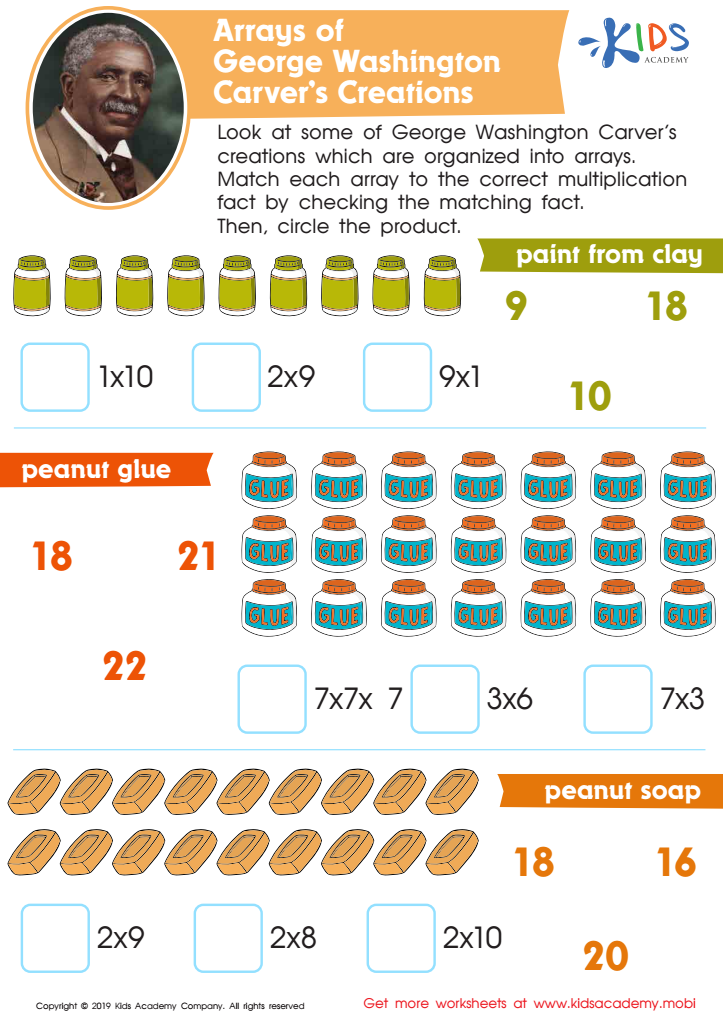
Arrays of George Washington Carver’s Creations Worksheet
Remind your child of what George Washington Carver created. Can they tell you? This worksheet has arrays with his creations. Match the array to the multiplication fact and help your child to circle the product.
 Assign to My Students
Arrays of George Washington Carver’s Creations Worksheet
Worksheet
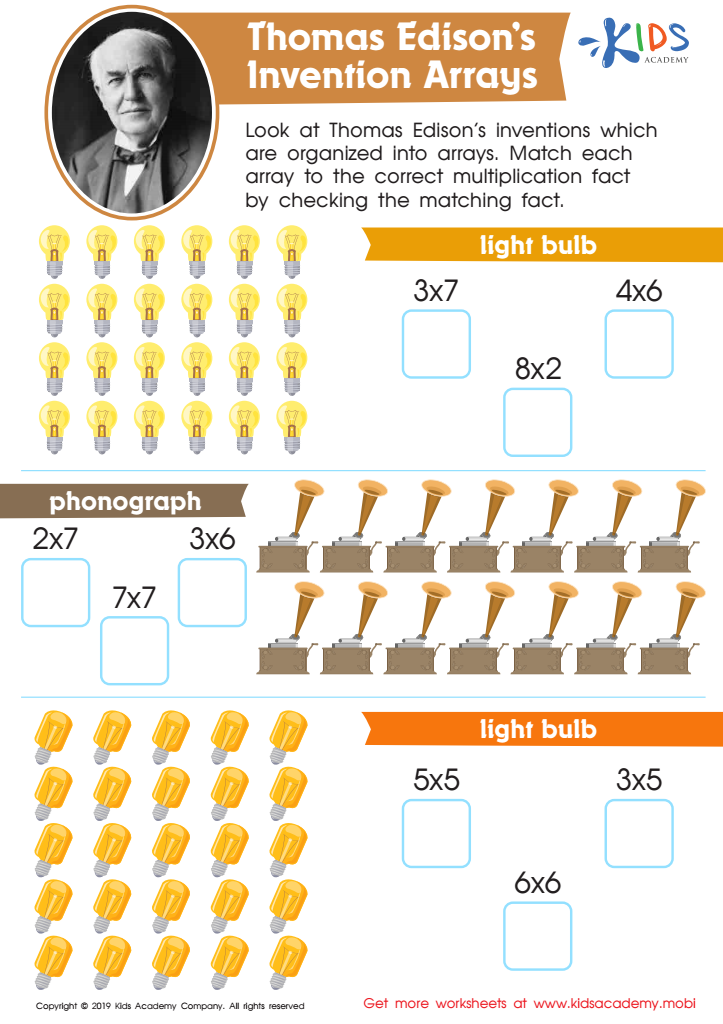
Thomas Edison’s Invention Arrays Worksheet
Test your students' knowledge on history by asking them what Thomas Edison invented. If they get the right answer, provide more information on other inventors. Check out this printout of Edison's light bulb inventions laid out in arrays. Get them to match each array to the correct multiplication fact.
Thomas Edison’s Invention Arrays Worksheet
Worksheet
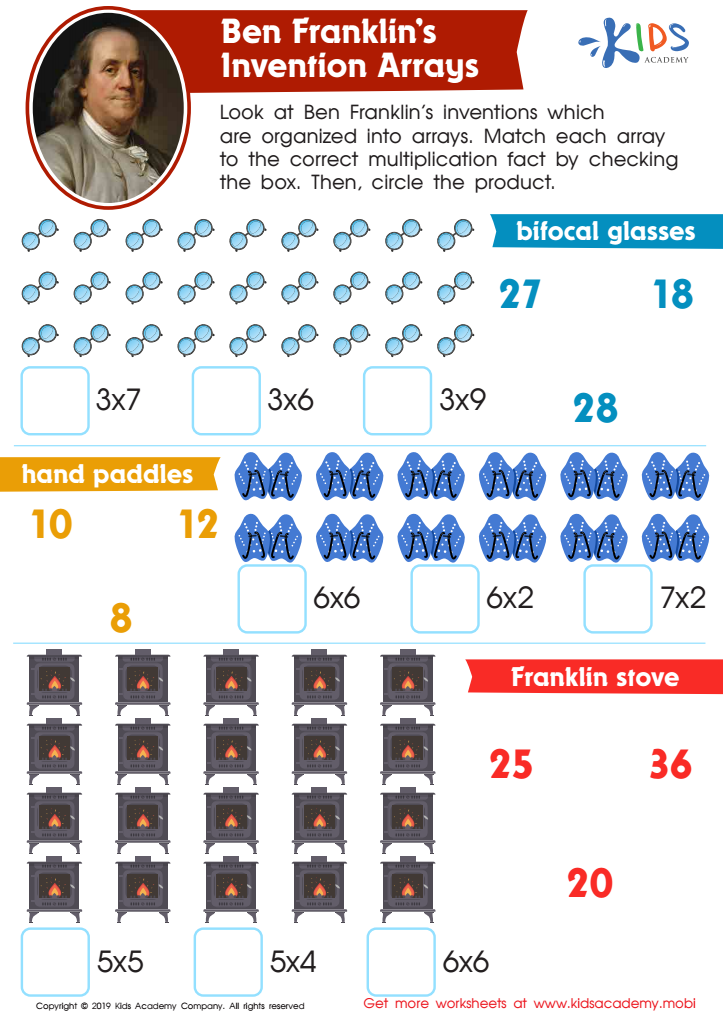
Ben Franklin’s Invention Arrays Worksheet
Have your child guess some of the inventors of the popular items we use today. For instance, the light bulb was invented by Thomas Edison. Look at Ben Franklin's inventions and help your kids match the arrays to the correct multiplication fact. Check the box and circle the product.
Ben Franklin’s Invention Arrays Worksheet
Worksheet
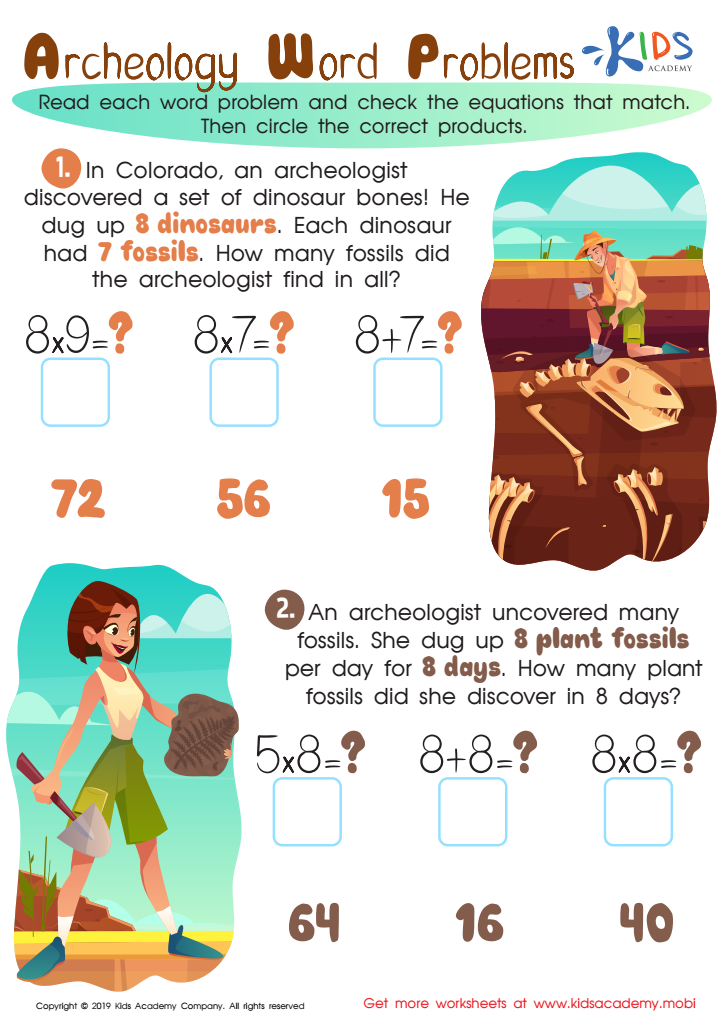
Archeology Word Problems Worksheet
Encourage your child to explore their career options! Show them an archeologist's job with this worksheet - featuring a picture of a dinosaur bone discovery. Read the accompanying text, then solve the word problems. Help your kids circle the correct answers to better understand this profession.
Archeology Word Problems Worksheet
Worksheet
Join Kids Academy for Free
Who is primarily going to use this learning content?







Parents and teachers should care about historical knowledge of normal multiplication for ages 7-8 because it provides a strong foundation for mathematical skills that children will use throughout their educational journey. At this age, students develop critical thinking abilities and start to understand the relationships between numbers. Historical context helps to make these concepts relatable. For instance, understanding the origins of multiplication—from repeated addition to arrays—can enhance students' comprehension of why a method works, rather than just memorizing facts.
Moreover, discussing the evolution of multiplication techniques inspires a sense of curiosity and appreciation for mathematics. It encourages children to recognize math not just as abstract symbols, but as a powerful tool that has been shaped by human experience. This contextual knowledge can enhance engagement, making mathematical learning more meaningful and enjoyable.
Additionally, recognizing the value of multiplication in real-world scenarios, such as in economics and cooking, promotes practical learning. By incorporating historical insights into their teaching, both parents and teachers can help children develop a deeper understanding of math, build confidence, and foster a love for learning that extends beyond the classroom. Ultimately, this foundation equips students to tackle more complex mathematical ideas in the future.








