
Phonics Skills Normal Vowel Blends Worksheets for 7-Year-Olds
5 filtered results
Difficulty Level
Grade
Age
-
From - To
Subject
Activity
Standards
Boost your child’s reading abilities with our engaging "Phonics Skills Normal Vowel Blends Worksheets for 7-Year-Olds" from Kids Academy! These meticulously designed activities help second graders excel in recognizing vowel blends, enhancing both their phonics and vocabulary skills. By offering enjoyable exercises, such as matching, filling in the blanks, and word-building puzzles, our worksheets make learning to read a fun and interactive experience. Ideal for classroom use or homeschooling, these resources support educators in laying a strong foundation for fluent reading and improved literacy. Discover how these worksheets can make vowel blend practice more effective and enjoyable for young learners!
Favorites
With answer key
Interactive
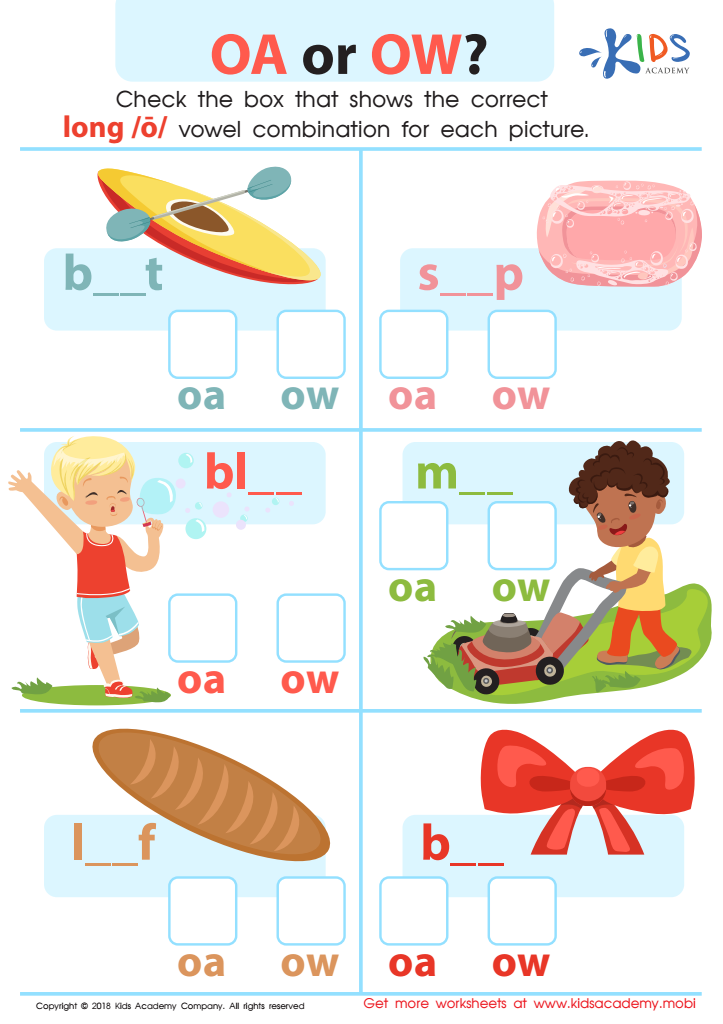
Reading: OA or OW Worksheet
This printable worksheet helps young and emergent readers with decoding words and understanding digraphs (two letters with one sound). It requires students to complete the spelling for each word based on the picture, focusing on /oa/ and /ow/ spellings. It's ideal for a reading classroom and for spelling practice.
Reading: OA or OW Worksheet
Worksheet
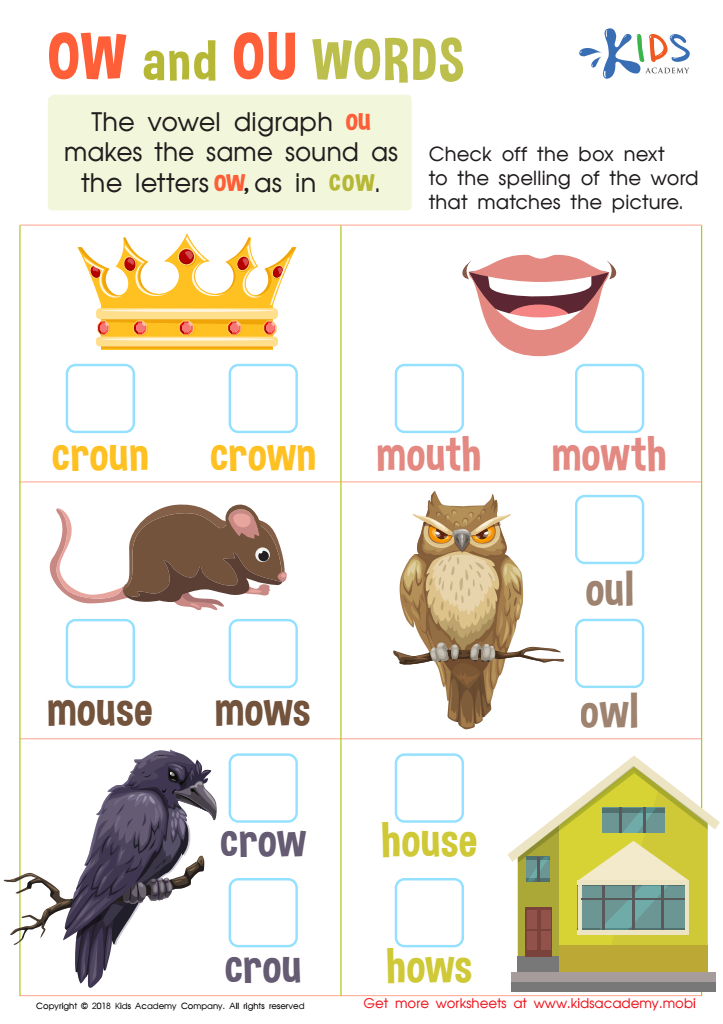
Reading: OW and OU Words Worksheet
Help your kids learn phonetics! Explain the different sounds and long/short variations. Emphasize that some vowel sounds are the same, e.g. ou = ow in cow. For practice, have them read aloud the words in the worksheet and check the box next to the spelling that matches the picture.
Reading: OW and OU Words Worksheet
Worksheet
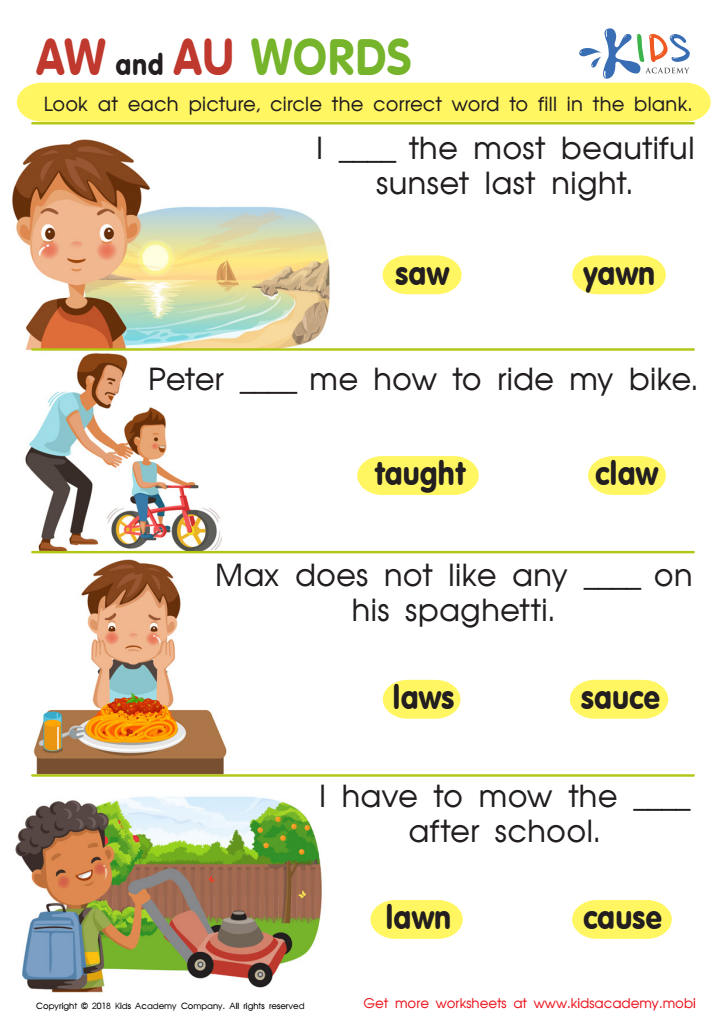
Reading: AW and AU Words Worksheet
This worksheet helps kids recognize that /au/ and /aw/ can make the same sound. Students read sentences and pick the correct word with one of the digraphs. Understanding digraphs improves decoding and reading fluency. Perfect for reading and phonics classes.
Reading: AW and AU Words Worksheet
Worksheet
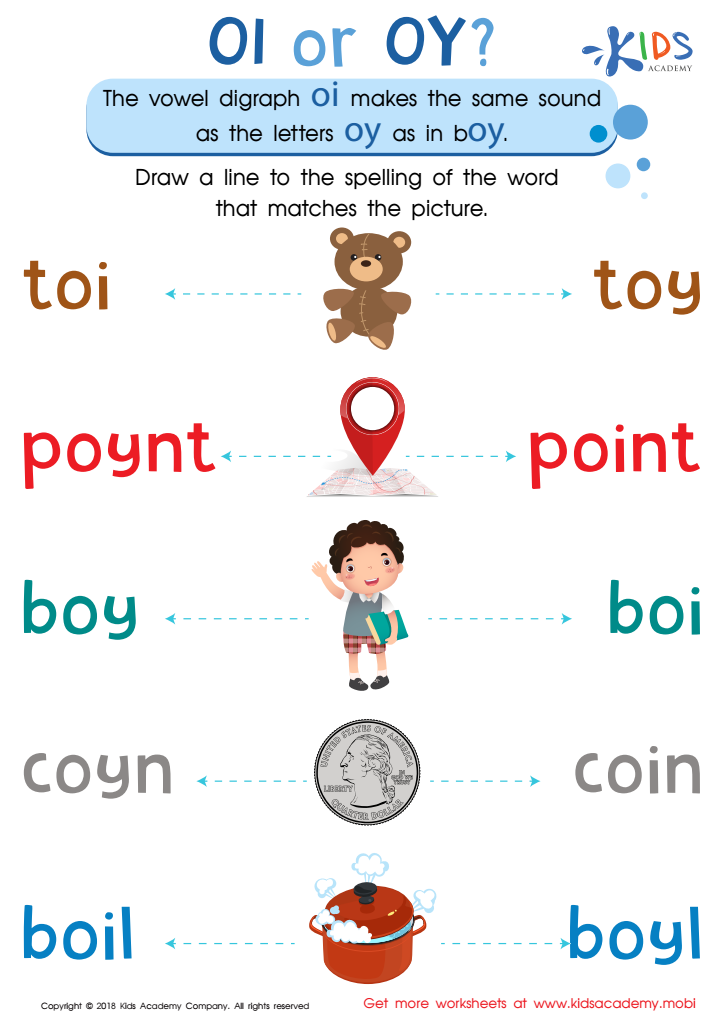
Reading: OI and OY Worksheet
Ask your students if they know the rule for words with /oi/ or /oy/ sound. If not, it's easy to learn! Rule: If /oy/ at end of word, spell with 'oy'; if /oi/ in middle of word, spell with 'oi'. Use this worksheet to help them master these digraphs and improve their ability to decode.
Reading: OI and OY Worksheet
Worksheet

Long and Short E Worksheet
This fun printout makes learning phonics enjoyable for Grade 3 students. Get them to read the words “tree” and “bed” to recognize the different sounds of the letter “E”. After hearing the words they can color the words and the pictures to understand differences between long and short vowels.
Download (PDF)
 Assign to My Students
Assign to My Students
Long and Short E Worksheet
Worksheet
Join Kids Academy for Free
Who is primarily going to use this learning content?





Phonics skills, particularly normal vowel blends, are crucial for 7-year-olds as they form the foundation of effective reading and writing abilities. At this age, children transition from recognizing individual letter sounds to blending them, which is essential for decoding words and developing fluent reading skills.
Parents and teachers should prioritize phonics because it aids in word recognition and enhances children's ability to grasp meaning from text. Understanding vowel blends, where two vowels come together to make a single sound (like in "boat" or "train"), helps kids decipher multisyllabic words, improving their reading efficiency and comprehension. This is vital in preventing reading difficulties that could hinder academic progress in all subjects, since reading is fundamental to learning.
Moreover, mastering phonics boosts children’s confidence and fosters a love of reading. When kids can effortlessly decode new words, they are more likely to enjoy reading, which opens doors to acquiring new knowledge and expanding their imagination. It also promotes better spelling and writing skills.
In summary, focusing on phonics and vowel blends at this early stage equips children with the essential tools for literacy, laying a strong foundation for their educational journey and lifelong learning. Hence, parents and teachers have a key role in nurturing these skills.








