
Understanding place values Normal Worksheets for 7-Year-Olds
7 filtered results
Difficulty Level
Grade
Age
-
From - To
Subject
Activity
Standards
Help your 7-year-old master the concept of place values with our engaging worksheets! Designed specifically for young learners, these activities make understanding tens and ones a breeze. Each thoughtfully crafted worksheet combines fun with education, ensuring that children gain confidence in their math skills. Kids will practice arranging numbers, identifying place values, and solving problems, all while enjoying colorful and interactive exercises. Perfect for both classroom and home use, these worksheets are a valuable resource for parents and educators aiming to build a solid foundation in mathematics. Start exploring our collection today and watch your child excel!
Favorites
With answer key
Interactive
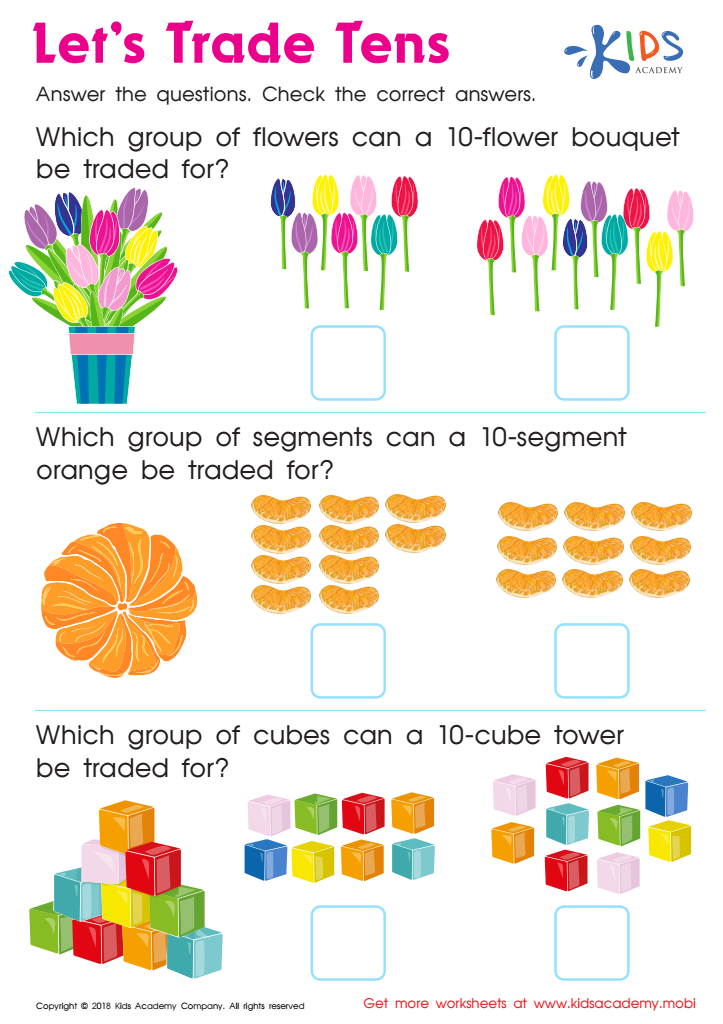
Lets Trade Tens Worksheet
This free worksheet strengthens counting and logic skills. Kids will enjoy exchanging flowers for bouquets, orange slices for a whole fruit, and cube towers for individual cubes. Combining numbers and problem solving is essential for first grade math. Seeing two options helps them understand how 10s look.
 Assign to My Students
Lets Trade Tens Worksheet
Worksheet
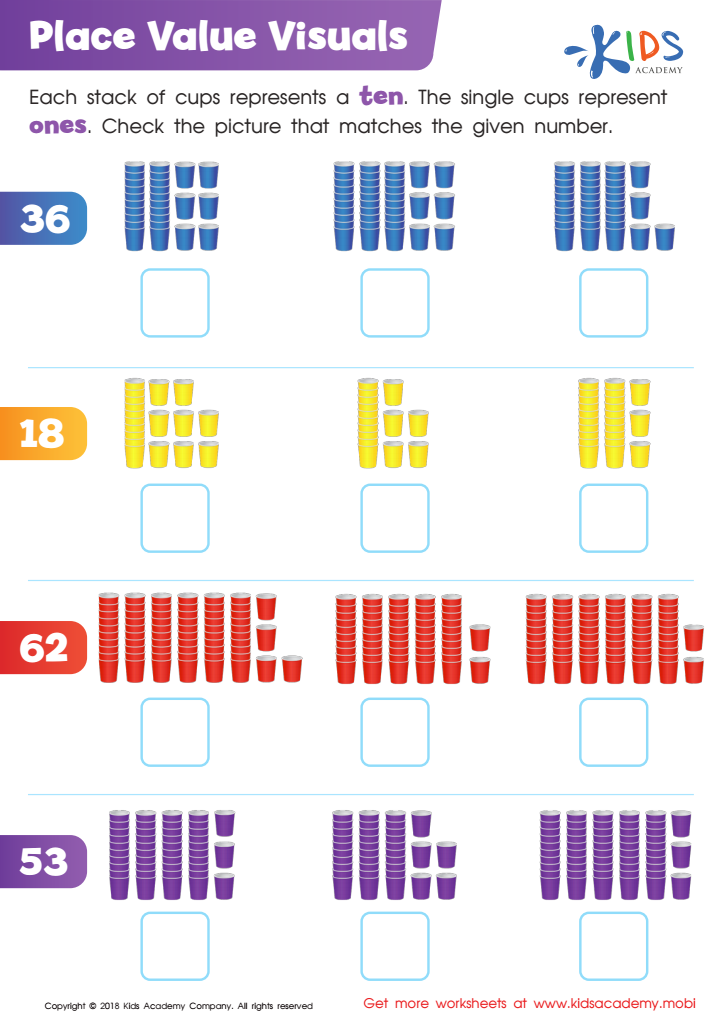
Place Value Visuals Worksheet
Help your child count the cups in each picture, using the simple rule that each stack is 10 and each single cup is 1. Ask them to match the number on the left to the picture on the right. No need to count each cup individually; since each stack is 10, 3 stacks is 30 and so on.
Place Value Visuals Worksheet
Worksheet
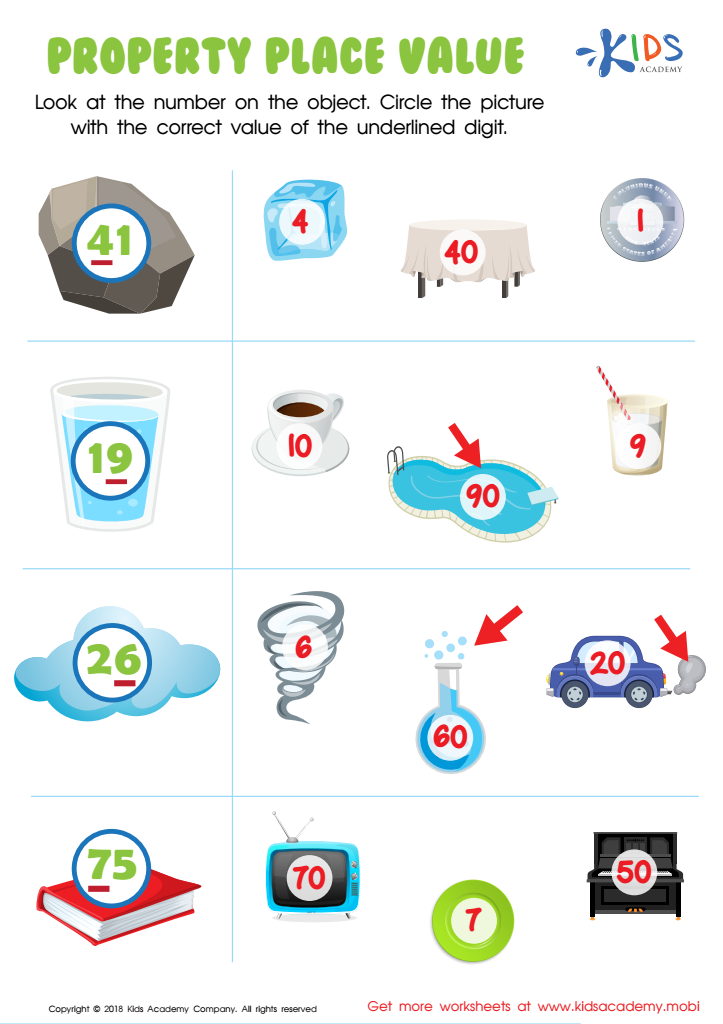
Property Place Value Worksheet
Help your child learn place value with this engaging worksheet! Kids Academy knows that colorful pictures motivate learners. Instruct them to name the place value of the underlined numbers on the left. Then, look through the images on the right to find the numbers that represent the indicated place value.
Property Place Value Worksheet
Worksheet
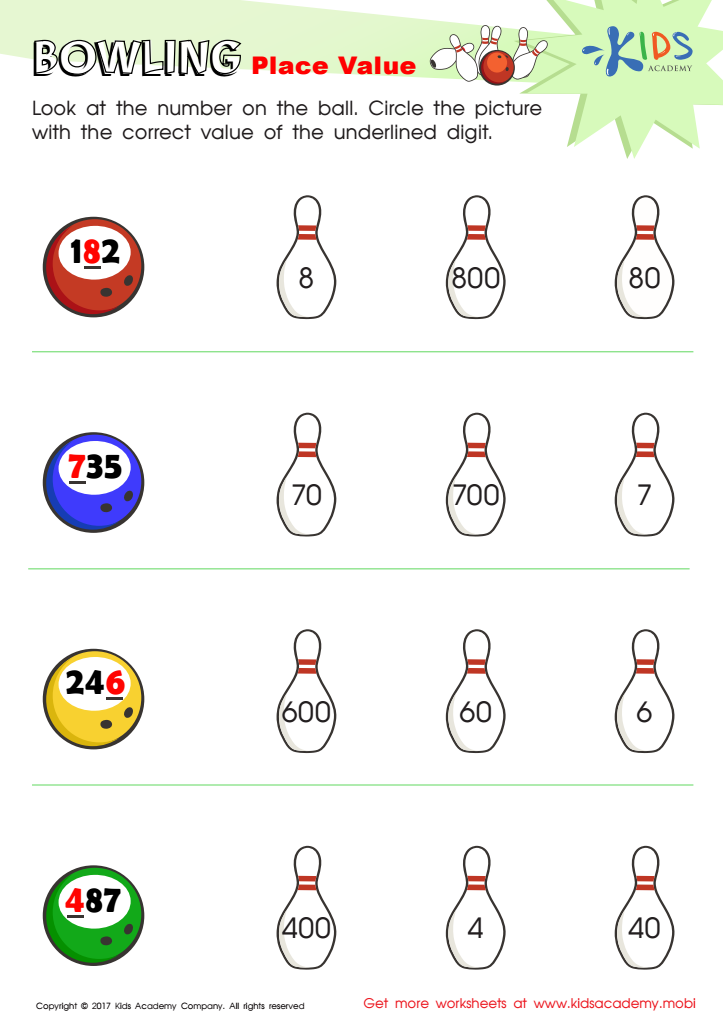
Place Value Worksheet
Try this place value worksheet to help your 2nd grader understand place value in a more meaningful way.
Place Value Worksheet
Worksheet
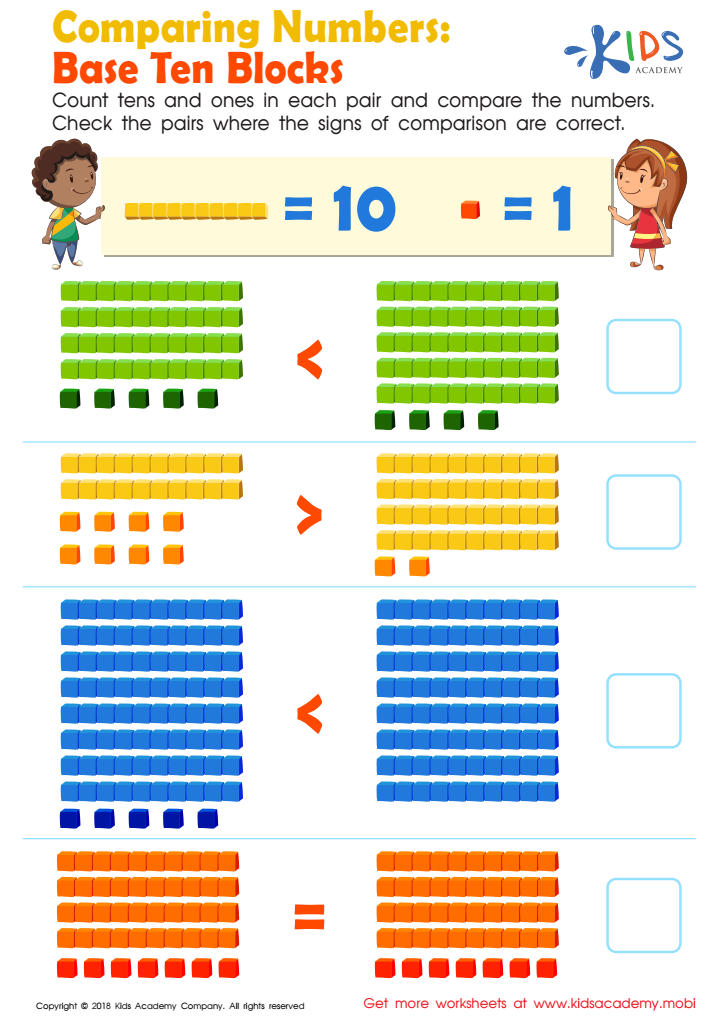
Comparing Numbers: Base Ten Blocks Worksheet
Make math fun for your child with a colorful worksheet. They'll need to compare signs by counting blocks on each side and signifying whether it's correct or not. This is one way to help your child beat the unhappiness that comes with math.
Comparing Numbers: Base Ten Blocks Worksheet
Worksheet
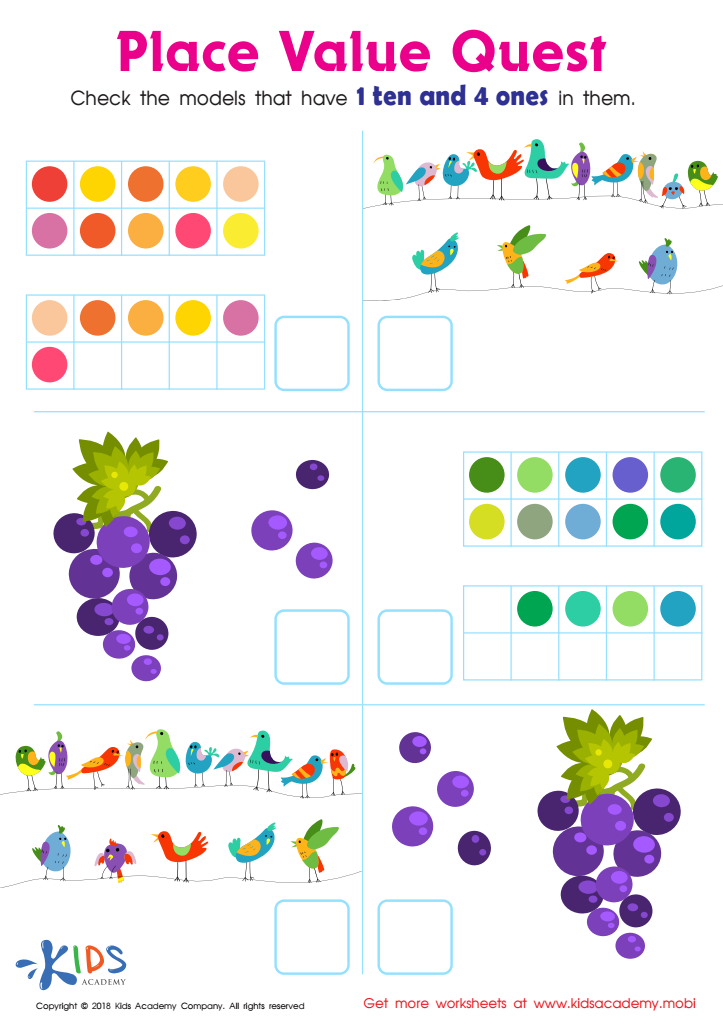
Place Value Quest Worksheet
Help your child explore place value with this fun worksheet! They'll pick the set of images that have 1 ten and 4 ones from a selection of birds, grapes, and dots. Checking the boxes that contain the answer, your child will learn to count and identify tens and ones. A quick math practice page that's sure to be a hit!
Place Value Quest Worksheet
Worksheet
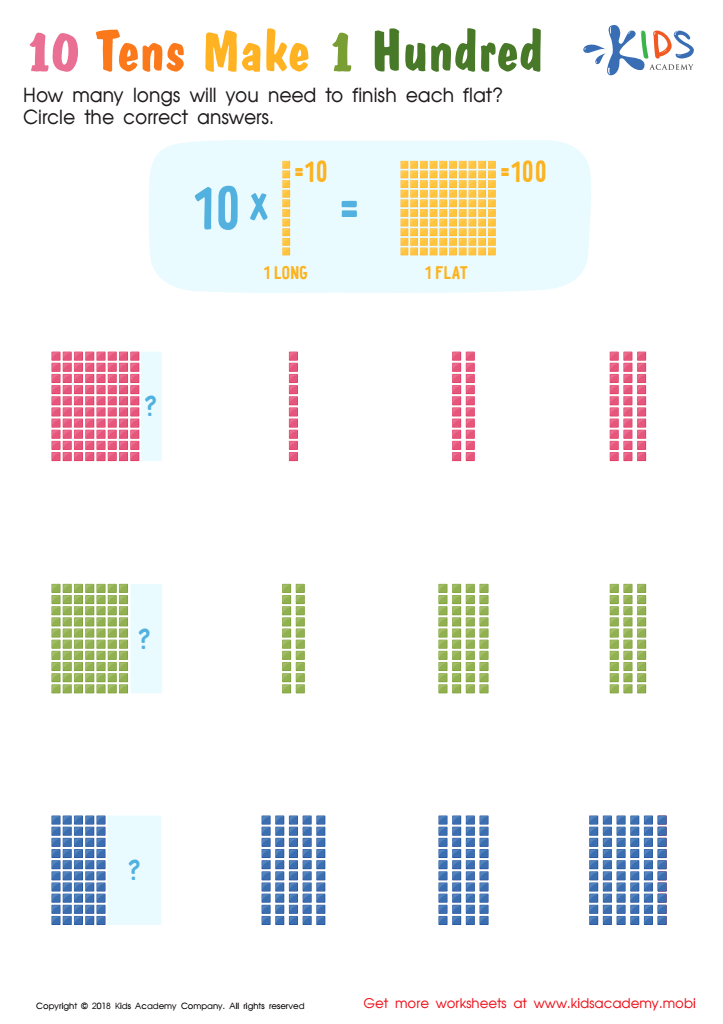
10 Tens Make 1 Hundred Worksheet
Help your child understand multiplication with this worksheet. Ask them how many 'longs' will be needed to complete each flat, then have them circle the correct answer from the options. With this exercise, your child will learn that 10 'tens' make 1 'hundred'!
10 Tens Make 1 Hundred Worksheet
Worksheet
Join Kids Academy for Free
Who is primarily going to use this learning content?






Understanding place values is crucial for 7-year-olds as it forms the foundation for more advanced mathematical concepts they will encounter in the future. At this age, children are beginning to work with larger numbers in addition and subtraction problems. Recognizing place values helps in these operations by allowing children to grasp that a digit's value depends on its position in a number. For example, in the number 483, knowing that '4' represents four hundred, rather than just four, is vital for understanding and computation.
In addition to solving arithmetic problems more efficiently, understanding place values also enhances a child's ability to estimate and understand the relative sizes of numbers, leading to better number sense. This skill supports learning in other subjects, like science and economics, where quantitative reasoning is essential.
From a cognitive development point of view, learning place values encourages logical thinking and problem-solving, triggering critical thinking. Socially, as children become proficient with place values, they gain confidence in their mathematical abilities, which can boost their overall academic confidence.
Teachers and parents play a key role in ensuring this understanding by providing appropriate learning activities and real-world examples. Reinforcing these concepts through interactive and practical methods can make learning engaging and effective for young minds. Hence, investing time and effort in teaching place values is hugely beneficial for a child's overall academic growth.








