
Mental math skills Normal Addition & Subtraction Worksheets for Ages 8-9
3 filtered results
Difficulty Level
Grade
Age
-
From - To
Subject
Activity
Standards
Enhance your child's arithmetic prowess with our Mental Math Skills: Normal Addition & Subtraction Worksheets designed for ages 8-9. These expertly crafted worksheets focus on bolstering your child's confidence and fluency in basic math through engaging exercises that challenge and stimulate young minds. By frequently practicing these activities, children develop faster mental calculation abilities, vital for tackling more complex math problems in the future. Perfect for home or school use, our worksheets make learning both effective and enjoyable. Give your child the gift of strong foundational math skills with our comprehensive, easy-to-follow resources. menyseds Explore and download now!
Favorites
With answer key
Interactive
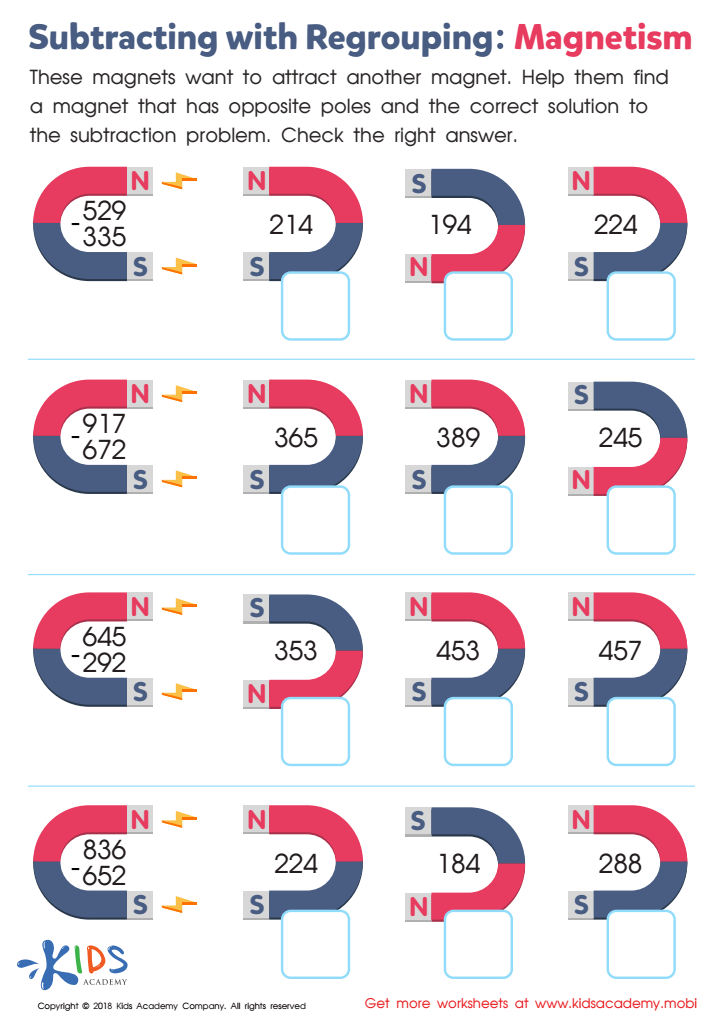
Subtracting with Regrouping: Magnetism Worksheet
Download Kids Academy's worksheet for a fun way to review science and math! Look at the magnet and remember opposites attract. Find another with opposite poles, then solve the problem on the left and check the solution against the magnet. Check the box next to the correct answer to complete this page.
 Assign to My Students
Subtracting with Regrouping: Magnetism Worksheet
Worksheet
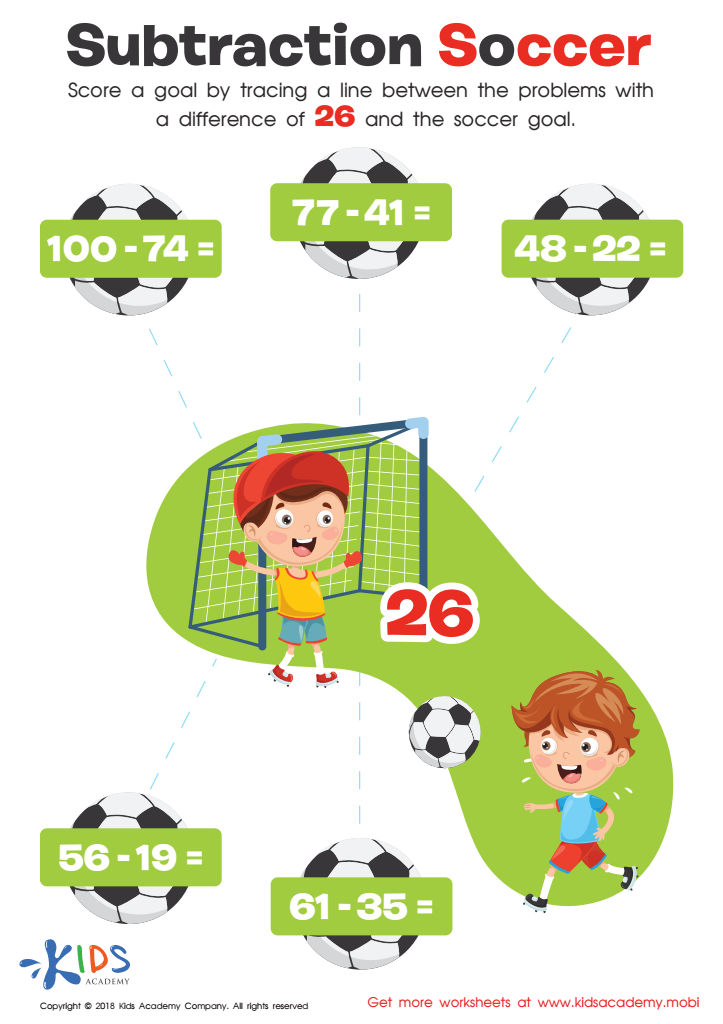
Subtraction Soccer Worksheet
Soccer is a fun sport your child likely enjoys. Math, on the other hand, might not be so exciting. You can show them mathematics can be fun with this traceable worksheet. The kids in the sheet are playing a game of soccer. Ask your child to help them score a goal by tracing a line between the problems with a difference of 26 and the soccer ball. Have fun!
Subtraction Soccer Worksheet
Worksheet
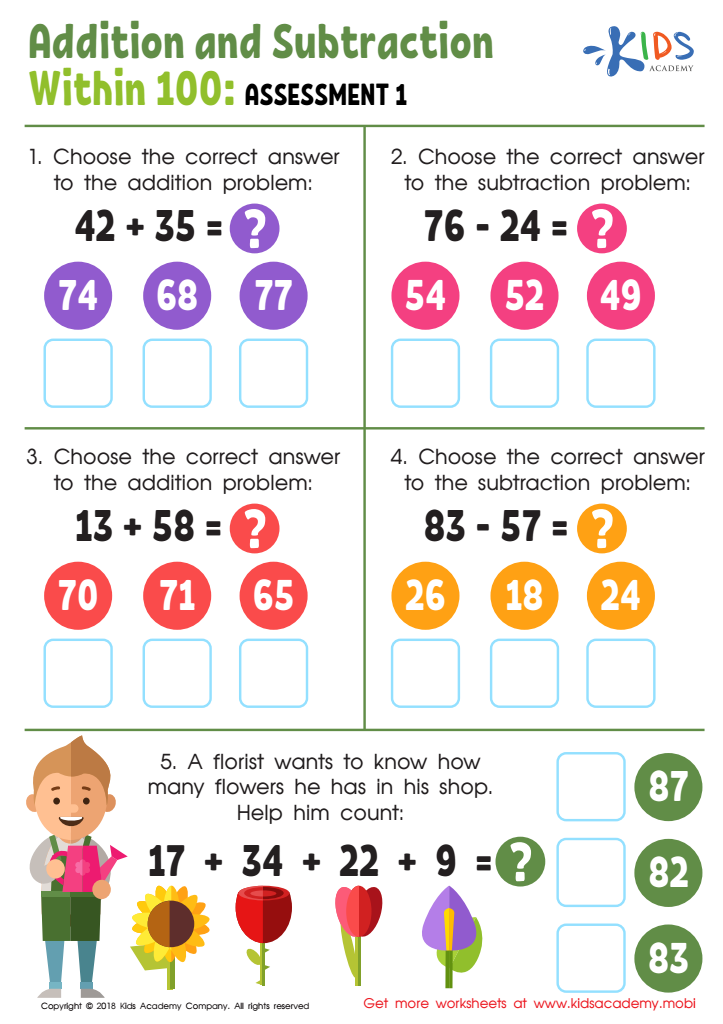
Addition and Subtraction Within 100 Worksheet
This worksheet has four math problems for your child to solve. It's perfect for building their addition and subtraction skills. Read each problem aloud and help them pick the right answer. With your guidance, your child will soon be able to complete such tasks on their own.
Addition and Subtraction Within 100 Worksheet
Worksheet
Join Kids Academy for Free
Who is primarily going to use this learning content?








Developing mental math skills, particularly in basic addition and subtraction, is critically important for children aged 8-9. First, these skills lay a crucial foundation for more complex mathematical concepts. By mastering simple arithmetic, children build confidence and competence, which are essential as they progress to more advanced topics like multiplication, division, fractions, and algebra.
Moreover, mental math promotes cognitive development. It enhances memory, increases problem-solving abilities, and improves the capacity to think quickly and logically. This cognitive enhancement is not limited to math alone but extends to other areas of learning and daily life.
Mental math also fosters a sense of autonomy and independence. When children can perform calculations in their heads, they are less reliant on calculators and other tools, which enhances their self-confidence. This independence is particularly valuable in everyday situations, such as making quick decisions during shopping or playing games, which often require quick mental calculations.
For teachers, focusing on mental math within the curriculum ensures that students are actively engaging with materials and thinking analytically, which can improve overall academic performance. For parents, supporting mental math at home can create valuable bonding opportunities through math-related games and activities while reinforcing what is learned in school. In sum, prioritizing these skills equips children with essential tools that benefit both their academic journey and everyday life.








