
Mental math skills Normal Worksheets for 8-Year-Olds
6 filtered results
Difficulty Level
Grade
Age
-
From - To
Subject
Activity
Standards
Enhance your 8-year-old's mental math skills with our engaging normal worksheets! Specifically designed to make math fun and intuitive, these worksheets foster critical thinking and problem-solving abilities. Your child will tackle various exercises that promote fast calculations and boost confidence in math. Different formats, including pictorial and numerical questions, keep learning exciting and cater to diverse learning styles. Perfect for practice at home or in the classroom, these printable resources encourage independent learning. Download your set today and watch your little one develop a strong foundation in mental math, laying the groundwork for future math success!
Favorites
With answer key
Interactive
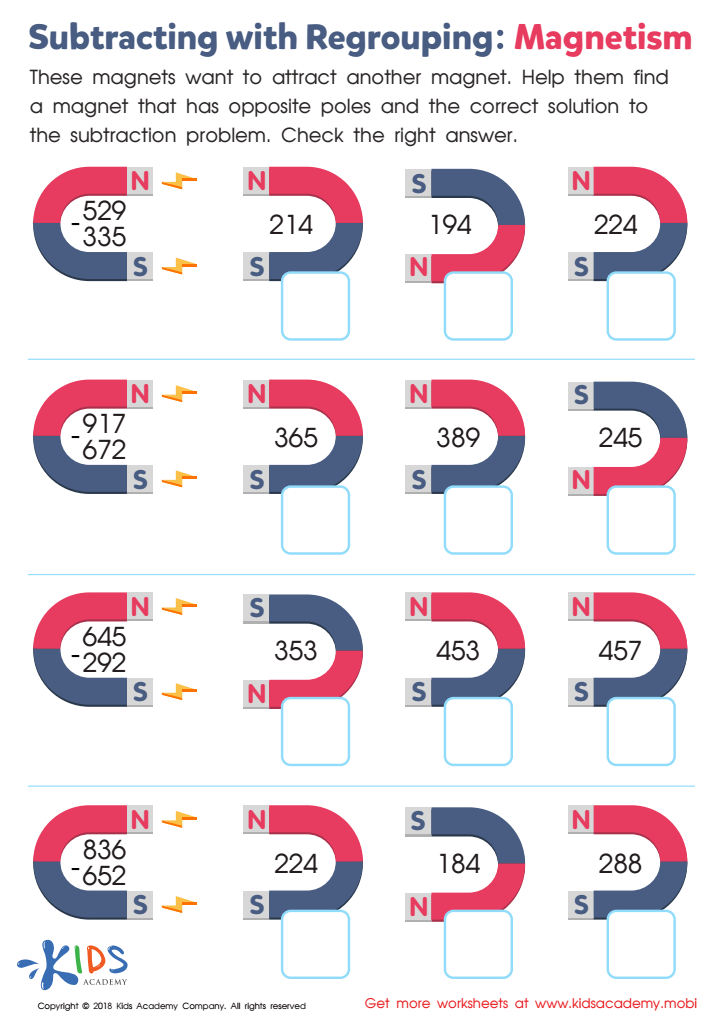
Subtracting with Regrouping: Magnetism Worksheet
Download Kids Academy's worksheet for a fun way to review science and math! Look at the magnet and remember opposites attract. Find another with opposite poles, then solve the problem on the left and check the solution against the magnet. Check the box next to the correct answer to complete this page.
 Assign to My Students
Subtracting with Regrouping: Magnetism Worksheet
Worksheet
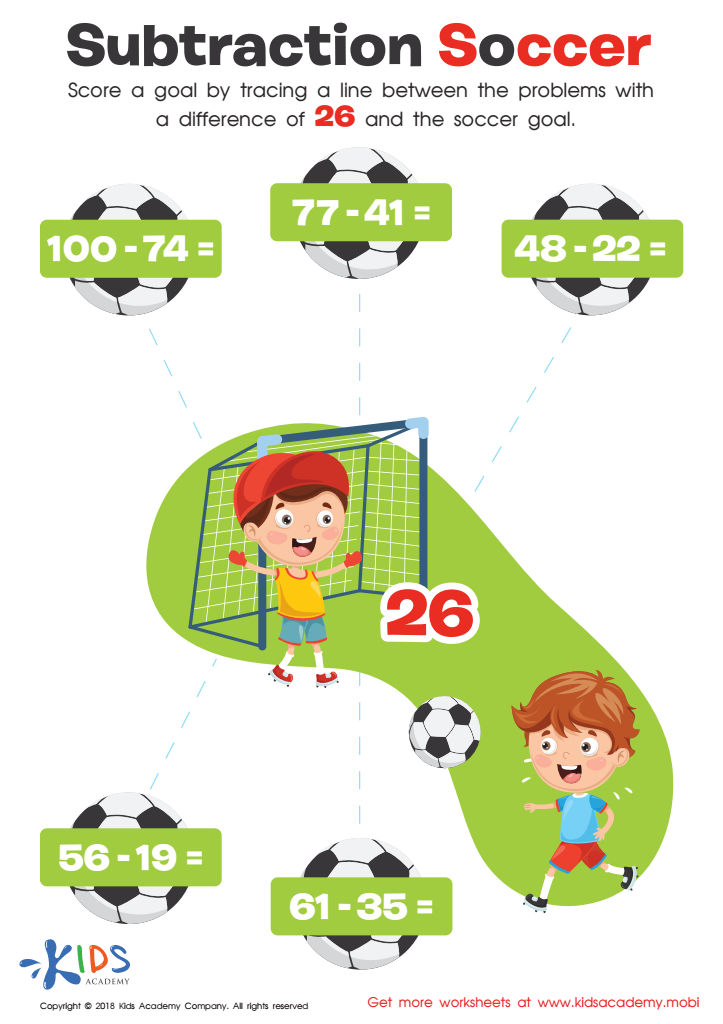
Subtraction Soccer Worksheet
Soccer is a fun sport your child likely enjoys. Math, on the other hand, might not be so exciting. You can show them mathematics can be fun with this traceable worksheet. The kids in the sheet are playing a game of soccer. Ask your child to help them score a goal by tracing a line between the problems with a difference of 26 and the soccer ball. Have fun!
Subtraction Soccer Worksheet
Worksheet
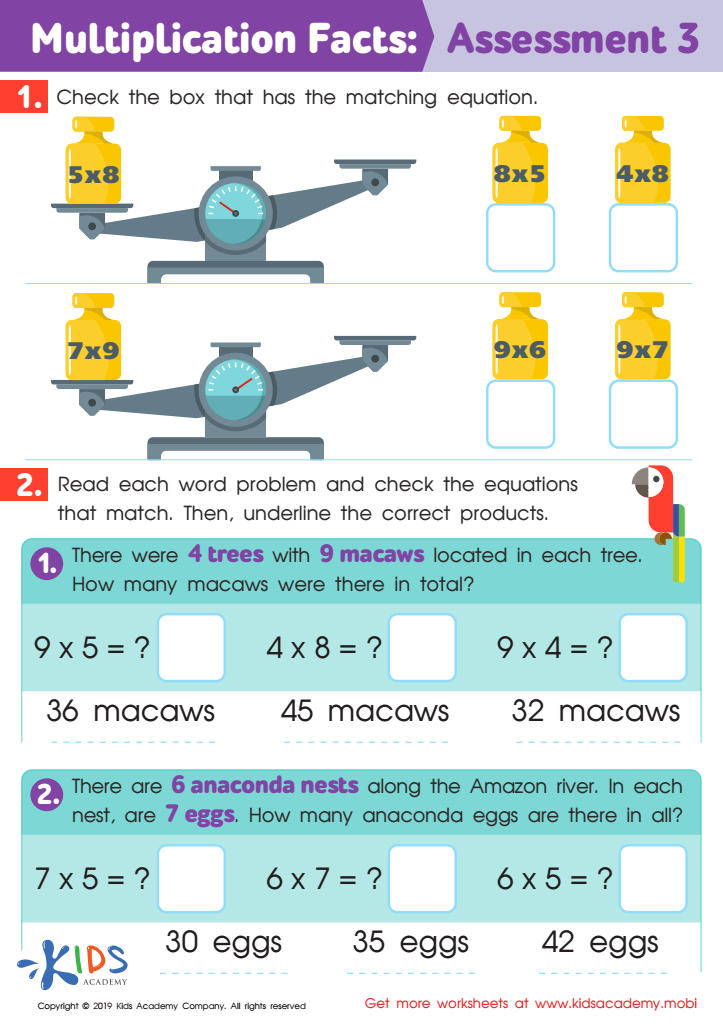
Multiplication Facts: Assessment 3 Worksheet
Test your kid's maths skills with this easy to use worksheet! Help them check the box that matches the equation in the first part, then read each word problem and underline the right answers to the second part. Assess your child's muliplication knowledge and find out where they need extra help.
Multiplication Facts: Assessment 3 Worksheet
Worksheet
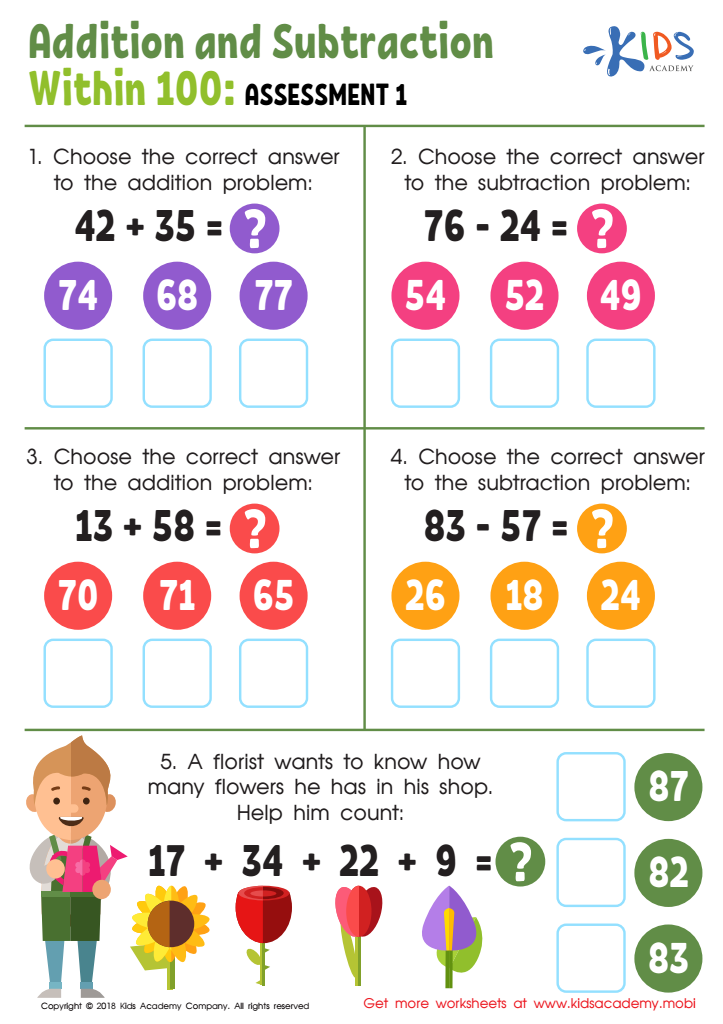
Addition and Subtraction Within 100 Worksheet
This worksheet has four math problems for your child to solve. It's perfect for building their addition and subtraction skills. Read each problem aloud and help them pick the right answer. With your guidance, your child will soon be able to complete such tasks on their own.
Addition and Subtraction Within 100 Worksheet
Worksheet
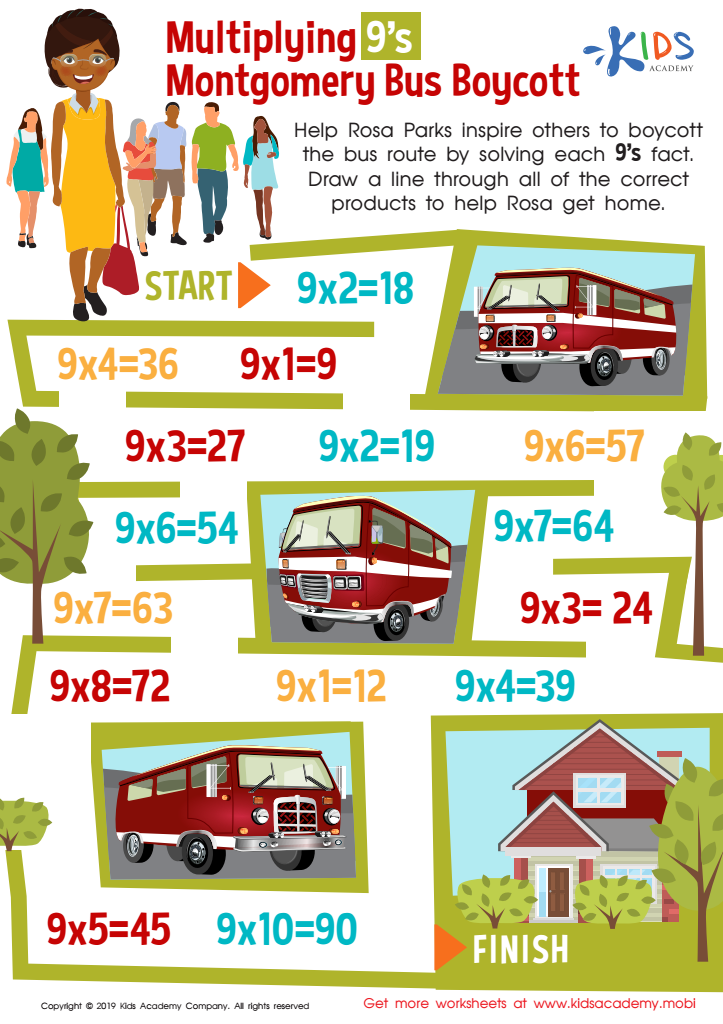
Multiplying 9’s Montgomery Bus Boycott Worksheet
As your students learn math, the numbers get bigger. This worksheet is great for learning the nine times table. Help Rosa Park get home - ask them to solve each multiplication fact, then draw a line through the correct products. Encourage your students to stand up for what's right!
Multiplying 9’s Montgomery Bus Boycott Worksheet
Worksheet
Join Kids Academy for Free
Who is primarily going to use this learning content?








Mental math skills are crucial for 8-year-olds as they form the foundation for a child’s future mathematical understanding and everyday problem-solving abilities. When children can perform calculations in their head, they develop numerical fluency, which enhances their confidence in tackling more complex math concepts later on. This skill boosts cognitive abilities, such as critical thinking and logical reasoning, and encourages a positive attitude toward mathematics.
For parents and teachers, nurturing mental math skills means fostering independence in learning. As children become proficient in mental calculations, they can handle basic operations without relying heavily on calculators or counting tools. This independence aids in their overall academic success and encourages perseverance in overcoming challenges.
Moreover, mental math is intrinsically linked to real-life situations—be it managing money, measuring ingredients while cooking, or estimating time for school-related activities. By promoting these skills, parents and teachers equip children with practical tools they will carry into adulthood.
Lastly, mental math can enhance social interactions; children often engage in friendly arithmetic challenges, learning cooperation and communication skills. In fostering mental math, parents and teachers play a vital role in helping children become competent, confident, and engaged learners.








