
Understanding pollination Normal Math Worksheets for 8-Year-Olds
3 filtered results
Difficulty Level
Grade
Age
-
From - To
Subject
Activity
Standards
Explore our engaging "Understanding Pollination" math worksheets designed specifically for 8-year-olds! These worksheets provide a fun and interactive way to learn about pollination while reinforcing essential math skills. Perfect for early learners, each activity combines nature with math, enabling students to grasp concepts like counting, addition, and measurement through real-life scenarios involving plants and their pollinators. Kids will enjoy a diverse range of problems that promote critical thinking, creativity, and a love for learning. Encourage your child's academic growth and enhance their understanding of environmental science with these innovative, age-appropriate math challenges! Perfect for classroom or home practice.
Favorites
With answer key
Interactive
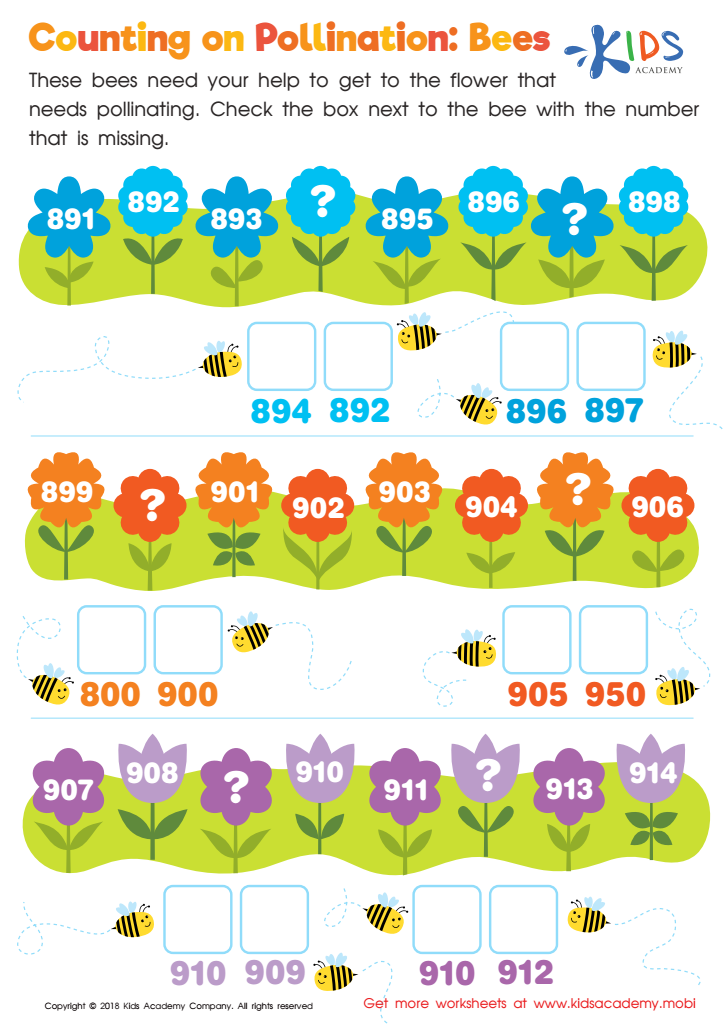
Counting on Pollination: Bees Worksheet
This downloadable worksheet helps kids improve their math skills while having fun - they'll help the bees pollinate the flowers by finding the missing number. It's an entertaining way to practice number patterns, sequences and number line skills, aiding in fast and efficient math computations.
 Assign to My Students
Counting on Pollination: Bees Worksheet
Worksheet
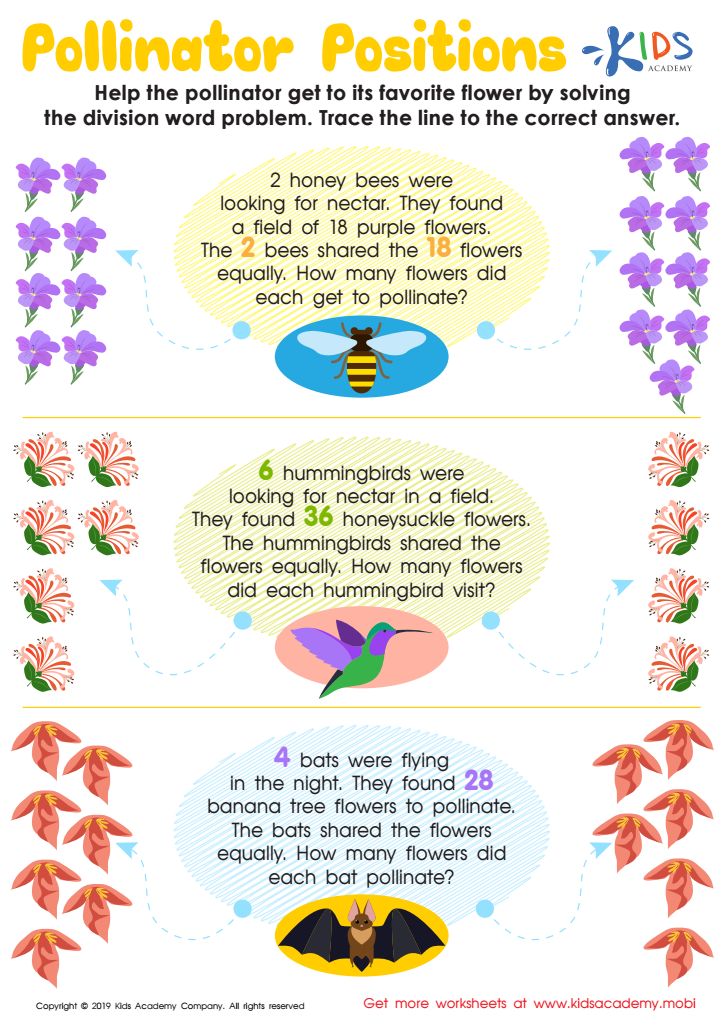
Pollinator Positions Worksheet
Kids will love learning about pollinators and how vital they are. Help their favorite friends get to the right flowers with this fun PDF. Children can solve the problems without even knowing they're doing division; just read the word problems and use the highlighted numbers. Finish by tracing the lines to the correct quotient!
Pollinator Positions Worksheet
Worksheet
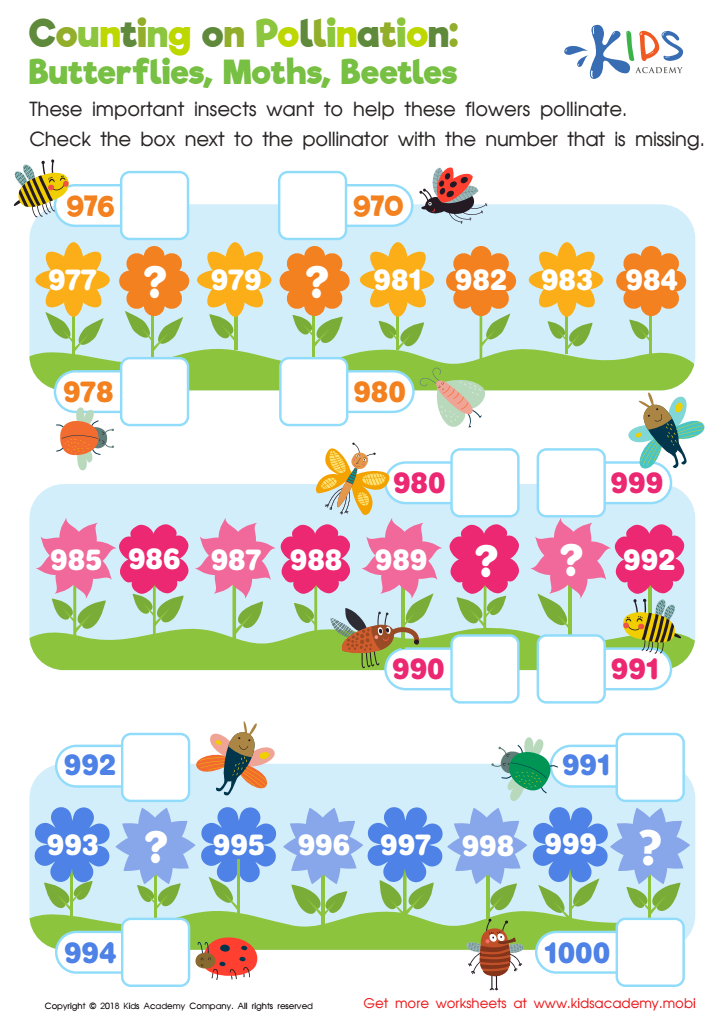
Counting on Pollination: Butterflies, Moths, Beetles Worksheet
A number line can help boost computation accuracy and efficiency. It can also be used with more advanced numbers. Help your child practice by having them identify missing numbers in sequences. This fun worksheet lets them help the pollinators in the process, as they strengthen their number sense.
Counting on Pollination: Butterflies, Moths, Beetles Worksheet
Worksheet
Join Kids Academy for Free
Who is primarily going to use this learning content?







Understanding pollination is vital for parents and teachers to share with 8-year-olds because it lays the foundation for critical environmental concepts and promotes scientific inquiry. Pollination, the process by which plants reproduce, directly impacts food production, biodiversity, and ecosystems. Helping children grasp this concept fosters awareness of the broader world, emphasizing how living things interact within ecosystems.
Moreover, teaching about pollination can cultivate a sense of responsibility toward nature. It encourages students to appreciate the role of pollinators like bees, butterflies, and birds in maintaining healthy plant life, which is crucial for their survival and the world’s food supply.
Furthermore, integrating math into this understanding allows children to develop essential skills, from basic counting and comparing to more advanced concepts like percentages and ratios, as they analyze bee populations and plant growth rates. This interdisciplinary approach not only enhances critical thinking and problem-solving abilities but also keeps learning engaging and relevant. By offering a framework for students to apply their math skills in a real-world context, teachers and parents empower them to be informed citizens who can contribute to environmental conservation efforts in the future. Understanding pollination is therefore crucial for developing informed, responsible, and enthusiastic learners.








