Map reading skills Normal Science Worksheets
1 filtered results
-
From - To
Enhance your child's understanding of geography and navigation with our engaging Map Reading Skills Normal Science Worksheets. Designed for early learners, these printable resources introduce essential map concepts such as scale, symbols, and directions in an interactive manner. Each worksheet encourages curiosity and critical thinking, fostering a love for exploration. With a variety of activities including identifying landmarks and reading coordinates, students will build essential skills for effective map interpretation. Ideal for classroom use or at-home practice, our worksheets align with educational standards, making it easy for children to develop proficiency while having fun. Discover the world through maps today!
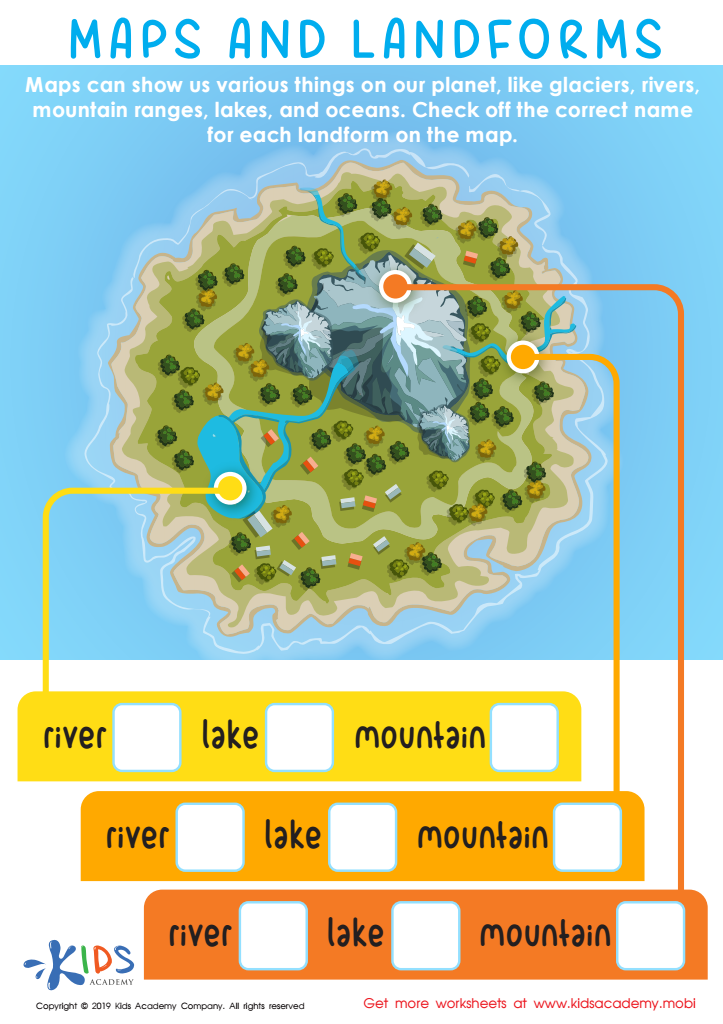
Maps and Landforms Worksheet
 Assign to My Students






Map reading skills are essential for both parents and teachers to cultivate in early childhood education. Firstly, these skills foster critical thinking and problem-solving abilities. When children learn to read maps, they engage with spatial reasoning and spatial awareness, helping them understand how to navigate their environment. This has implications beyond geography; it enhances skills in mathematics and science as children analyze data represented in different forms.
Secondly, map reading promotes independence and confidence. As children learn to interpret maps, they gain a sense of control over their surroundings, enabling them to explore different areas safely. Parents and teachers can encourage outdoor activities, which nurture an appreciation for nature while reinforcing navigation skills.
Furthermore, teaching map reading encourages teamwork and communication when children work together in group activities that involve navigation. Discussing map-related concepts fosters language development as they articulate directions and distance.
Lastly, in today’s increasingly digital world, understanding traditional maps lays the groundwork for digital navigation tools and GPS technology. By prioritizing map reading skills, parents and teachers are equipping children with necessary life skills that will foster independence, enhance academic abilities, and facilitate responsible navigation in an increasingly complex world.







