
Map reading skills Normal Our Planet and Environment Worksheets
1 filtered results
Difficulty Level
Grade
Age
-
From - To
Subject
Activity
Standards
Enhance your students' understanding of our planet with our "Map Reading Skills Normal: Our Planet and Environment" worksheets. Designed for early learners, these engaging resources focus on developing essential map reading skills, fostering geographical awareness, and promoting critical thinking. Each worksheet encourages hands-on exploration, allowing students to identify key map features, interpret symbols, and understand scale. Perfect for integrating science and geography lessons, these worksheets support interactive learning and make complex concepts accessible. Bring the world to your classroom and empower your kids to navigate their environment confidently using our thoughtfully crafted materials tailored to young learners. Start their adventure today!
Favorites
With answer key
Interactive
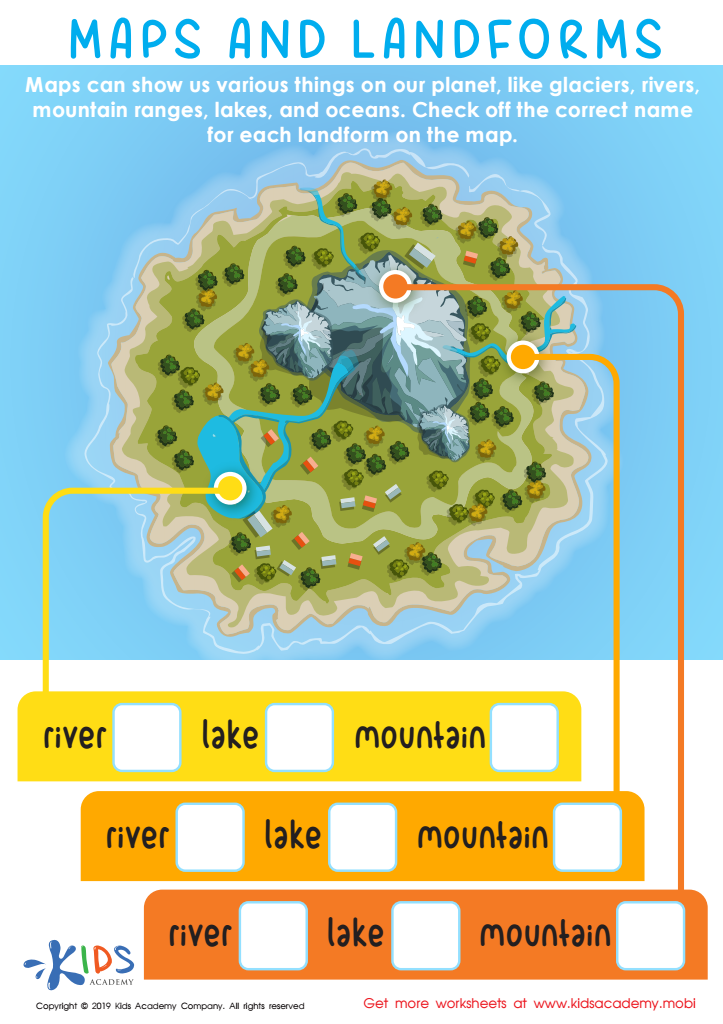
Maps and Landforms Worksheet
We can educate our kids on the world and its landforms by showing them a map. Point out mountains, rivers, and oceans, and help them identify each correctly. With this knowledge, they will better understand our planet.
 Assign to My Students
Maps and Landforms Worksheet
Worksheet
Join Kids Academy for Free
Who is primarily going to use this learning content?




Map reading skills are vital for both parents and teachers to instill in young children, especially concerning our planet and environment. Understanding maps equips students with the ability to navigate and comprehend their surroundings, fostering a sense of place and community. This skill enhances spatial awareness, aiding in real-world navigation and geographical literacy which are essential in our increasingly interconnected world.
Moreover, map reading encourages critical thinking and problem-solving skills. When children interpret a map, they learn to analyze information, assess distances, and draw conclusions based on visual data. This cognitive development is crucial as they engage deeper with global issues like climate change and environmental conservation.
Additionally, teaching children about different types of maps—topographic, political, or thematic—provides insight into environmental features, resources, and human influences on landscapes. Parents and teachers can leverage mapping skills to promote awareness of ecological footprints and inspire sustainable behaviors. Ultimately, equipping children with map reading abilities cultivates informed citizens who can engage thoughtfully with pressing environmental challenges, fostering a generation committed to protecting our world while learning how to navigate it more effectively.







