Mathematical reasoning Normal Grade 3 Numbers Worksheets
4 filtered results
Difficulty Level
Grade
Age
-
From - To
Subject
Activity
Standards
Enhance your third grader's math skills with our comprehensive Mathematical Reasoning Normal Grade 3 Numbers Worksheets. Designed to align with key learning standards, these engaging worksheets focus on developing critical thinking and problem-solving abilities through a variety of numerical challenges. Students will gain confidence in understanding number operations, patterns, and logical reasoning. These carefully crafted activities are perfect for reinforcing classroom lessons, supporting homeschooling efforts, or providing additional practice for standard tests. Make math fun and accessible with our interactive approach that helps bridge the gap between basic concepts and advanced problem-solving skills. Start nurturing a love for math today!
Favorites
With answer key
Interactive
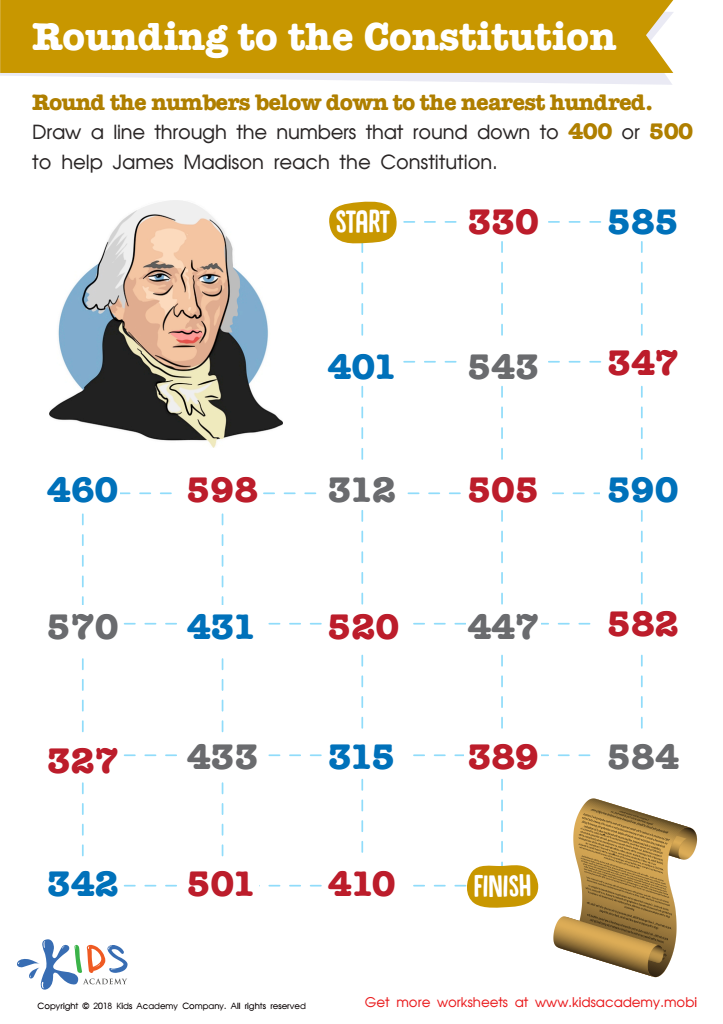
Rounding to the Constitution Worksheet
Before starting this traceable worksheet, ask your students: who is James Madison? If they know, you're doing great! If not, now's your chance to give a quick history lesson. Then, ask them to round the numbers to the nearest numbers. Get your students to draw a line through the numbers that round down to 400/500, to help James Madison reach the Constitution.
 Assign to My Students
Rounding to the Constitution Worksheet
Worksheet
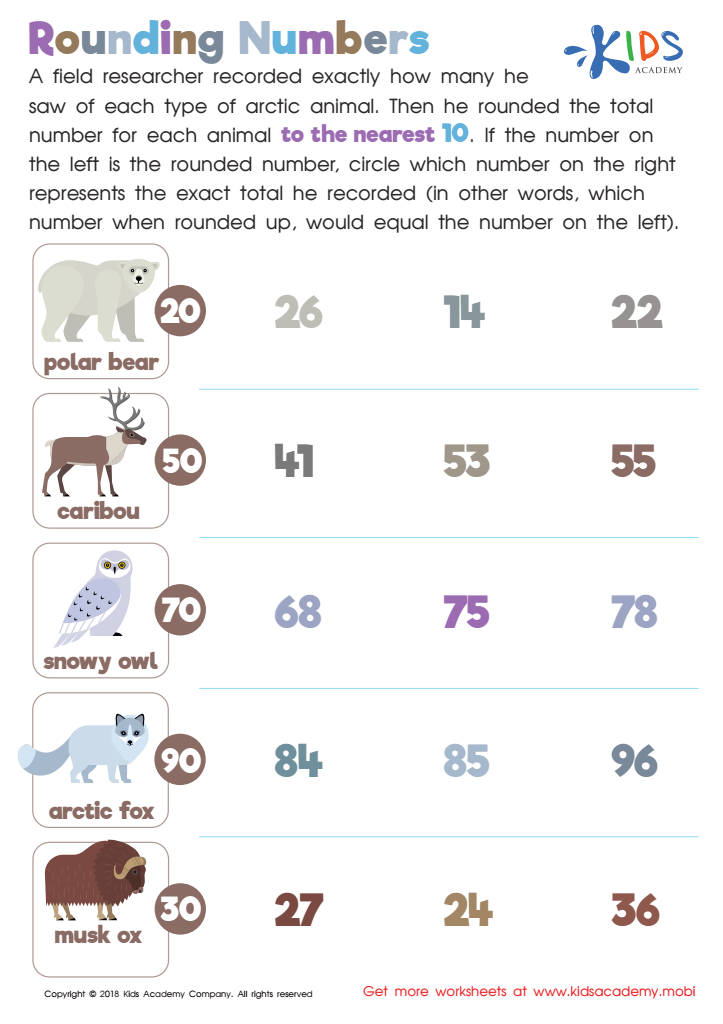
Rounding Numbers Worksheet
Take a trip north with this cute rounding math worksheet! Perfect for mastering number work, it adds a twist to the usual rounding practice. Help your child by getting them to view each animal picture to find the exact total of the rounded number. Then, look at the numbers on the right to determine what number was used to create the rounded total.
Rounding Numbers Worksheet
Worksheet
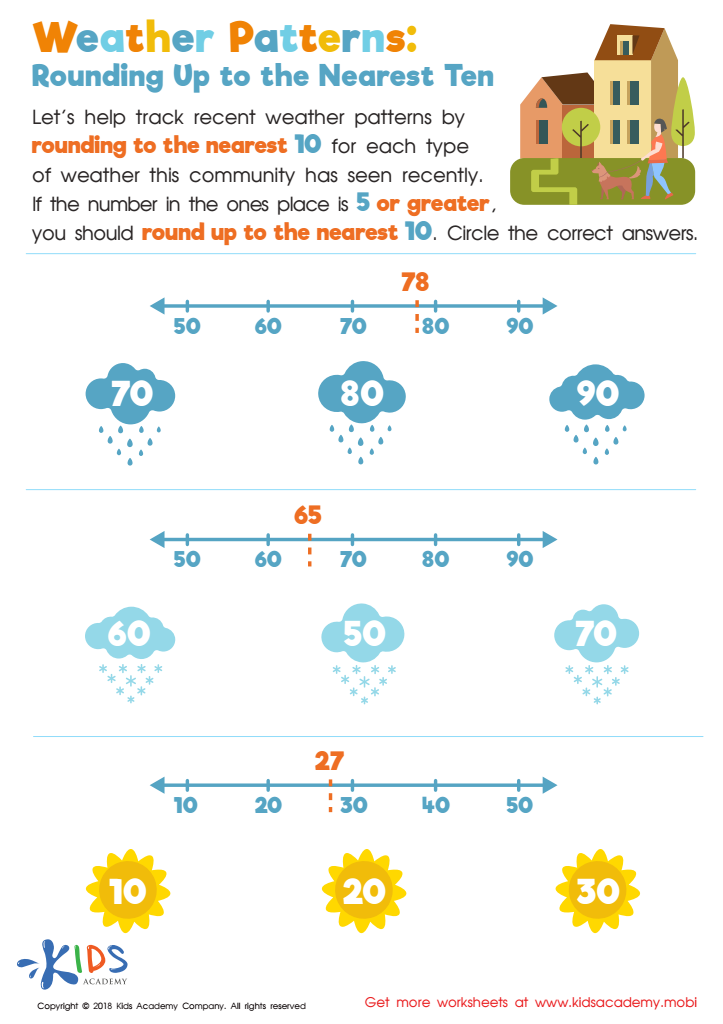
Weather Patterns Worksheet
Use this Weather Patterns worksheet to help your kids develop their mathematical skills. Get them to round the recent weather patterns to the nearest 10 and round up if the number in the ones place is 5 or higher. Work with them to figure out which answers are correct and get them to circle them.
Weather Patterns Worksheet
Worksheet
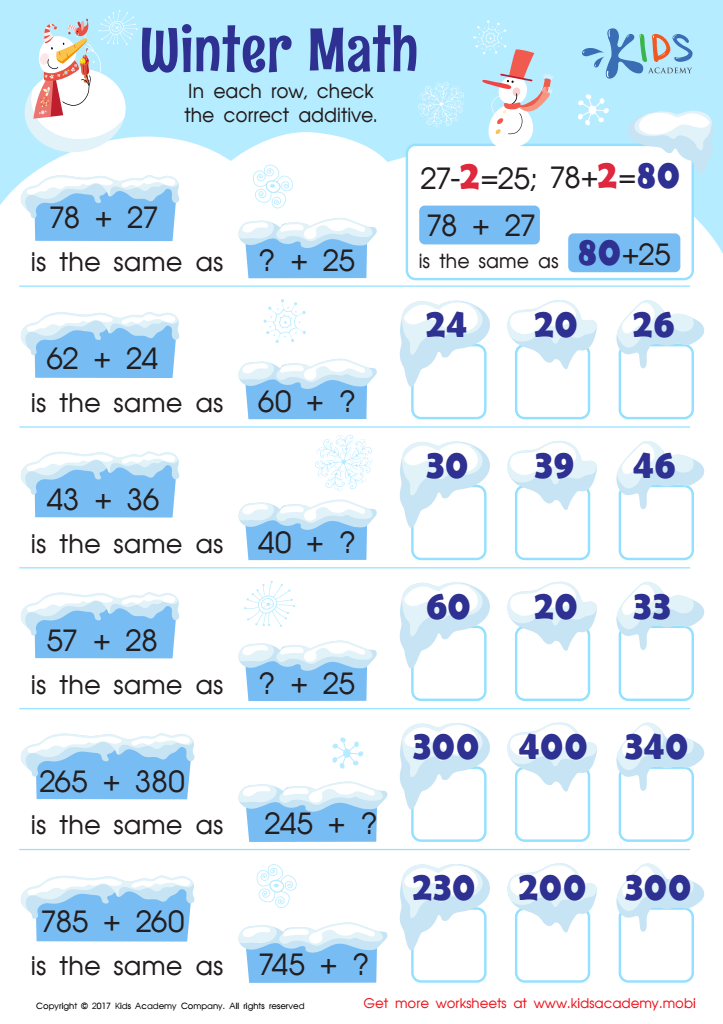
Free Addition Worksheet
Perfect for a wintry day, challenge your 3rd grader to compare addition equations and fill in the missing numbers in the PDF.
This winter-themed worksheet is sure to bring a smile while your 3rd grader practices their addition skills. Perfect for a blustery day, challenge your child to compare addition equations and complete the missing numbers in the PDF.
Free Addition Worksheet
Worksheet
Join Kids Academy for Free
Who is primarily going to use this learning content?








Mathematical reasoning forms a crucial aspect of a child's cognitive development and foundational education. For third graders, developing strong mathematical reasoning skills around normal grade 3 numbers (typically including understanding numbers up to 1,000, addition, subtraction, and the basics of multiplication and division) is vital.
Firstly, mathematical reasoning enhances problem-solving and critical-thinking skills. When children grasp these concepts, they learn to approach different challenges logically and systematically. This computational fluency can transfer to other academic subjects and day-to-day activities, thus fostering overall intellectual growth.
Secondly, proficiency in mathematical reasoning builds confidence. When children understand numbers and operations, they navigate academic tasks with greater ease and less anxiety. Confidence in math during early years ensures students are more likely to stay engaged and motivated in their future education, particularly in STEM fields.
Lastly, nurturing strong math skills at this stage sets the foundation for more advanced concepts they will encounter in later grades. The importance of understanding precise and accurate mathematical reasoning cannot be overstated. It’s like learning to read before tackling literature; a firm grasp of fundamental math enables students to succeed in increasingly complex topics as they progress through their academic journey.
In summary, parents and teachers should prioritize fostering mathematical reasoning to build confident learners equipped with robust problem-solving abilities, ensuring long-term educational and personal success.