
Vowels and Consonants worksheets activities for 6-Year-Olds
1 filtered results
Difficulty Level
Grade
Age
-
From - To
Subject
Activity
Standards
Dive into the fascinating world of language with our Vowels and Consonants Worksheets Activities! Designed to captivate and educate, our comprehensive pack is perfect for young learners eager to explore the basics of English phonetics. Through a series of engaging and interactive worksheets, children will embark on a journey of discovery, differentiating between vowels and consonants, enhancing their reading, writing, and pronunciation skills. Each activity is crafted to reinforce learning in a fun and memorable way, ensuring a solid foundation in understanding the building blocks of words. Ideal for classroom use or at-home learning, these activities promise to make the journey of language learning an exciting adventure!
Favorites
With answer key
Interactive
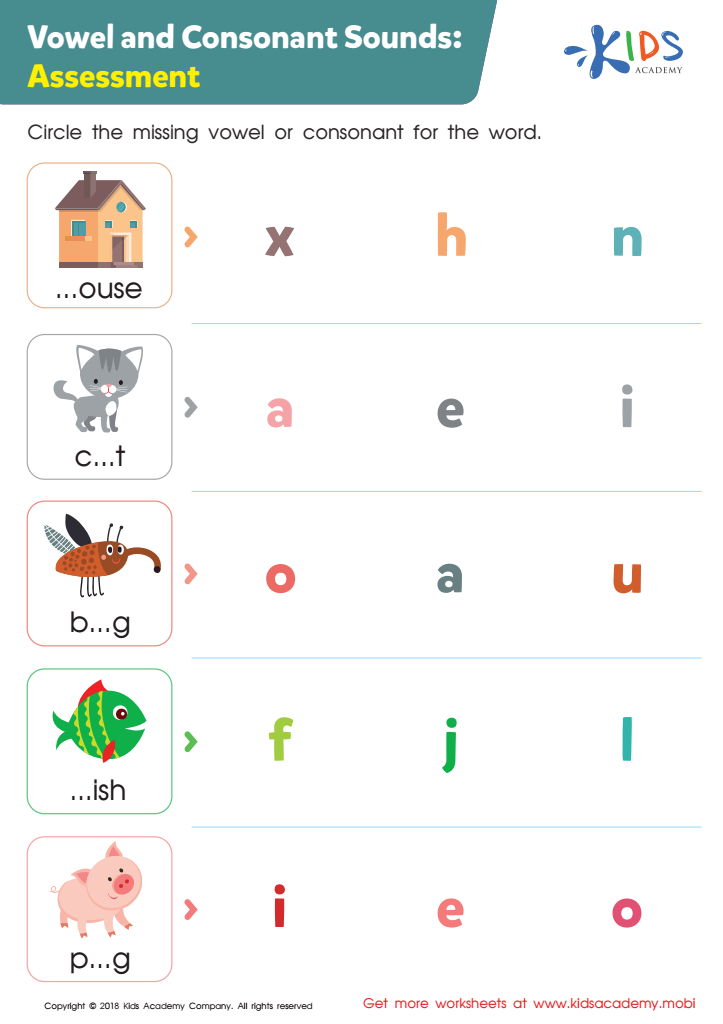
Vowel and Consonant Sounds: Assessment Worksheet
Test young elementary students on vowel and consonant sounds with this friendly phonics assessment worksheet. Get kids to name each image and look at the word underneath. Ask them to sound out the word, then circle the missing letter to complete. This will help assess their knowledge and skills!
 Assign to My Students
Vowel and Consonant Sounds: Assessment Worksheet
Worksheet
Join Kids Academy for Free
Who is primarily going to use this learning content?








Vowels and Consonants worksheets activities are an essential component of early language education, providing learners with the foundation they need to develop the skills required for reading and writing effectively. These activities are not just exercises; they are the building blocks that support language acquisition, pronunciation, and literacy. Vowels and Consonants worksheets activities are incredibly useful for several reasons.
Firstly, they introduce young learners to the basic elements of the English language. Understanding the difference between vowels and consonants is crucial for decoding words, which is the first step towards reading. By engaging in these worksheets, children become familiar with the concept that vowels are the sounds that allow our speech to flow smoothly, whereas consonants break up that flow. This fundamental knowledge is key to mastering the phonetic aspects of English.
Secondly, Vowels and Consonants worksheets activities promote phonemic awareness. Phonemic awareness is the ability to hear, identify, and manipulate individual sounds (phonemes) in spoken words. Through these worksheets, learners can practice identifying the sounds each letter makes, which is critical for spelling and reading. This kind of phonics practice helps in developing a strong literacy foundation, making future learning efforts more effective and less frustrating for the student.
Moreover, these activities are designed to be engaging and interactive, making learning fun and motivating for children. This positive engagement encourages continuous learning and practice, which is necessary for mastering the complexities of the English language. Vowels and Consonants worksheets can come in various forms - from coloring pages that help distinguish between vowel and consonant sounds to matching games that improve sound-letter recognition. This variety ensures that learning never becomes dull.
In conclusion, Vowels and Consonants worksheets activities are invaluable tools in the journey of language learning. They lay the groundwork for reading and writing, enhance phonemic awareness, and turn learning into an enjoyable experience. By incorporating these worksheets into early education, we are setting our young learners on the path to literacy success.








