Harness Your Knowledge of Space with Fun and Educational Activities for 7-Year-Olds | Kids Academy
2 filtered results
-
From - To
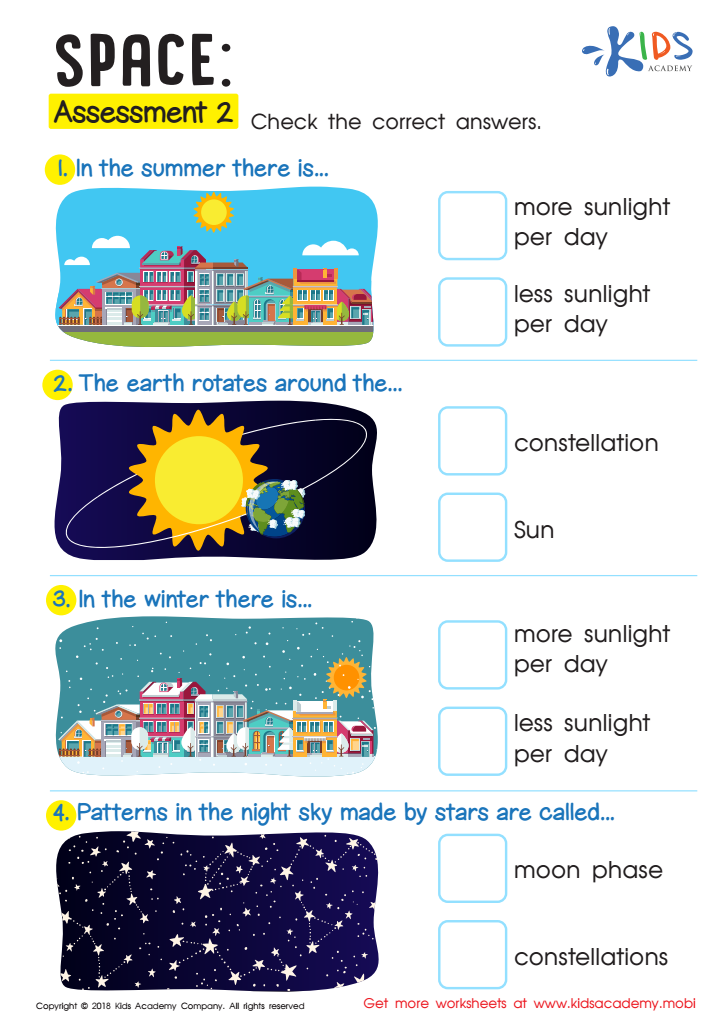
Space: Assessment 2 Worksheet
 Assign to My Students
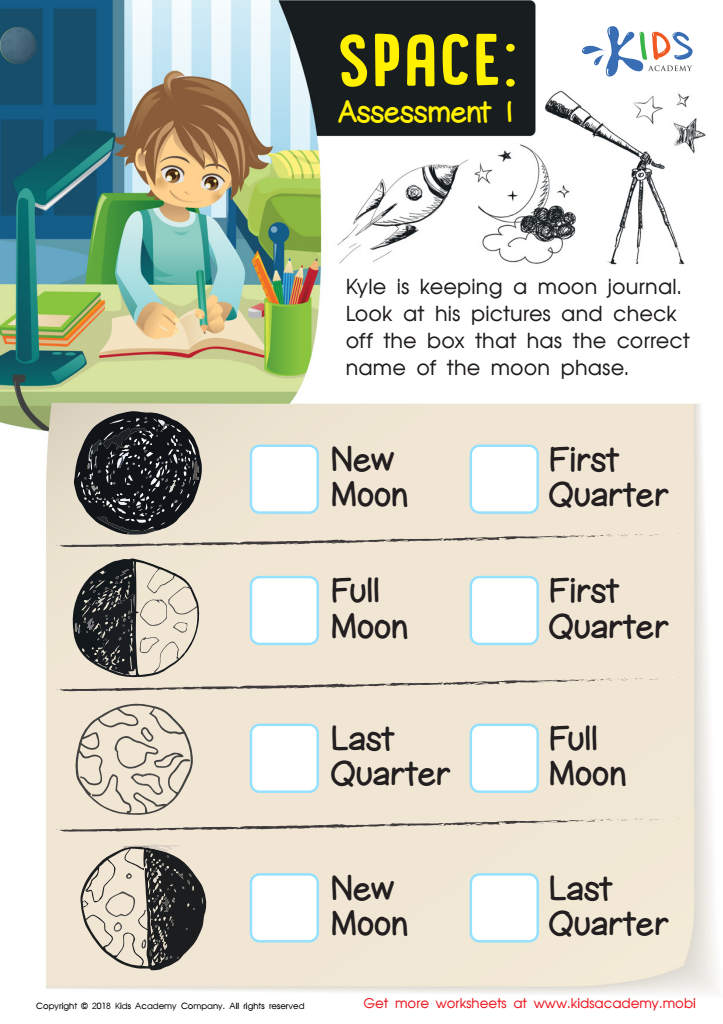
Space: Assessment 1 Worksheet




.jpg)


Space worksheets activities play a crucial role in educational environments, offering a unique blend of learning and engagement for students of all ages. The allure of space — with its mysterious planets, shining stars, and the boundless possibilities of extraterrestrial life — naturally captivates the curiosity of learners. By integrating space worksheets activities into the curriculum, educators can harness this fascination to cultivate a deeper understanding of astronomy, physics, and even history.
First and foremost, space worksheets activities provide a structured yet flexible approach to learning complex scientific concepts. These activities can break down intricate theories about the universe into digestible parts, making it easier for students to grasp the fundamentals of gravity, the solar system, and the life cycle of stars. This step-by-step learning process encourages students to build their knowledge base incrementally, fostering a sense of accomplishment as they connect the dots between different astronomical phenomena.
Moreover, space worksheets activities are incredibly versatile, catering to a wide range of learning styles. For visual learners, diagrams of planetary orbits or galaxies can illuminate the text's descriptions. Kinesthetic learners might benefit from interactive assignments, such as building scale models of the solar system. Meanwhile, analytical thinkers can dive into problem-solving exercises, calculating distances between planets or the speed of light. This adaptability ensures that every student can find an entry point to engage with the subject matter, regardless of their preferred learning method.
Another significant advantage of space worksheets activities is their ability to inspire creativity and imagination. As students explore the vastness of the universe on paper, they are encouraged to envision themselves as astronauts, astronomers, or even intergalactic travelers. This imaginative play can spark a lifelong interest in science, technology, engineering, and mathematics (STEM) fields, laying the groundwork for future academic and career pursuits.
In conclusion, space worksheets activities are a valuable educational tool, blending the intrigue of the cosmos with practical learning strategies. By making complex scientific principles accessible and engaging, these activities not only enhance students' knowledge and critical thinking skills but also ignite their curiosity about the universe and their place within it.








