
Normal Beginning Sounds worksheets activities for 3-Year-Olds
1 filtered results
Difficulty Level
Grade
Age
-
From - To
Subject
Activity
Standards
Introducing our engaging collection of Normal Beginning Sounds worksheets activities, meticulously designed to enrich early literacy development. Tailored for young learners, these activities focus on mastering the art of identifying and associating normal beginning sounds with corresponding letters. Ideal for preschoolers and kindergarteners, our worksheets are crafted to enhance phonemic awareness through a series of fun and interactive exercises. Watch your child's reading and writing skills flourish as they navigate through our thoughtfully constructed activities, laying a robust foundation in their phonics journey. Embrace the joy of learning with our Normal Beginning Sounds worksheets activities, your essential toolkit for early literacy success.
Favorites
With answer key
Interactive
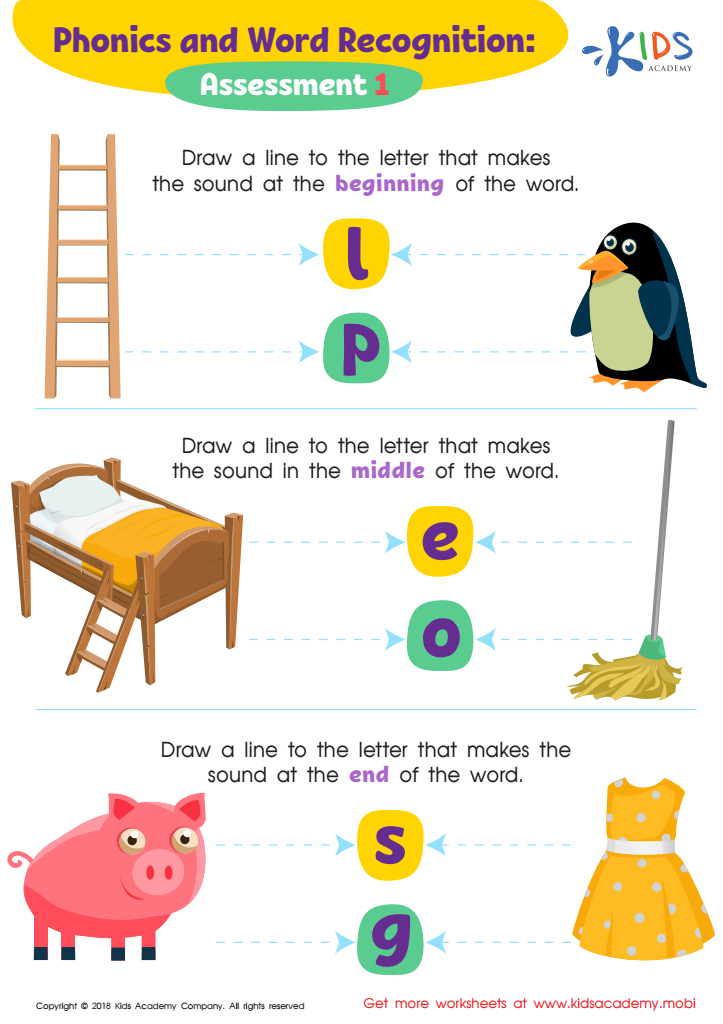
Phonics and Word Recognition: Assessment 1 ELA Worksheet
This fun worksheet tests your child's sound recognition skills for each part of a word. Ask your child to name each image and trace the line to match it with the corresponding letter. Listen for beginning sounds on 1st, middle sounds on 2nd, and ending sounds on 3rd. Encourage learning with this colorful and interactive activity!
 Assign to My Students
Phonics and Word Recognition: Assessment 1 ELA Worksheet
Worksheet
Learning Skills
Join Kids Academy for Free
Who is primarily going to use this learning content?








Normal Beginning Sounds worksheets activities are an indispensable tool in the foundational stages of reading and writing education for young learners. These activities are not just another task for children to complete; they are a carefully designed educational strategy aimed at enhancing phonemic awareness, a crucial component of literacy development. Understanding and recognizing the sounds that letters make is the very bedrock upon which the skills of reading and writing are built. Here’s why these normal beginning sounds worksheets activities are so beneficial.
Firstly, normal beginning sounds worksheets are structured in a way that gradually introduces children to the complex world of phonics in an engaging and manageable manner. By concentrating on the initial sounds of words, children gradually learn to associate letters with their corresponding sounds, an essential skill for decoding new words. This early exposure to phonemic awareness lays a solid foundation for more advanced reading skills, including fluency and comprehension.
Moreover, these activities are designed to cater to various learning styles. Whether a child is a visual, auditory, or kinesthetic learner, normal beginning sounds worksheets activities provide diverse approaches to learning sounds. For instance, a worksheet might include pictures to match with their beginning sounds for visual learners, while auditory learners might benefit from saying the sounds out loud as they work through the worksheet.
Another significant benefit of these worksheets is the confidence they instill in young learners. As children complete these activities, they experience a sense of achievement, which boosts their confidence and motivation. This positive reinforcement is vital in the early stages of learning, making children more inclined to participate and take on new challenges.
In conclusion, normal beginning sounds worksheets activities are a critical component of early literacy education. They offer a structured, diverse, and confidence-boosting approach to learning phonemic awareness, setting children on a path to reading and writing success. By investing time in these foundational activities, educators and parents are providing children with the tools they need to become proficient readers and writers.








