
Normal Beginning Sounds worksheets activities for 4-Year-Olds
1 filtered results
Difficulty Level
Grade
Age
-
From - To
Subject
Activity
Standards
Introducing our engaging collection of Normal Beginning Sounds worksheets activities, meticulously designed for young learners embarking on their reading journey. These activities are crafted to sharpen phonemic awareness by focusing on the initial sounds in words. With a vibrant array of exercises, children will delight in matching, identifying, and writing the first letter of common words. Tailored to captivate and educate, our Normal Beginning Sounds worksheets provide a solid foundation in phonics through interactive and enjoyable tasks. Perfect for classroom use or at-home learning, these activities promise to make the exploration of beginning sounds a truly enjoyable adventure for early readers.
Favorites
With answer key
Interactive
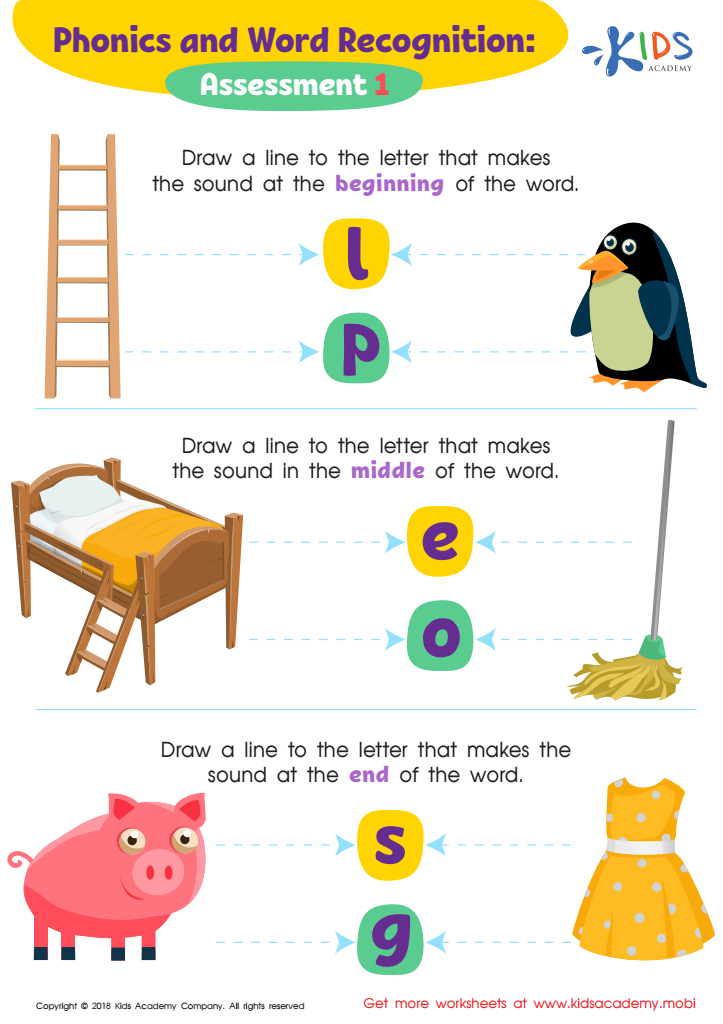
Phonics and Word Recognition: Assessment 1 ELA Worksheet
This fun worksheet tests your child's sound recognition skills for each part of a word. Ask your child to name each image and trace the line to match it with the corresponding letter. Listen for beginning sounds on 1st, middle sounds on 2nd, and ending sounds on 3rd. Encourage learning with this colorful and interactive activity!
 Assign to My Students
Phonics and Word Recognition: Assessment 1 ELA Worksheet
Worksheet
Learning Skills
Join Kids Academy for Free
Who is primarily going to use this learning content?








Normal Beginning Sounds worksheets activities are a vital component in the foundational phase of learning how to read and write. These activities are specifically designed to enhance young learners' phonemic awareness, which is crucial for the development of reading skills. The inclusion of Normal Beginning Sounds worksheets in early education helps children distinguish between different sounds at the beginning of words, setting a solid ground for phonics instruction and the ability to decode words.
The usefulness of Normal Beginning Sounds worksheets activities extends beyond mere recognition of sounds. They are instrumental in improving a child’s ability to listen attentively and differentiate between sounds, which are fundamental skills in the journey of becoming proficient readers and communicators. Through engaging and repetitive practice, children become familiar with the sounds that letters of the alphabet make at the beginning of words, which aids in memory retention and the development of a strong vocabulary.
Moreover, these worksheets provide a structured way for children to make connections between sounds and letters, an essential step in reading fluently. As children identify and match letters with their corresponding sounds, they begin to understand the building blocks of words, paving the way for spelling and writing skills. The simplicity and focus of Normal Beginning Sounds worksheets make them accessible to learners, ensuring that they are not overwhelmed but rather encouraged by their successes.
Additionally, Normal Beginning Sounds worksheets activities are versatile and can be tailored to meet the individual needs of each learner, accommodating different learning styles and paces. This personalized approach fosters a positive learning environment, where children can explore sounds and letters without the pressure of competition, promoting confidence and a love for learning.
In conclusion, Normal Beginning Sounds worksheets activities are an indispensable tool in early literacy education. They lay the groundwork for reading and writing by developing phonemic awareness, enhancing listening skills, and introducing the correlation between sounds and letters, thereby supporting children in their journey to become fluent readers and writers.








