Sorting Worksheets for Ages 3-5 - Page 2
25 filtered results
-
From - To
 Assign to My Students








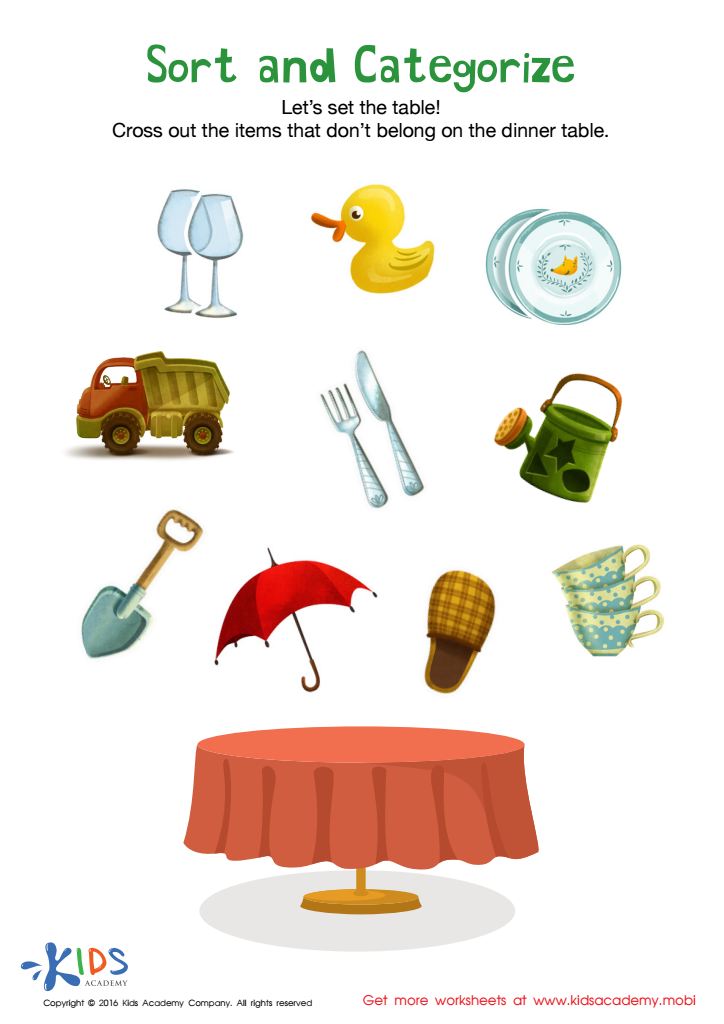
Worksheets on Sorting for Ages 3-5 are a fundamental tool in early childhood education, offering a plethora of benefits to young learners. At this critical stage of development, children are naturally curious and eager to understand the world around them. Sorting activities cater precisely to this innate inquisitiveness, encouraging kids to observe, compare, and classify objects based on their characteristics such as shape, size, color, or type.
Engaging in Sorting for Ages 3-5 through worksheets provides a structured yet fun way for children to develop their cognitive skills. These exercises enhance critical thinking and problem-solving abilities as kids decide on the criteria for grouping items. Moreover, sorting tasks are instrumental in refining fine motor skills. As children manipulate small items to sort them according to the worksheet instructions, they improve hand-eye coordination and dexterity, which are essential for writing and other academic activities.
Additionally, worksheets on sorting lay the groundwork for mathematical concepts. Understanding similarities, differences, and patterns prepares children for more complex operations such as counting, addition, and subtraction. In a nurturing and supportive environment, Sorting for Ages 3-5 worksheets also bolster language development, as children learn new vocabulary and articulate their thought process while sorting items.
In conclusion, Sorting for Ages 3-5 worksheets are invaluable resources that foster early learning in a multifaceted manner. Through engaging, age-appropriate sorting activities, young learners build foundational skills that are crucial for their future academic success and overall development.








