Easy Two-step Word Problems Worksheets for 3-Year-Olds
5 filtered results
Difficulty Level
Grade
Age
-
From - To
Subject
Activity
Standards
Introducing our Educational Downloadable Worksheets designed specifically for three-year-olds! Dive into the world of math with our Easy Two-step Word Problems worksheets, tailored to captivate young minds and foster early problem-solving skills. These engaging worksheets are perfect for little learners, featuring colorful illustrations and simple, age-appropriate challenges. Each sheet is crafted to build confidence and foundational mathematical understanding in a fun, interactive way. Ideal for both classroom and home use, these worksheets are a fantastic resource for initiating your child’s journey into numeracy. Get ready to make learning an exciting adventure for your preschooler!
Favorites
With answer key
Interactive
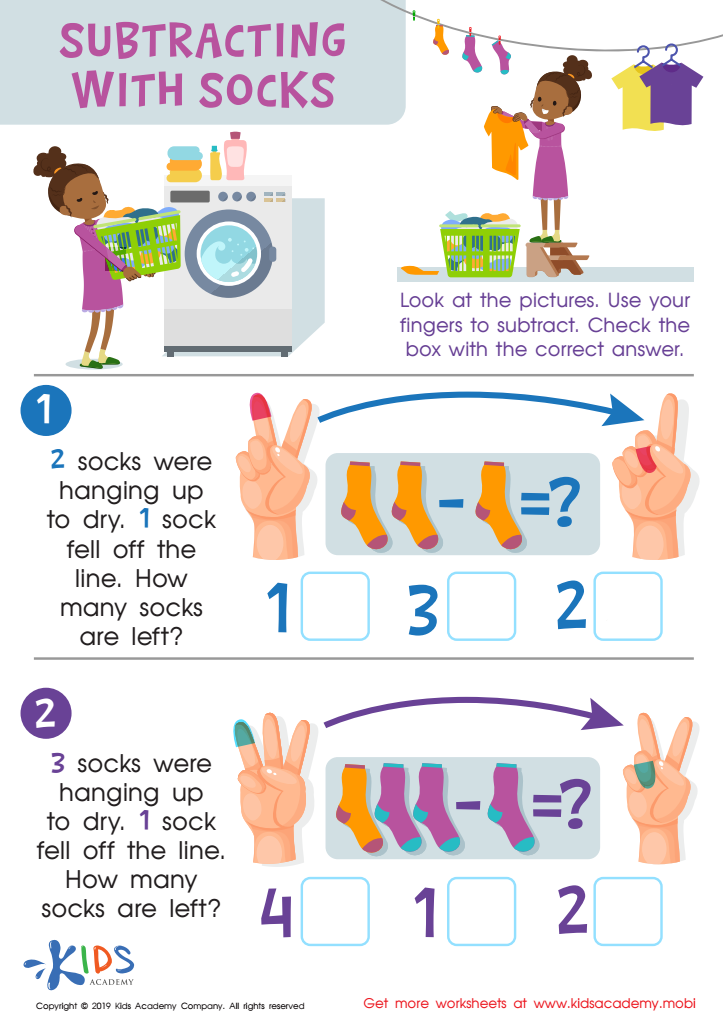
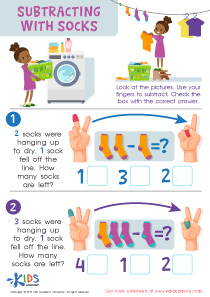
Subtracting Socks Worksheet
Before beginning this exercise with your children, warm them up with a counting game. If math is not their favorite subject, use this worksheet. Help them read the two word problems, then use their fingers to count and subtract. Ask them to select the correct answer and check the box.
 Assign to My Students
Subtracting Socks Worksheet
Worksheet
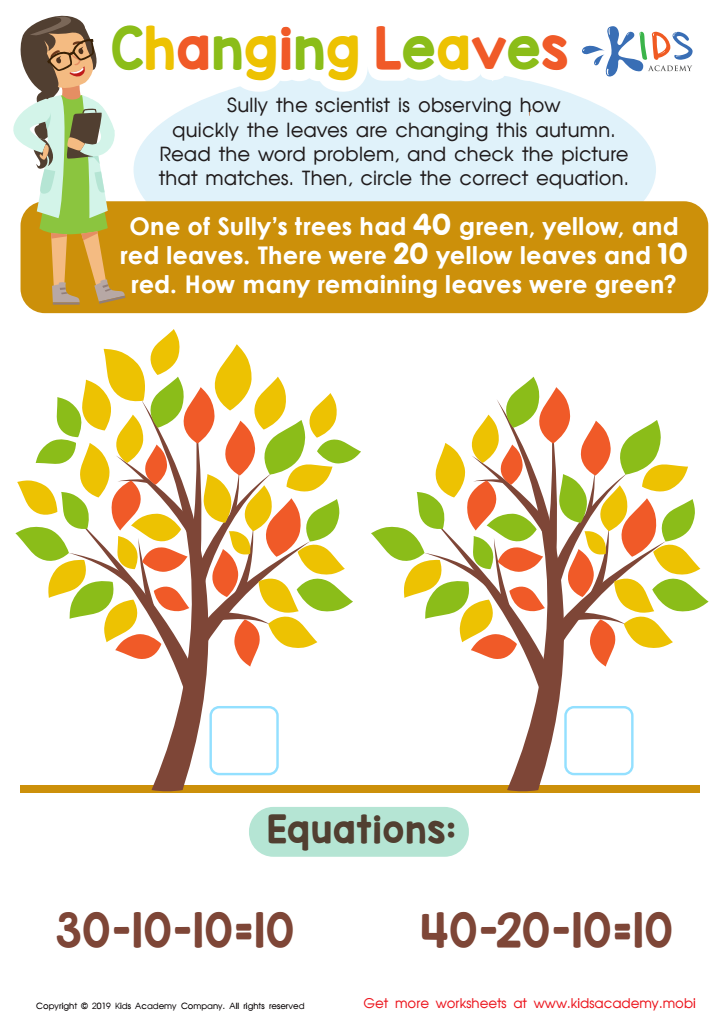
Changing Leaves Worksheet
Fall is the perfect time for kids to help Sully the scientist observe the changing leaves! Download the free worksheet with a subtraction word problem and bolded info to find the matching equation and picture. It's a fun way for your tots to learn while they admire the reddening, yellowing, and orange leaves.
Changing Leaves Worksheet
Worksheet
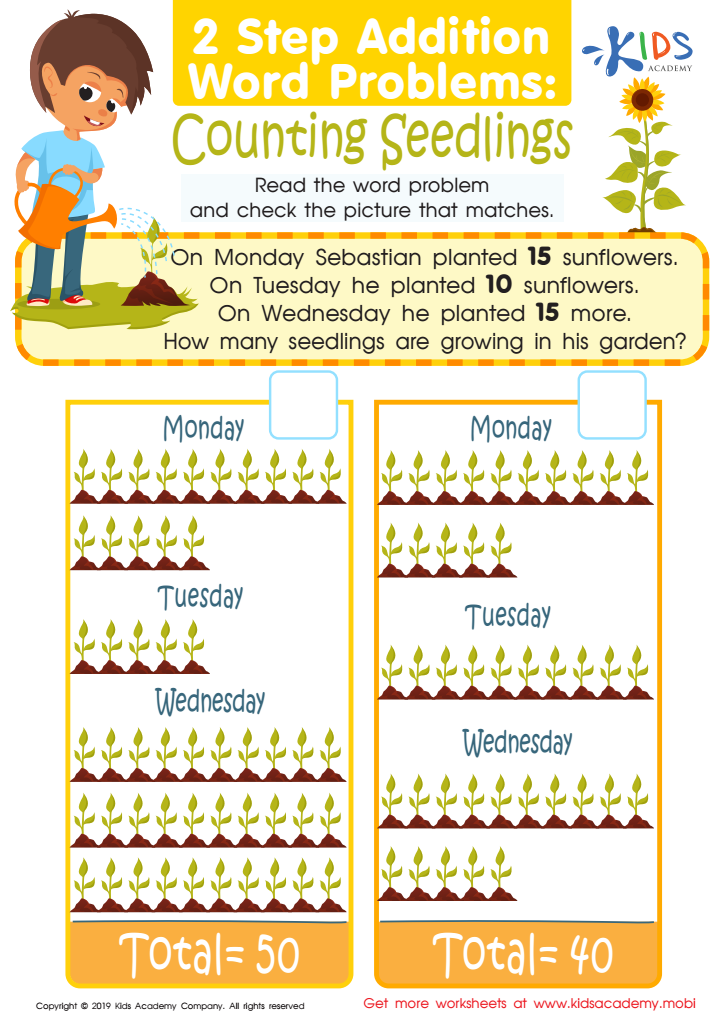
Counting Seedlings Worksheet
Understanding math word problems is key. Multiple steps can prove challenging - this free worksheet provides one-to-one picture representation to help kids solve multi-step addition word problems. Strengthen addition skills by choosing the matching picture to the answer.
Counting Seedlings Worksheet
Worksheet
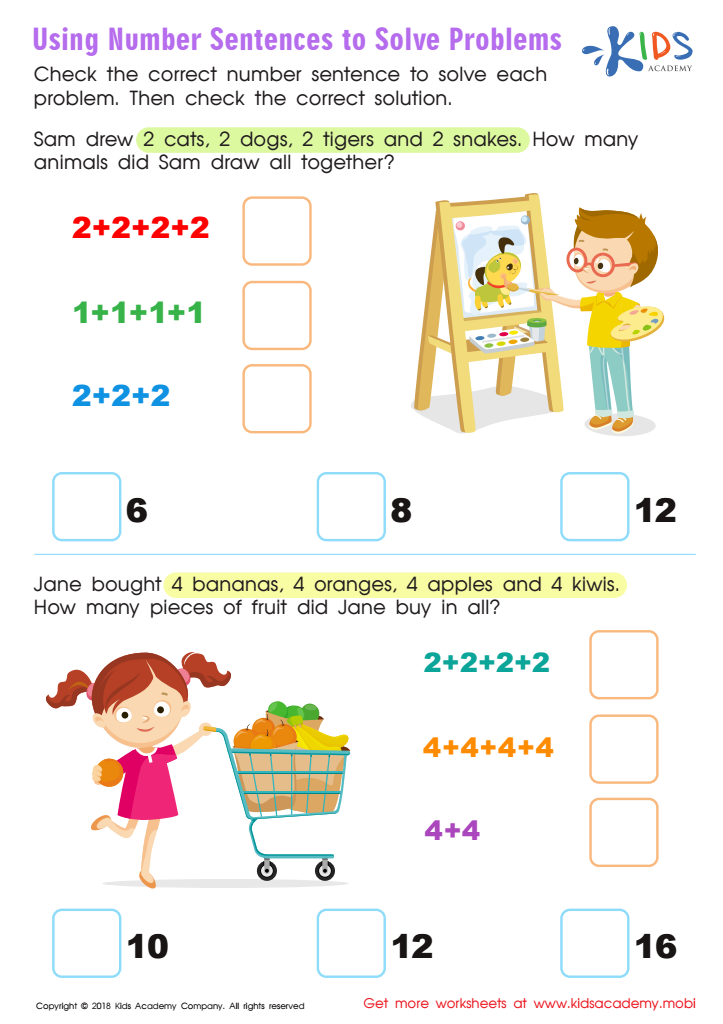
Using Number Sentences to Solve Problems Worksheet
Solving math problems requires an efficient strategy. Picture representation can help young mathematicians with basic addition problems, especially when it involves repeated addends. As they gain confidence, they'll be able to apply their number sentence solving abilities to more complex equations.
Using Number Sentences to Solve Problems Worksheet
Worksheet
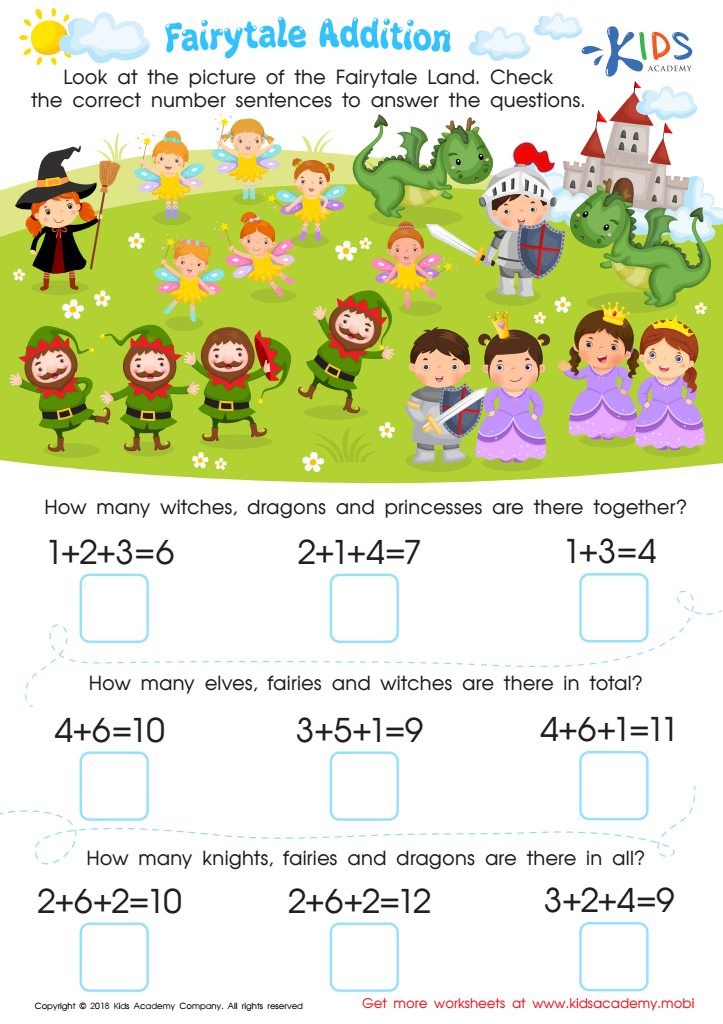
Fairytale Addition Worksheet
Take your kids to Fairytale Land! They'll meet witches, dragons, fairies, elves, knights, and princesses. This free worksheet adds up the fun, letting kids use three addends to solve addition equations and find the right answers. With friends like these, math won't even seem like math!
Fairytale Addition Worksheet
Worksheet
Join Kids Academy for Free
Who is primarily going to use this learning content?



The Value of Easy Worksheets on Two-Step Word Problems for Three-Year-Olds: An Insight into Educational Homework Sheets
In the formative years of childhood, particularly at three years old, the foundation of cognitive, problem-solving, and critical thinking skills is being laid down. It is a crucial time when children are highly receptive to learning through play and interactive activities. This is where educational homework sheets, especially those focusing on easy two-step word problems, become a vital educational tool.
Understanding the Basics of Two-Step Word Problems
Two-step word problems require a child to make use of multiple cognitive processes to arrive at a solution. For a three-year-old, these problems are simplified into manageable tasks that align with their developmental stage. For instance, an easy two-step problem might involve a scenario like, "There are two apples and you get three more. How many apples do you have now?" This encourages the child to engage in both counting and basic addition, fostering numerical and analytical skills.
Why Use Educational Homework Sheets for Two-Step Word Problems?
-
Structured Learning: Educational homework sheets provide a structured format that guides young learners through the problem-solving process. This structure helps children understand how to approach and solve problems in a step-by-step manner, which is essential in learning how to break down more complex tasks as they grow older.
-
Interactive Engagement: Typically, these worksheets are designed with colorful illustrations and engaging tasks that capture the interest of young minds. This visual and interactive approach helps sustain the attention of three-year-olds, making learning both fun and effective.
-
Development of Cognitive Skills: Engaging with two-step word problems enhances cognitive development in young children. These activities encourage logical thinking, memory retention, and the ability to follow multi-step directions. Each of these skills is crucial not only in academic settings but in everyday problem-solving scenarios.
-
Foundational Math Skills: Early exposure to basic math through two-step problems helps in laying a strong foundation for future mathematical learning. These worksheets help children recognize numbers, understand the concept of addition or subtraction, and begin to develop an intuitive sense of quantity and operations.
-
Language Development: Solving word problems also enhances language skills. Children learn to comprehend and process information given in sentence form, thereby improving their vocabulary and understanding of language constructs.
-
Parent-Child Interaction: Educational homework sheets designed for young children often encourage parent participation. This involvement allows parents to guide their children through the problem-solving process, fostering a supportive learning environment. It also provides an opportunity for parents to observe and understand their child's learning style and areas where they might need more support or encouragement.
-
Confidence Building: Successfully solving these problems can boost a child’s confidence and encourage a positive attitude towards learning and challenges. This is particularly important at an early age, as it sets the tone for their future educational experiences.
-
Preparation for School: By engaging with two-step word problems at home, children get a head start in terms of readiness for school. Educational homework sheets serve as a gentle introduction to the types of academic tasks they will encounter in preschool and beyond.
-
Customizable Learning: One significant advantage of using educational homework sheets is their adaptability. They can be tailored to the specific developmental level and interests of the child, making it easier to keep them engaged and focused on the task at hand.
-
Monitoring Progress: These worksheets not only assist in learning but also help parents and educators track a child’s progress. Observing how a child approaches and solves these problems can provide valuable insight into their developmental advancements and areas that might require additional focus.
Conclusion
In conclusion, easy worksheets on two-step word problems are more than just educational homework sheets; they are a comprehensive tool that aids in the holistic development of three-year-olds. They equip young learners with essential skills that are fundamental to their future academic and personal success. By integrating such interactive and educational resources at an early age, we pave the way for children to become confident, capable, and enthusiastic learners.