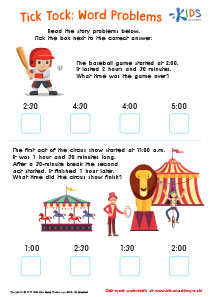
Extra Challenge Multiplication and Division Word Problems Worksheets for Ages 3-4
1 filtered results
-
From - To
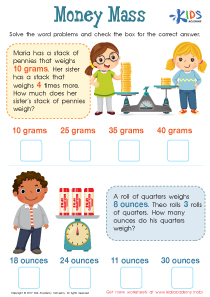
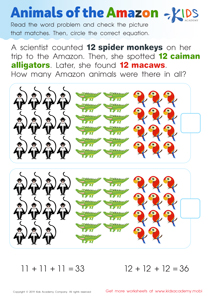
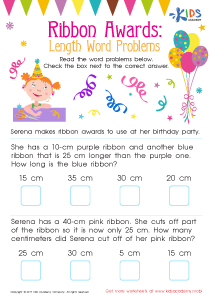
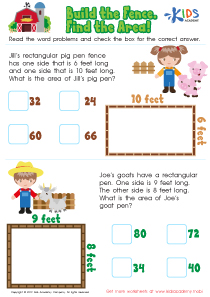
Introducing our Extra Challenge Multiplication and Division Word Problems worksheets—perfectly crafted for children aged 3-4 years. These educational worksheets are designed to inspire and engage young learners, helping them develop critical foundational math skills through fun and interactive challenges. Each sheet is filled with beautifully illustrated problems that capture children's imaginations while encouraging logical thinking and problem-solving abilities. Whether at home or in the classroom, our worksheets provide an exciting way for your little ones to explore complex concepts in an accessible format. Give your child a head start in math with our captivating educational tools!
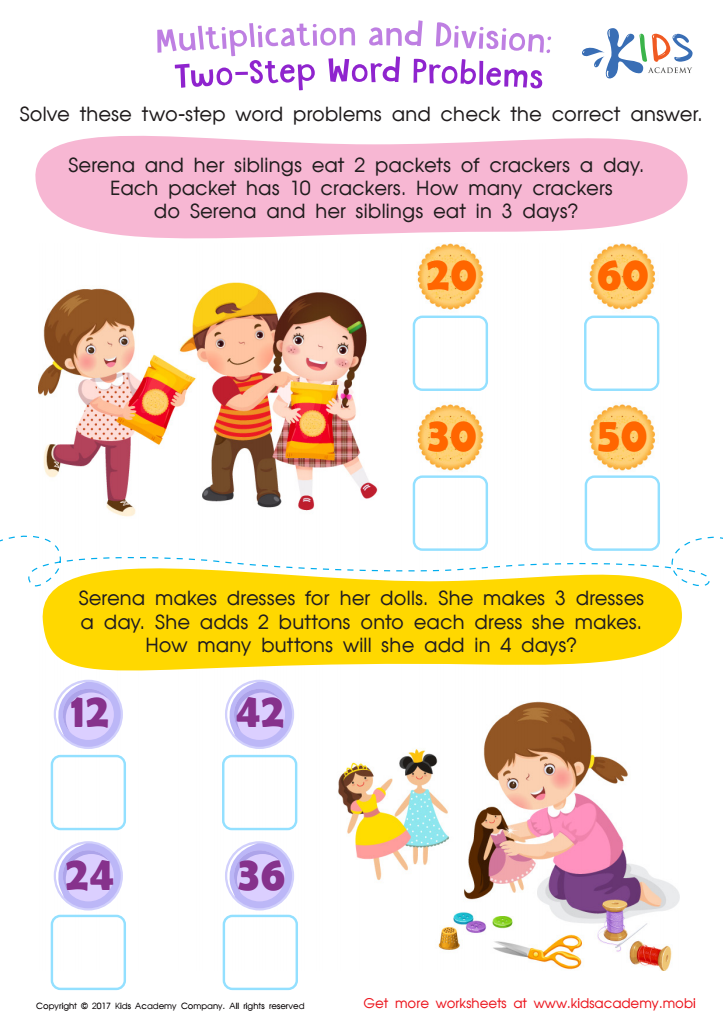
Two Step Word Problems Worksheet
 Assign to My Students








When it comes to early childhood education, finding the right resources to engage and challenge young minds is crucial. Extra Challenge worksheets on Multiplication and Division Word Problems can be exceptionally beneficial tools in fostering mathematical skills among children aged 3-4 years. These educational printables are designed not just to teach, but to inspire curiosity and a love for learning in young students.
First and foremost, these worksheets serve as an excellent introduction to basic mathematical concepts. At ages 3 to 4, children are just beginning to grasp number recognition and counting. While true multiplication and division might seem advanced for toddlers, introducing simple concepts related to these operations can help set a strong foundation for later learning. For instance, through fun and engaging scenarios, children can start to understand ideas like doubling (a precursor to multiplication) and halving (an introductory division concept).
The design of these worksheets often incorporates vivid, appealing graphics that are suitable for young children. These colorful and engaging images help hold a child's attention, making the learning process more enjoyable and effective. Themes and characters that children love can turn a challenging math problem into a playful activity that they look forward to.
Moreover, these educational printables enhance critical thinking and problem-solving skills. Word problems, even simplified for young learners, require children to comprehend the scenario and decide which mathematical operation to apply to find a solution. This process boosts cognitive development and encourages children to apply reasoning over rote memorization.
Another significant advantage of the Extra Challenge worksheets is their ability to cater to various learning styles. Whether a child is a visual, auditory, or kinesthetic learner, worksheets can be used alongside other educational tools and methods to provide a comprehensive learning experience. For instance, parents and educators can use physical objects to help children visualize a problem, thereby complementing the worksheet tasks.
Incorporating these worksheets into daily learning routines is also a way to promote educational consistency. Regular practice with these printables can help reinforce what children learn, ensuring that the new concepts are not only understood but retained. This consistent practice helps prevent learning loss, especially important in early childhood when developmental strides are critical.
Furthermore, by introducing challenging concepts in a gentle, age-appropriate way, Extra Challenge worksheets prepare children for formal schooling. Early exposure to structured learning can ease the transition into more formal education settings, making children more comfortable and confident as they progress in their educational journey.
Lastly, these educational printables are incredibly convenient for parents and educators. They are typically easy to access, download, and print, allowing for quick setup and implementation in any learning environment, whether in a classroom or at home. This accessibility means that learning can continue outside of school hours, helping children to engage with educational material in a variety of settings.
The flexibility of these worksheets also plays a vital role. They can be used as part of a structured lesson plan or for spur-of-the-moment educational opportunities. This adaptability makes them an invaluable resource for parents looking to infuse learning into everyday activities, as well as for teachers needing to differentiate instruction based on individual learner needs.
Additionally, these Educational printables promote parental involvement in early childhood education. By working through the worksheets together, parents can actively participate in their child's learning process, gaining insight into their strengths and areas for improvement. This involvement not only enhances the learning experience but also strengthens the parent-child bond.
Safety and suitability are also key features of these worksheets. Designed specifically for young children, they ensure that the content is age-appropriate, avoiding any concepts that are too complex that might lead to frustration. Instead, they focus on building confidence and enjoyment in learning, which are crucial in these formative years.
In conclusion, Extra Challenge worksheets on Multiplication and Division Word Problems are more than just educational printables; they are tools that spark curiosity, develop foundational skills, and prepare children for a lifelong educational journey. By integrating these worksheets into early learning curriculums, educators and parents can provide children with a fun, engaging, and solid start in their mathematical education, setting them up for success in the years to come.