Extra Challenge Length and Mass Word Problems Worksheets for Ages 4-5
1 filtered results
-
From - To
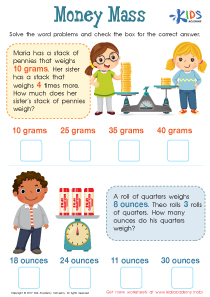
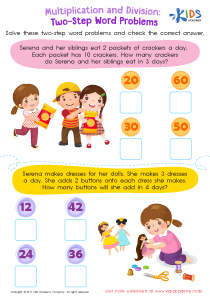
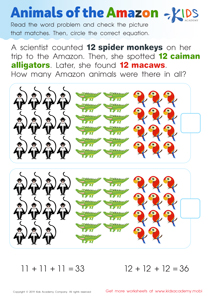
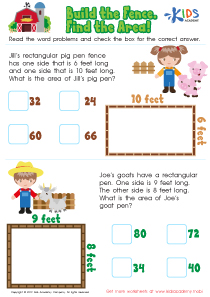
Introduce your young learners to the fascinating world of numbers and measurements with our Extra Challenge Length and Mass Word Problems worksheets! Designed specifically for children aged 4-5 years, these educational online printables offer engaging and age-appropriate challenges that help develop early mathematical skills. Each worksheet is crafted to spark curiosity and improve understanding of basic concepts in length and mass through fun, interactive problems. Perfect for home or classroom use, our printables ensure a solid foundation in early math, setting the stage for future academic success. Dive into learning today and watch your little ones enjoy mastering new skills!
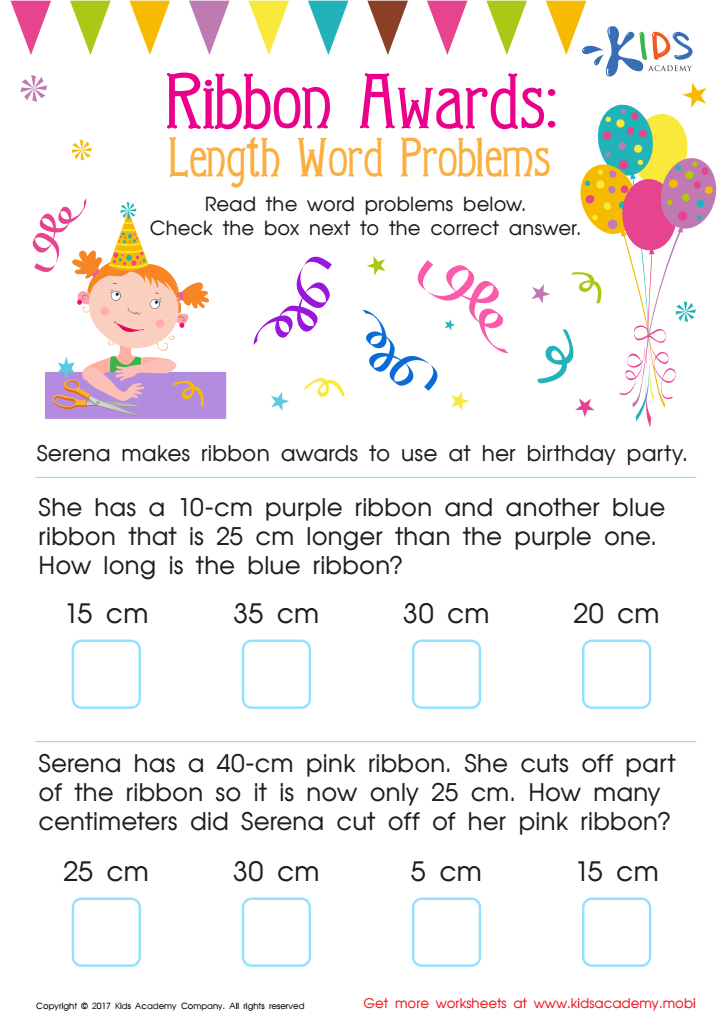
Length Word Problems Worksheet
 Assign to My Students


The Value of Educational Interactive Worksheets on Length and Mass Word Problems for Young Learners
In the foundational years of a child's education, particularly between the ages of 4 and 5, developing a strong grasp of basic concepts in mathematics is crucial. This is where educational interactive worksheets, especially those focused on length and mass word problems, come into play. These specialized worksheets are not only an effective tool in teaching young learners the essentials of measurement but also in fostering critical thinking skills from an early age.
Educational interactive worksheets are uniquely designed to blend learning with fun, making them an appealing activity for children. When it comes to topics like length and mass, young learners can sometimes find it challenging to grasp abstract concepts without visual aids and hands-on interaction. This is why worksheets tailored to these subjects are invaluable. They provide visual representations and scenarios that children can relate to, making the learning process more engaging and understandable.
Length and mass are fundamental aspects of early mathematics education. These concepts are everywhere in a child's world—from measuring their height, comparing the weights of different objects, to understanding which container holds more. By introducing these concepts through word problems, educational interactive worksheets help translate abstract ideas into real-world problems that children can understand and solve. This not only helps in learning numerical concepts but also enhances a child's ability to apply mathematical reasoning in daily life.
Moreover, educational interactive worksheets on length and mass word problems are designed to be age-appropriate. For children aged 4 to 5, these worksheets use simple, easy-to-follow problems that involve recognizable scenarios, such as comparing the heights of different animals or figuring out the weight of fruits in a basket. This relevance to everyday situations helps children connect with the material, thereby improving their retention and understanding.
Another significant benefit of using these worksheets is the development of problem-solving skills. As children work through various word problems, they learn how to analyze questions, identify necessary information, and use logic to find solutions. These skills are critical not only in mathematics but across all areas of learning and everyday life.
Interactive elements in these worksheets, such as cut-out rulers, balance scales, or drag-and-drop features in digital formats, further enhance the learning experience. These interactive tools make learning dynamic and keep children engaged. They also cater to various learning styles, whether a child is a visual, auditory, or kinesthetic learner, thereby providing personalized learning experiences that can cater to individual needs.
In addition, these educational interactive worksheets are often structured in a way that allows for progressive learning. This means that each worksheet can gradually increase in complexity, adapting to the child's growing understanding and confidence. Starting with simpler tasks, such as identifying which object is longer or heavier, and progressing to more complex problems requiring actual measurement and comparison, helps ensure that the learning process is neither too challenging nor too simplistic. This scaffolding approach is crucial in maintaining a child’s interest and fostering a positive attitude towards learning.
Parental and educator involvement is another important aspect facilitated by these worksheets. They are designed to be straightforward enough for parents to use alongside their children at home, providing an excellent opportunity for interactive family learning sessions. This involvement is beneficial as it allows parents to observe their child’s strengths and areas needing improvement, offering real-time feedback and encouragement that is essential during these developmental years.
Educational interactive worksheets on length and mass also prepare children for formal schooling. Familiarity with these concepts and the ability to tackle word problems can give children a significant advantage as they transition into more structured classroom environments. The problem-solving and critical thinking skills developed through these worksheets ensure that children are not only consumers of information but also active learners capable of questioning, exploring, and understanding the world around them.
Lastly, the use of these worksheets supports inclusivity in learning. They can be easily adapted to suit children with different learning needs and abilities, ensuring that every child has the chance to succeed and flourish regardless of their starting point. Teachers and educators can modify the difficulty level, use different tools or resources, and even integrate sensory elements to cater to diverse learning groups, making education accessible and enjoyable for everyone.
In conclusion, educational interactive worksheets on length and mass word problems are more than just simple paper-based activities; they are a comprehensive educational tool that engages young minds in a meaningful way. By integrating these worksheets early in a child's educational journey, we are not only teaching them about numbers and measurements but also instilling a lifelong love for learning and an inquisitive mindset that will benefit them in all areas of life.