Normal Money Word Problems Worksheets for Ages 8-9
1 filtered results
Difficulty Level
Grade
Age
-
From - To
Subject
Activity
Standards
Introducing our engaging range of Educational Online Printables, specifically designed for children aged 8-9 years! Our Normal Money Word Problems worksheets are crafted to enhance young learners' understanding of everyday financial transactions and basic arithmetic operations involving money. These printables make learning fun and relevant by incorporating a variety of real-world scenarios that children can relate to. Each worksheet is meticulously structured to build confidence and improve problem-solving skills, ensuring a solid foundation in financial literacy. Perfect for home practice or classroom use, these worksheets will help children navigate through the basics of money management with ease and interest.
Favorites
With answer key
Interactive
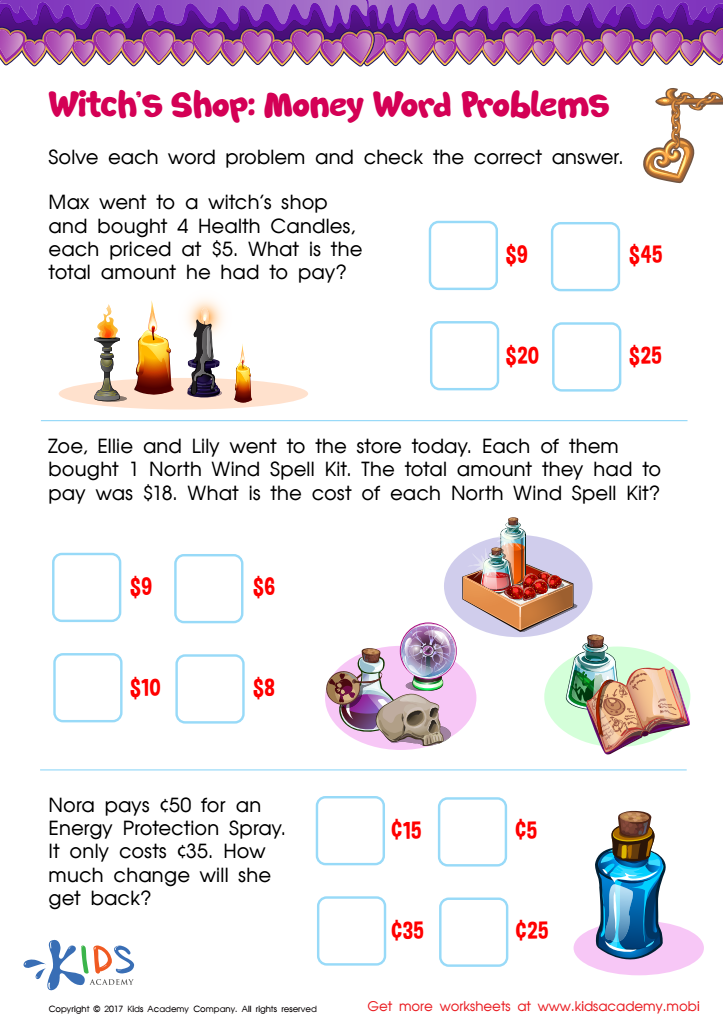
Money Word Problems Printable
Boost your 3rd grader's math skills with money word problems. This worksheet takes them to a witch's shop for a fun way to practice multiplication and division.
 Assign to My Students
Money Word Problems Printable
Worksheet
Learning Skills
Join Kids Academy for Free
Who is primarily going to use this learning content?








The Value of Educational Interactive Worksheets on Money Word Problems for Children Aged 8-9
Educational interactive worksheets, especially those focused on money word problems, serve as an invaluable tool for children aged 8-9 years. These worksheets are meticulously designed to strike a balance between learning and engagement, offering young learners a dynamic way to grasp essential mathematical concepts and real-world applications. Let’s explore why these worksheets are particularly advantageous for children in this age group.
1. Building Fundamental Math Skills
At the ages of 8 and 9, children are developing crucial math skills that will support their academic and everyday activities. Money word problems help reinforce basic arithmetic operations such as addition, subtraction, multiplication, and division. Educational interactive worksheets provide structured practice in applying these operations in practical scenarios involving money, thereby deepening their understanding and proficiency.
2. Enhancing Problem-Solving Abilities
Problem-solving is a critical skill that goes beyond mathematics. Through money word problems, children learn to analyze situations, identify relevant information, and determine the correct steps to arrive at a solution. Educational interactive worksheets designed for this age group often include scenarios that children might encounter in real life, such as making change, budgeting a small allowance, or comparing prices. These activities encourage logical thinking and decision-making skills.
3. Introducing Financial Literacy Early
Understanding money management from a young age is essential for lifelong financial literacy. Interactive worksheets on money word problems introduce basic concepts of earning, spending, saving, and investing in a manner that is understandable for children. By engaging with these concepts early, children not only learn about numbers and calculations but also the value of money and the importance of financial planning.
4. Catering to Diverse Learning Styles
Children have varied learning styles—some are visual learners, while others prefer hands-on activities. Educational interactive worksheets often combine text, images, and interactive elements like drag-and-drop or fill-in-the-blanks, catering to different preferences and keeping children engaged. This variety ensures that learning remains fun and accessible for every student, increasing the likelihood of absorbing and retaining the information presented.
5. Utilizing Technology for Enhanced Learning
Today’s children are growing up in a digital world. Educational interactive worksheets can be accessed on various devices, including tablets and computers, making them a perfect fit for both classroom and home learning environments. This digital aspect helps to prepare children for the future, where technology and digital literacy will play even more significant roles. Moreover, interactive features such as instant feedback and interactive problem-solving, make learning immediate and impactful. Children can see the consequences of their decisions in real-time, which reinforces learning through trial and error without the fear of judgment.
6. Encouraging Independent Learning
Educational interactive worksheets are designed to be intuitive enough for children to use without constant adult supervision. This autonomy boosts their confidence and instills a sense of responsibility. As they navigate through different money word problems, children learn to trust their own reasoning and develop a proactive approach towards learning. This independence is crucial as it fosters lifelong learning habits.
7. Supporting Curriculum Standards
Educational interactive worksheets on money word problems are often aligned with educational standards that govern primary education. This alignment ensures that the worksheets not only add value through supplementary learning but also support the core curriculum goals. Teachers and parents can use these resources knowing they are reinforcing the same concepts taught in schools, which is essential for consistent educational development.
8. Providing a Platform for Feedback and Improvement
One of the significant advantages of educational interactive worksheets is the ability to track a child’s progress over time. Many digital platforms include analytical tools that allow parents and educators to see a child’s strengths and areas that need improvement. This tracking makes it possible to tailor educational interventions more accurately and provide targeted support to ensure that every child can succeed.
In conclusion, educational interactive worksheets on money word problems are more than just an academic exercise; they are a comprehensive educational tool that equips children aged 8-9 with the numerical skills, problem-solving abilities, and financial literacy necessary for their future. By integrating these interactive elements into their learning process, children are not only engaged and motivated but also better prepared to handle the practical challenges of everyday life. This makes educational interactive worksheets an indispensable part of modern education.