Shape comparison Preschool Worksheets
3 filtered results
Difficulty Level
Grade
Age
-
From - To
Subject
Activity
Standards
Introduce your preschoolers to the exciting world of geometry with our Shape Comparison Preschool Worksheets. Specially designed for young learners, these engaging printables help kids identify and compare basic shapes like circles, squares, triangles, and rectangles. Through fun activities and colorful images, children enhance their cognitive skills and improve visual perception while mastering shape recognition. Our worksheets cater to different learning styles, making geometry enjoyable and accessible for all preschoolers. Visit our web page to download these educational resources and watch your little ones gain confidence in their early math skills!
Favorites
With answer key
Interactive
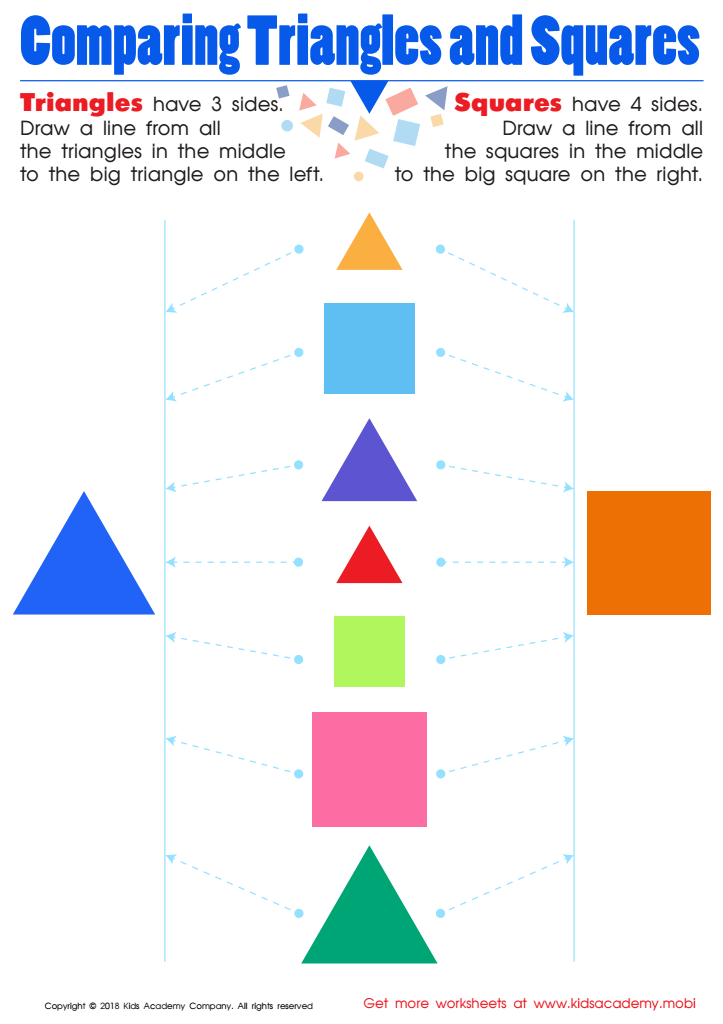
Comparing Triangles Squares Worksheet
Squares and triangles are different in the number of sides they have. Challenge kids to compare them with this fun worksheet! Read the descriptions at the top, then use the left and right shapes to match up the middle ones. Go down the page, joining the middle shapes to the side using the dotted lines!
 Assign to My Students
Comparing Triangles Squares Worksheet
Worksheet
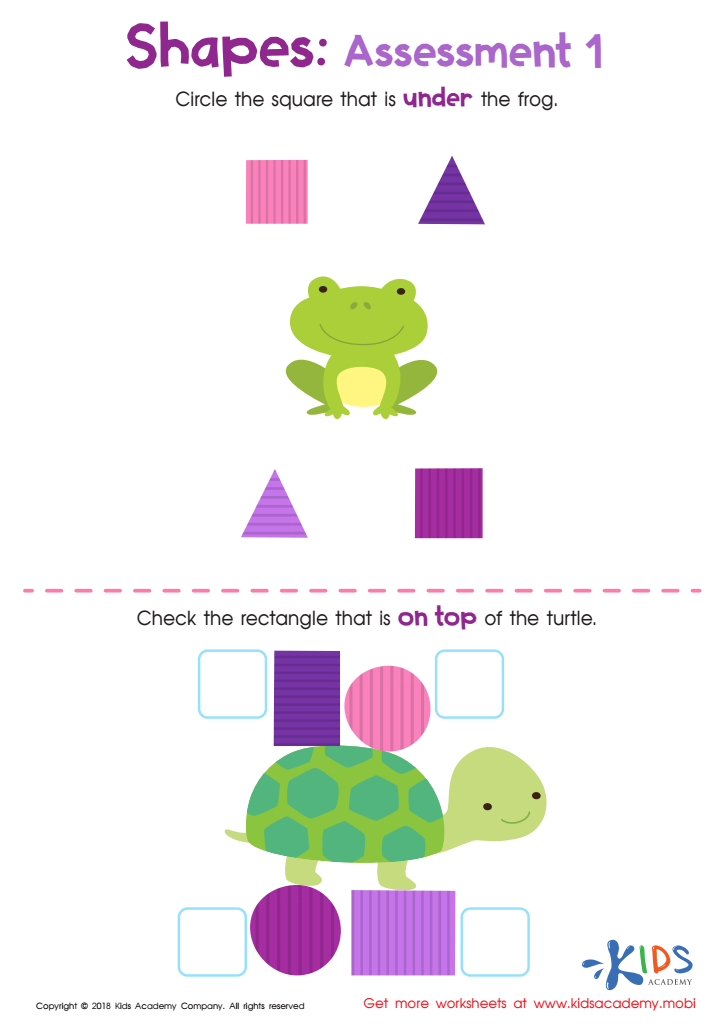
Geometry – Assessment 1 Worksheet
This activity helps preschoolers find shapes "on top of" and "under" animals. They must identify the correct shapes assigned to them. It's a great way to learn geometry and placements of objects.
Geometry – Assessment 1 Worksheet
Worksheet
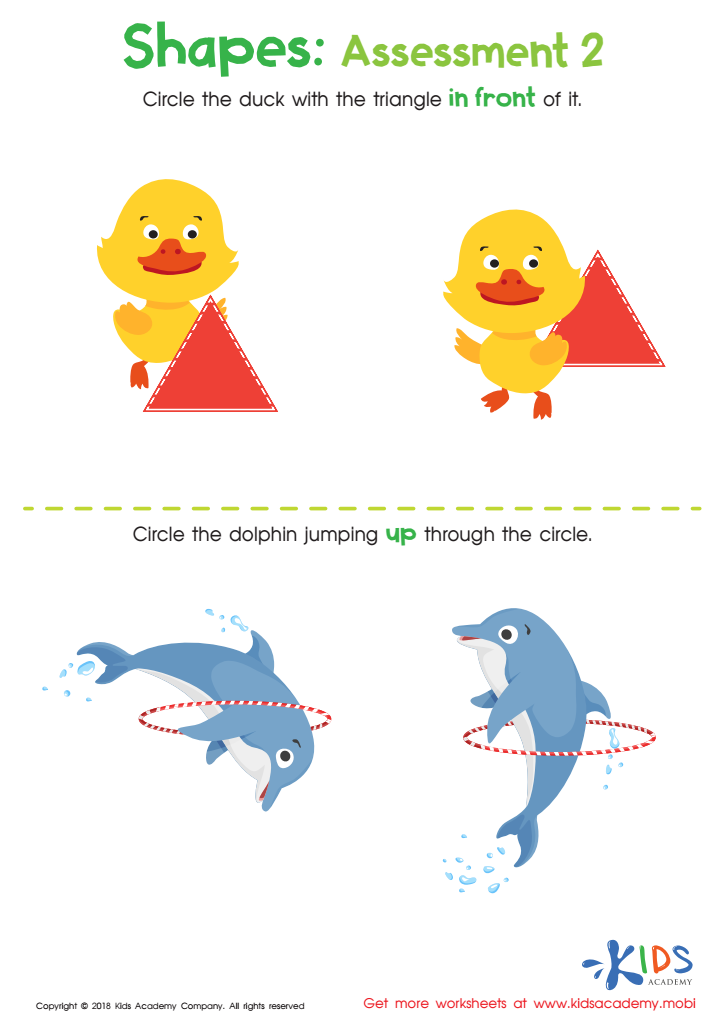
Geometry – Assessment 2 Worksheet
Preschoolers will learn to identify circles and triangles and practice using terms like "in front of" to place objects. This skill is key to further learning and is an important part of development.
Geometry – Assessment 2 Worksheet
Worksheet
Join Kids Academy for Free
Who is primarily going to use this learning content?






Shape comparison in preschool is crucial because it lays the foundational skills for a child's mathematical development and spatial reasoning, which are essential in many daily activities and future learning experiences. When young children explore and compare shapes, they enhance their ability to observe similarities and differences, a key skill in problem-solving and critical thinking.
Parents and teachers should care about incorporating shape comparison into preschool activities because it supports the development of fine motor skills as children manipulate different shapes. It also enriches their vocabulary as they learn terms like "circle," "square," "bigger," and "smaller," strengthening their language and communication skills.
Beyond academics, shape comparison tasks encourage social interaction. As children work together on puzzles or group activities, they practice teamwork, patience, and sharing—important social skills that contribute to their holistic development.
Lastly, early competence in shape recognition and comparison is predictive of later success in subjects such as geometry and science. By focusing on these skills during preschool, parents and teachers provide a supportive environment that sparks curiosity, confidence, and a lifelong interest in learning, equipping children with tools they will use throughout their educational journey and beyond.