Comparing objects Grade 2 Worksheets
3 filtered results
-
From - To
Unlock the joy of learning with our Comparing Objects Grade 2 Worksheets, designed to enhance your child’s critical thinking and observation skills. Perfectly tailored for second graders, these engaging activities involve comparing the size, shape, weight, and volume of everyday objects. Each worksheet offers fun challenges that help students develop important evaluation skills in a playful manner. Our vibrant, kid-friendly designs foster a love for learning while supporting common core standards. Watch as your child grows more confident in identifying similarities and differences between objects. Give your child the tools they need to succeed with our expertly crafted worksheets!
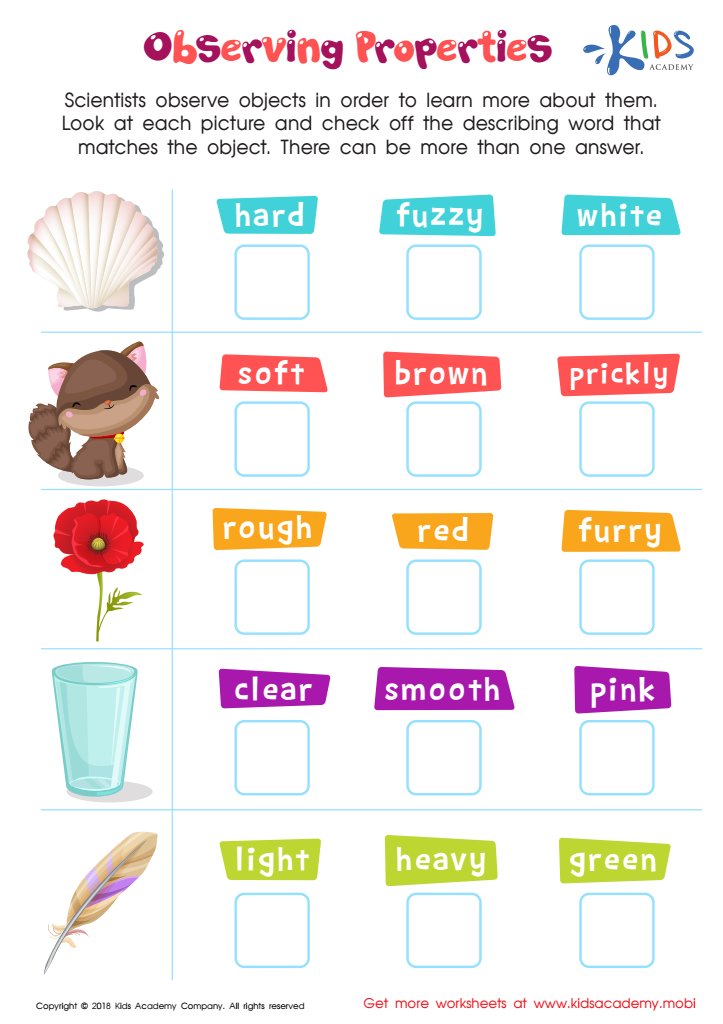
Observing Properties Worksheet
 Assign to My Students








Comparing objects in Grade 2 is fundamental for developing critical thinking and math skills in young students. At this stage, children begin to grasp concepts like size, weight, length, and capacity, which are essential for their cognitive development. When parents and teachers focus on these comparisons, they are helping students build the foundational skills needed for more complex mathematical concepts later on.
Engaging with activities that involve comparing objects introduces children to basic measurement and data collection. For instance, when students compare the lengths of pencils or the weights of different fruits, they learn to observe, categorize, and make judgments based on evidence. These skills are not only applicable in math but also in everyday life situations and scientific reasoning.
Moreover, comparing objects encourages the use of precise language. Terms like “longer,” “shorter,” “heavier,” and “lighter” become part of their vocabulary, enhancing their communication skills. It also promotes a hands-on, exploratory learning approach, which can make learning more engaging and enjoyable.
Developing the ability to compare objects helps students cultivate problem-solving skills and lays the groundwork for understanding units of measurement, data interpretation, and even early geometry concepts. Therefore, supporting these comparisons ensures a well-rounded, practical, and engaging educational experience for Grade 2 students.