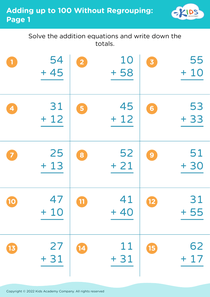
Recognize patterns Grade 2 Adding up to 100 with Regrouping Worksheets
3 filtered results
-
From - To
Explore our comprehensive "Recognize Patterns Grade 2 Adding up to 100 with Regrouping Worksheets" designed for young learners. These engaging worksheets enhance students' skills in recognizing numerical patterns while mastering addition with regrouping up to 100. Our activities incorporate bright visuals and clear instructions to make learning fun and effective. Essential for building foundational math skills, these worksheets help children understand how to break down complex problems and identify repeating patterns, paving the way for more advanced mathematical concepts. Ideal for classroom use or at-home practice, our resources support second grade math proficiency and confidence.
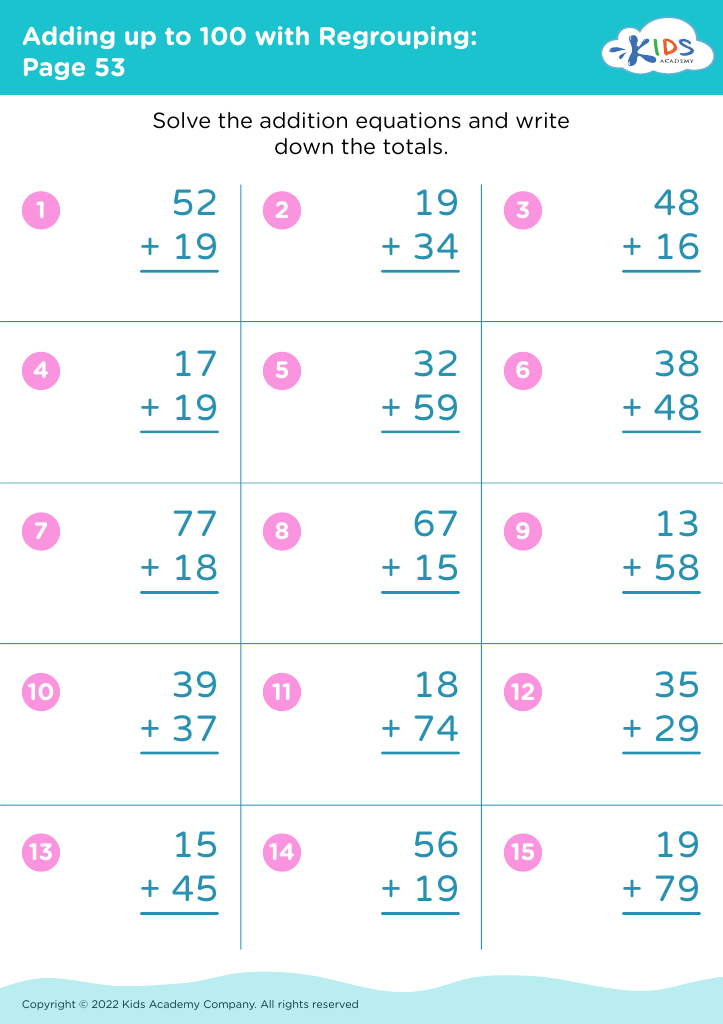
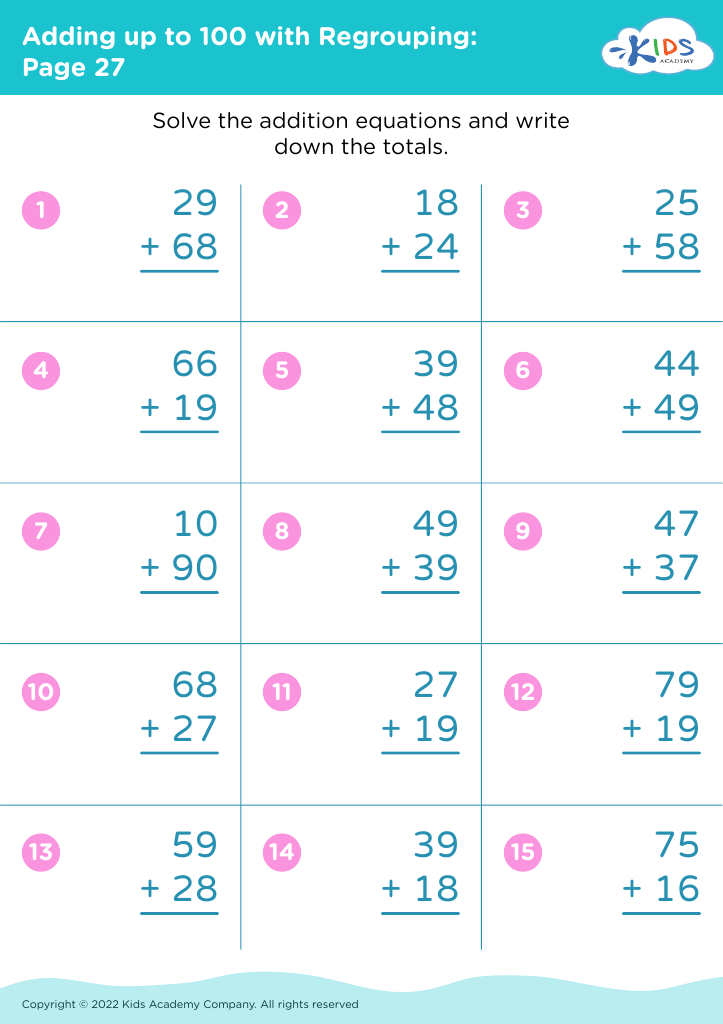
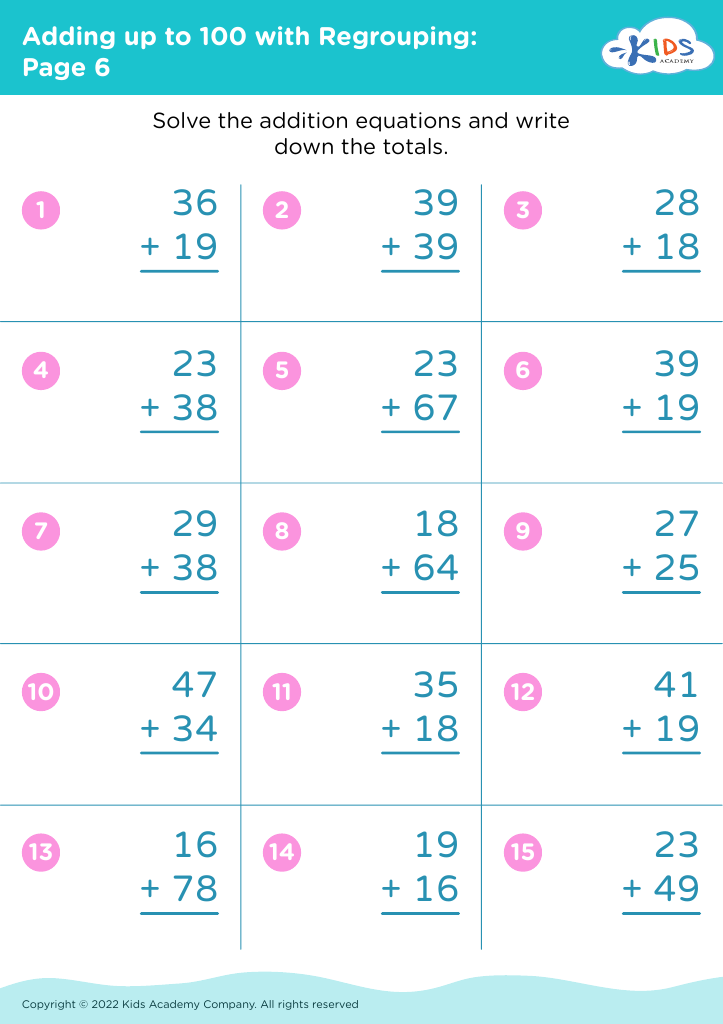




Recognizing patterns and grasping the concept of adding up to 100 with regrouping is a foundational skill crucial for Grade 2 students. Parents and teachers should prioritize this for several reasons. Firstly, it enhances students' number sense and understanding of place value, which are essential for more advanced math. Understanding patterns in numbers helps children make connections and paves the way for mental math, making arithmetic more intuitive.
Secondly, regrouping, often called carrying in addition, is a critical technique that aids in solving more complex problems accurately and efficiently. It teaches children to approach problems systematically, breaking down complex tasks into simpler, more manageable steps. This skill not only builds their confidence in mathematics but also ensures a strong grasp of fundamental mathematical principles.
Furthermore, proficiency in these areas supports academic success across various subjects. Math skills are increasingly integrated into subjects like science and even physical education, thus ensuring children have the competency to achieve multi-disciplinary success.
Finally, nurturing these skills at a young age encourages a positive attitude toward math, crucial for lifelong learning. It instills resilience and problem-solving abilities, equipping children to tackle real-world scenarios with logical thinking and perseverance. Therefore, a strong emphasis on patterns and regrouping by parents and teachers sets children on a path to academic and personal success.