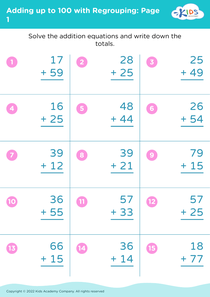
Understanding patterns Grade 2 Adding up to 100 Without Regrouping Worksheets
3 filtered results
-
From - To
Explore our engaging "Understanding Patterns Grade 2 Adding up to 100 Without Regrouping Worksheets" designed to strengthen young learners' math skills! These worksheets help students recognize and apply patterns in addition, fostering a deeper comprehension of number relationships. Through fun-filled exercises, second graders will practice adding numbers without regrouping, enhancing their confidence and fluency in math. Our hands-on approach makes learning exciting, supporting students in dominating essential concepts without feeling overwhelmed. Ideal for classroom activities or at-home practice, these worksheets cultivate a foundation for future mathematical success. Start your child's journey to mastering addition today with our expertly designed resources!
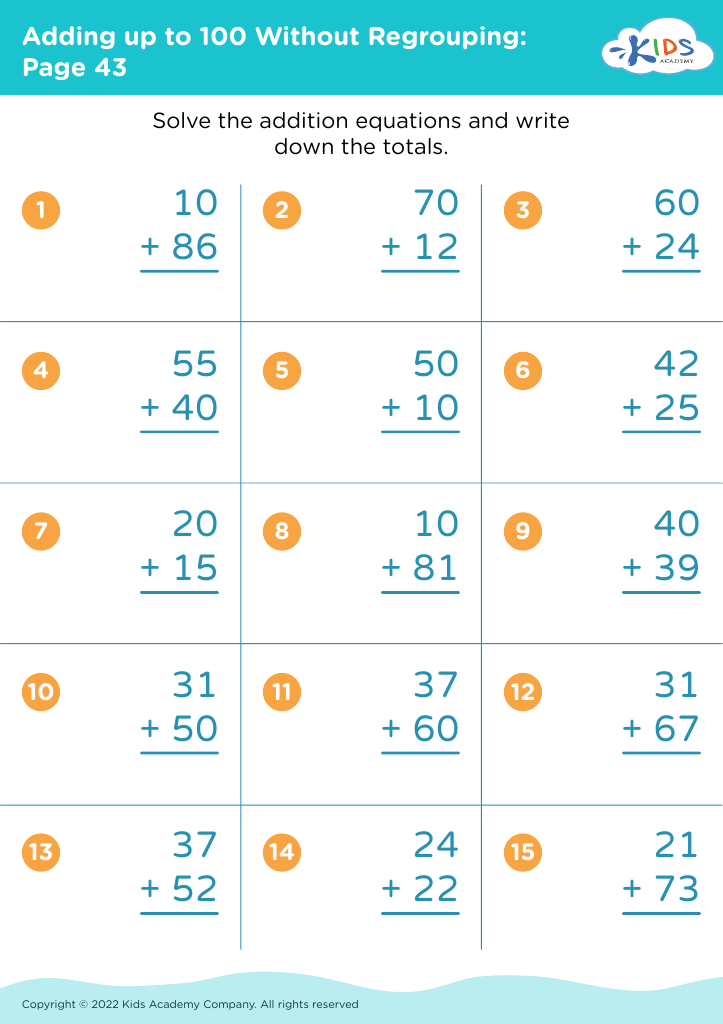
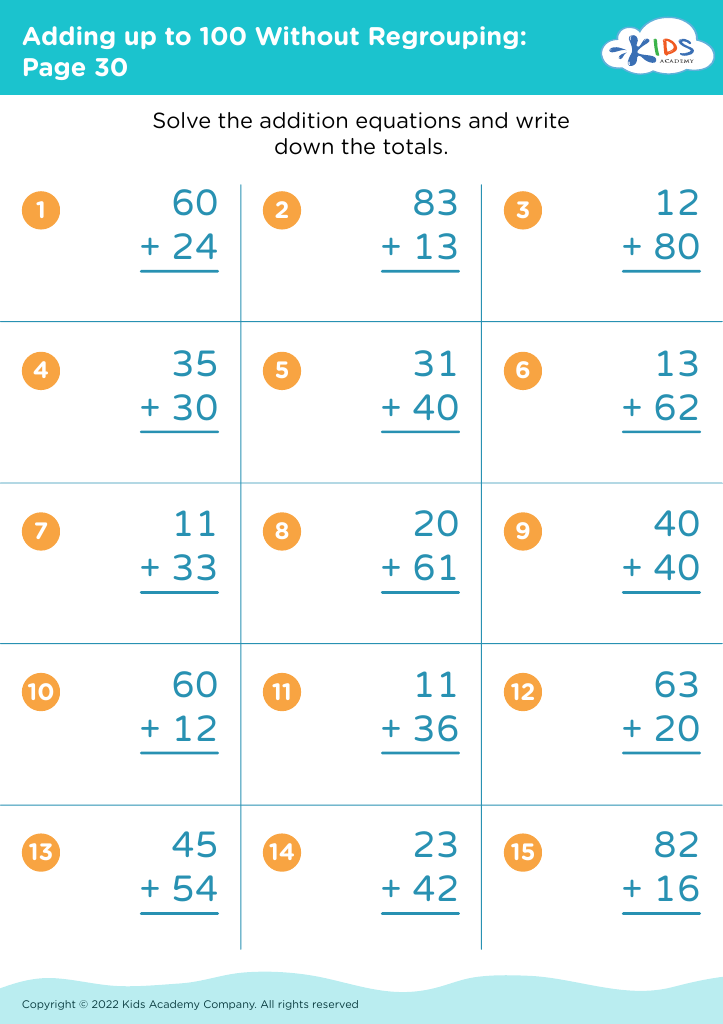
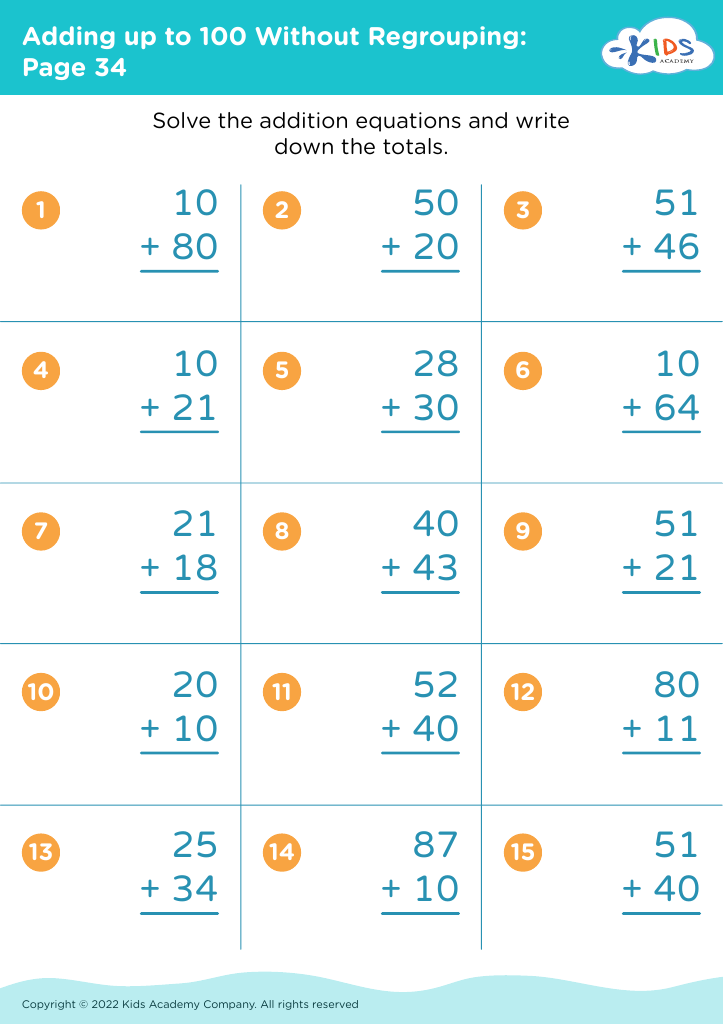




Understanding patterns in math, especially concepts like adding up to 100 without regrouping, is crucial for Grade 2 students for several reasons. First, patterns help young learners recognize relationships between numbers, making it easier to perform calculations and solve problems. This foundational skill restores confidence as students discover that numbers are connected, reducing math anxiety and fostering a positive attitude towards the subject.
Moreover, mastering the ability to add to 100 without regrouping equips children with essential arithmetic skills they will use throughout their education and daily lives. It enhances their number sense, which is the intuitive understanding of numbers and their relationships. This proficiency is a building block for more complex mathematical concepts, including addition with regrouping, subtraction, and later, multiplication and division.
Additionally, involving parents and teachers in the learning process encourages a cooperative approach to education. When adults appreciate the significance of these skills, they can provide meaningful reinforcement at home and in the classroom. Together, they can create engaging activities that promote understanding of numeric patterns and support children's mathematical growth. Ultimately, fostering these skills forms a solid foundation for future mathematical learning and increases students’ overall academic success.