Visual discrimination Grade 2 Geometry Worksheets
3 filtered results
Difficulty Level
Grade
Age
-
From - To
Subject
Activity
Standards
Enhance your Grade 2 students' geometry skills with our engaging Visual Discrimination Worksheets! Designed specifically for second graders, these worksheets help children identify shapes, colors, and patterns while strengthening their visual processing abilities. Each printable offers a fun and interactive approach to learning, making geometry exciting and accessible. Through various activities, students will practice distinguishing between different geometric figures, enhancing their critical thinking and observational skills. Perfect for classroom use or homework assignments, these worksheets provide the foundational knowledge necessary for future math success. Explore our collection now and watch your students gain confidence in geometry while enjoying their learning journey!
Favorites
With answer key
Interactive
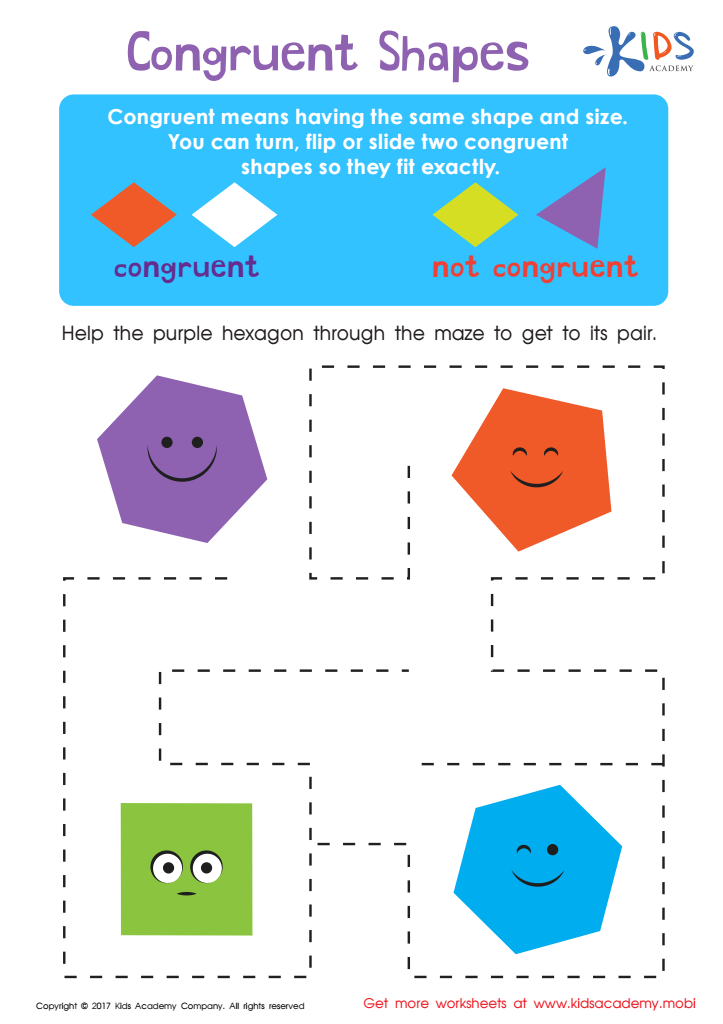
Congruent Shapes Worksheet
Help your child find the twin of the purple hexagon! This congruent shapes worksheet is great for increasing vocabulary while challenging mental rotation skills.
 Assign to My Students
Congruent Shapes Worksheet
Worksheet
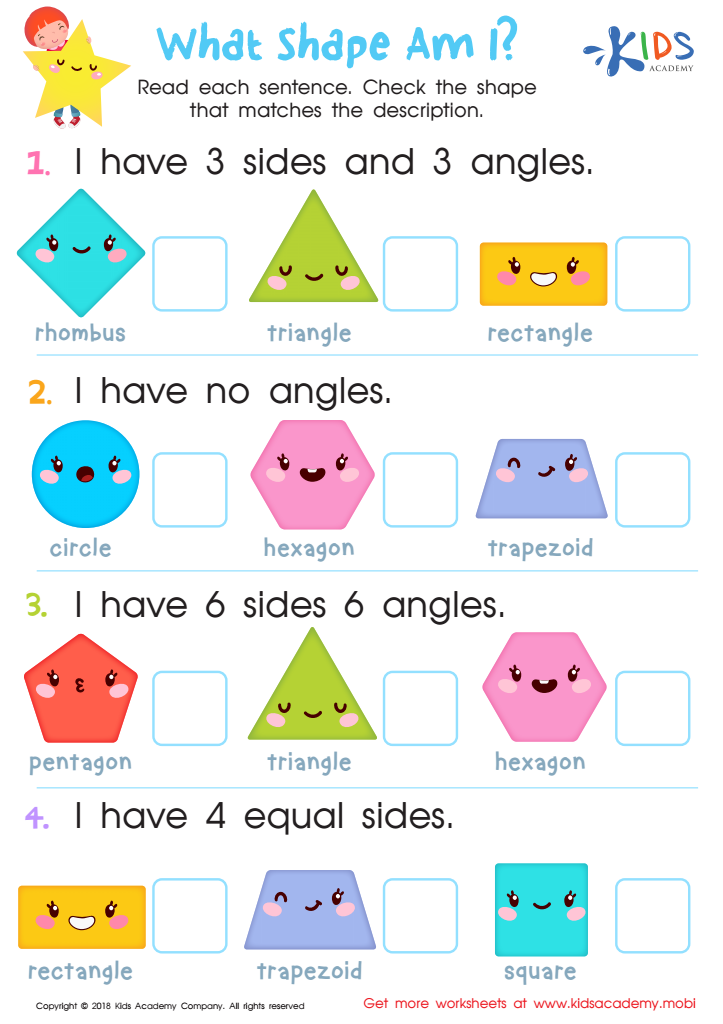
What Shape Am I? Worksheet
Help your child read each sentence in this colorful worksheet. Have them identify the shapes described and check the boxes. To prepare, ask simple questions like "How many sides does a triangle have?" and "Which shape has 4 equal sides?" Your child will become more skilled at shapes by the end of this activity.
What Shape Am I? Worksheet
Worksheet
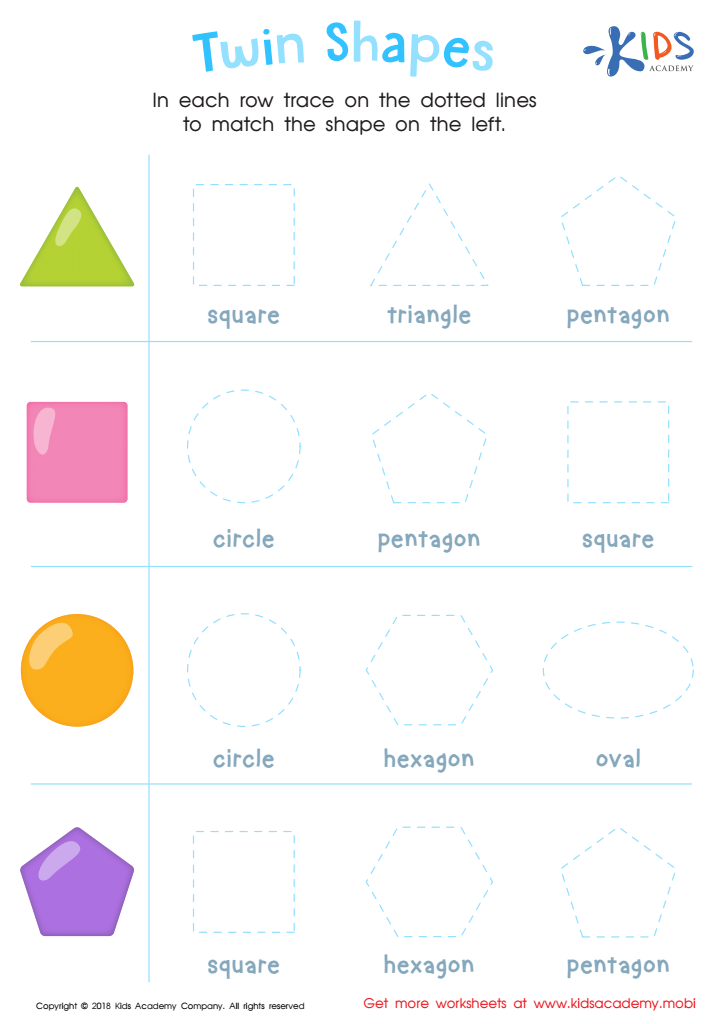
Twin Shapes Dot-to-Dot Worksheet
Test your child's ability to copy with this worksheet. Ask them to find and name the four shapes on the left. Then, they must match each with the dotted lines on the right. Help your child with all four shapes in this fun exercise.
Twin Shapes Dot-to-Dot Worksheet
Worksheet
Join Kids Academy for Free
Who is primarily going to use this learning content?








Visual discrimination is a crucial skill for Grade 2 students, especially in the context of geometry. It refers to the ability to differentiate between shapes, sizes, colors, and patterns. Parents and teachers should prioritize this skill for several reasons.
Firstly, strong visual discrimination can enhance a child’s understanding of geometric concepts. Recognizing various shapes and their properties lays the foundation for more complex mathematical concepts in the future. For instance, being able to distinguish between squares, rectangles, and triangles helps students grasp the fundamentals of area and perimeter.
Additionally, visual discrimination supports critical thinking and problem-solving skills. When children learn to identify differences and similarities in shapes, they begin to engage in analytical thinking, which is essential across all subject areas. Moreover, these skills can improve fine motor abilities as students are often required to manipulate shapes through drawing or using hands-on materials.
Finally, fostering visual discrimination can boost a child’s confidence. As they master these skills, they become more competent and willing to tackle more challenging geometry problems. By investing time in activities that enhance visual discrimination, parents and teachers are facilitating a solid foundation for students' ongoing educational journeys.