Comparing shapes Grade 2 Math Worksheets
4 filtered results
Difficulty Level
Grade
Age
-
From - To
Subject
Activity
Standards
Welcome to our "Comparing Shapes Grade 2 Math Worksheets" page! Here, young learners will explore the fascinating world of shapes through engaging activities designed to enhance their understanding of geometric concepts. Our worksheets are tailored for second graders, focusing on essential skills such as identifying, comparing, and contrasting various shapes. With interactive exercises and colorful illustrations, students will gain confidence in recognizing properties like size, attributes, and differences among shapes. These fun, printable worksheets support hands-on learning and encourage critical thinking, making math an exciting adventure for your child. Get ready to compare shapes and strengthen math skills today!
Favorites
With answer key
Interactive
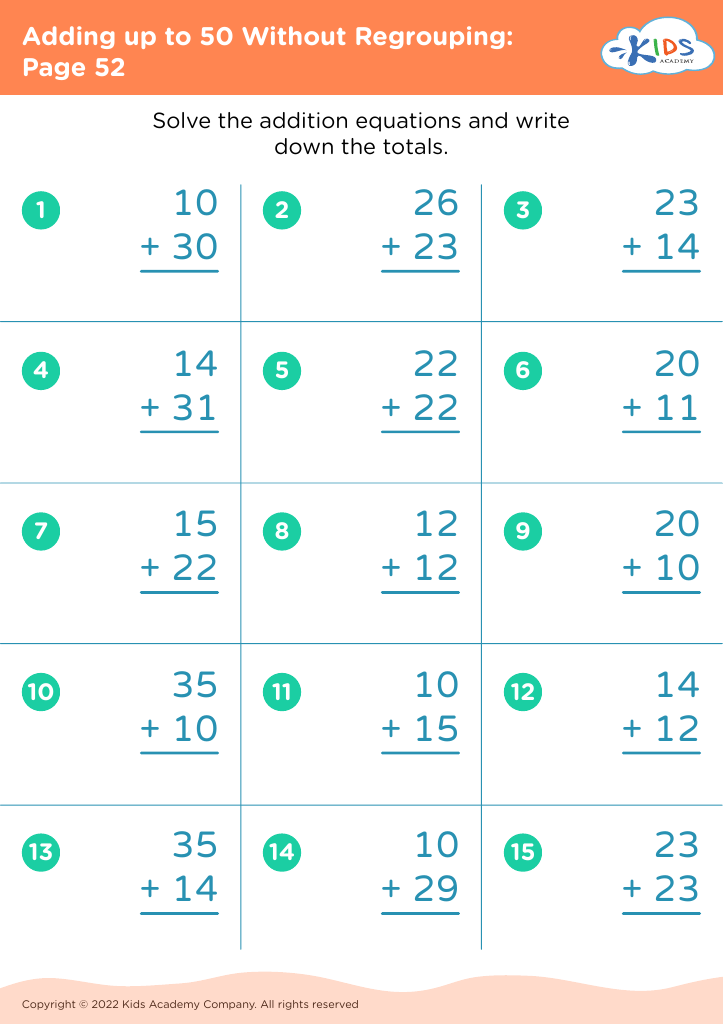
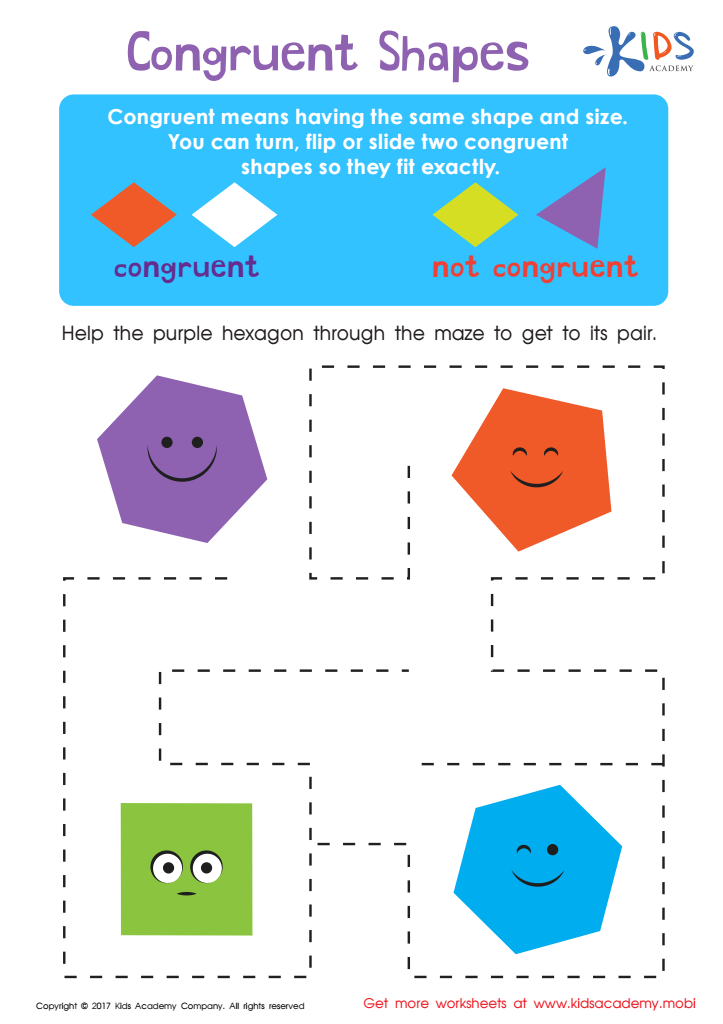
Congruent Shapes Worksheet
Help your child find the twin of the purple hexagon! This congruent shapes worksheet is great for increasing vocabulary while challenging mental rotation skills.
 Assign to My Students
Congruent Shapes Worksheet
Worksheet
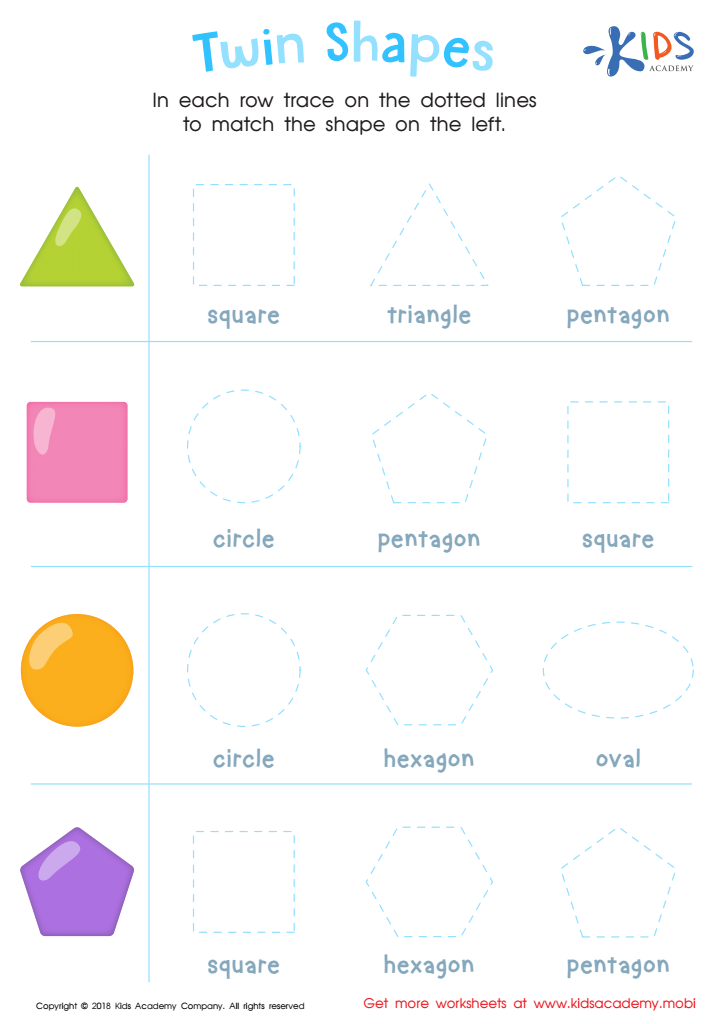
Twin Shapes Dot-to-Dot Worksheet
Test your child's ability to copy with this worksheet. Ask them to find and name the four shapes on the left. Then, they must match each with the dotted lines on the right. Help your child with all four shapes in this fun exercise.
Twin Shapes Dot-to-Dot Worksheet
Worksheet
Join Kids Academy for Free
Who is primarily going to use this learning content?








Comparing shapes is a fundamental concept in Grade 2 math that equips young learners with essential skills. Understanding the characteristics of different shapes helps children develop critical thinking abilities and geometric intuition. When parents and teachers focus on this area, they are fostering spatial awareness, which is important not only in mathematics but also in everyday life.
By comparing shapes, children learn to identify similarities and differences, laying the groundwork for more advanced concepts such as symmetry, congruence, and transformations. These skills are crucial in problem-solving and can enhance children's ability to visualize and manipulate objects in their environment, paving the way for success in fields like engineering, architecture, and even the arts.
Furthermore, comparing shapes offers opportunities for collaborative learning, encouraging discussions and teamwork among peers. When parents and teachers engage in activities involving shape comparisons, they create a rich learning environment that promotes curiosity and exploration.
Incorporating these lessons into daily routines can also make learning more relevant and fun, turning ordinary experiences into powerful educational moments. Ultimately, nurturing shape comparison skills in young learners enhances their overall cognitive development and prepares them for lifelong learning challenges.