Comparison Skills Grade 2 Math Worksheets
4 filtered results
Difficulty Level
Grade
Age
-
From - To
Subject
Activity
Standards
Enhance your child's math abilities with our engaging Grade 2 Comparison Skills worksheets! Designed specifically for second graders, these worksheets promote critical thinking and problem-solving through fun activities focused on comparing numbers, quantities, and measurements. Our resources include visually appealing exercises that encourage students to explore concepts like greater than, less than, and equal to, making learning both enjoyable and educational. These worksheets are perfect for classroom use or at-home practice, helping children build a solid mathematical foundation while developing essential comparison skills. Download our printable materials today and watch your child's confidence in math soar!
Favorites
With answer key
Interactive
 Assign to My Students
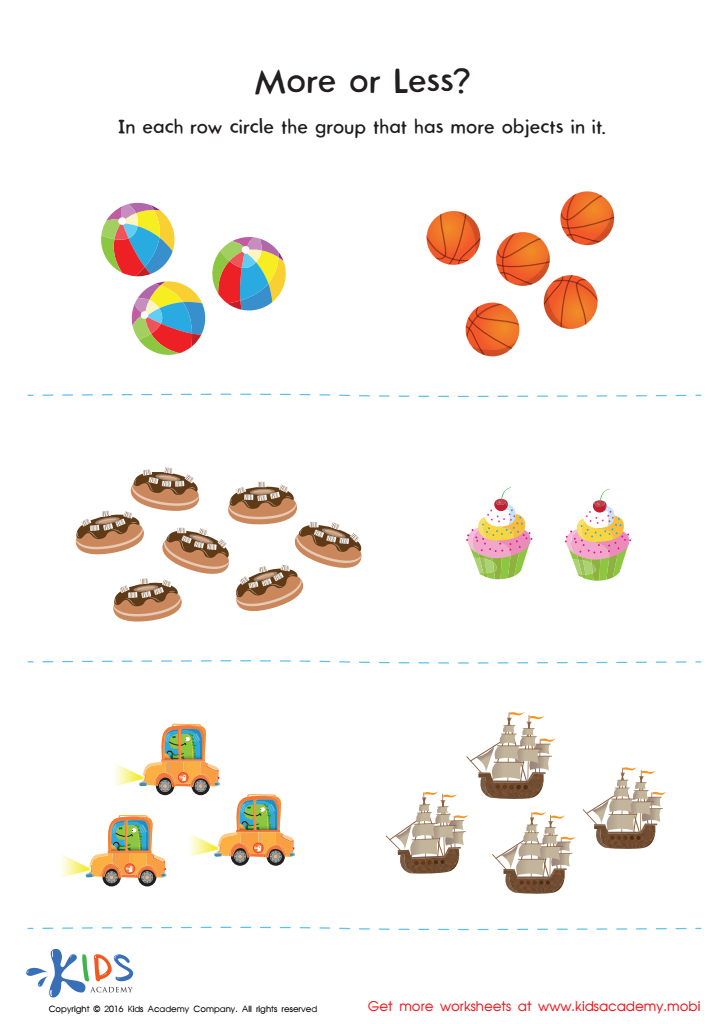
More or Less Size Worksheet
Worksheet
Join Kids Academy for Free
Who is primarily going to use this learning content?








Comparison skills are essential for Grade 2 math because they form the foundation for understanding relationships between numbers and quantities. At this stage, children transition from counting to interpreting numbers, making comparisons vital. By developing comparison skills, students learn to identify larger or smaller quantities, which supports their understanding of essential mathematical concepts like addition and subtraction.
Parents and teachers should care about these skills because they enhance critical thinking. When children compare numbers or objects, they practice analytical reasoning and decision-making as they assess differences and similarities. Additionally, mastering comparison skills fosters confidence in math, as children feel more accomplished when they can accurately gauge sizes or quantities.
Moreover, these skills are not confined to the math curriculum; they promote real-life applications. For example, understanding comparisons helps children make decisions in everyday situations, whether deciding how much of a snack to share or choosing between two game options.
By emphasizing comparison skills, parents and teachers equip students with necessary lifelong skills that extend beyond classroom walls. As children grow more adept at interpreting information, they lay the groundwork for success in more complex mathematical concepts and problem-solving scenarios in higher grades. Thus, nurturing these skills is crucial for students' overall development.