Identifying shapes Grade 2 Math Worksheets
26 filtered results
Difficulty Level
Grade
Age
-
From - To
Subject
Activity
Standards
Discover an engaging way to enhance your child's geometry skills with our "Identifying Shapes Grade 2 Math Worksheets!" Tailored for second graders, these worksheets provide hands-on practice in recognizing and naming various shapes, from basic to more complex figures. Each printable activity is designed to foster both fun and fundamental mastery of geometric concepts. Perfect for classroom use or extra practice at home, our worksheets include colorful illustrations and diverse exercises that cater to various learning styles. Empower your child to excel in math with these delightful and educational resources from Kids Academy!
Favorites
With answer key
Interactive
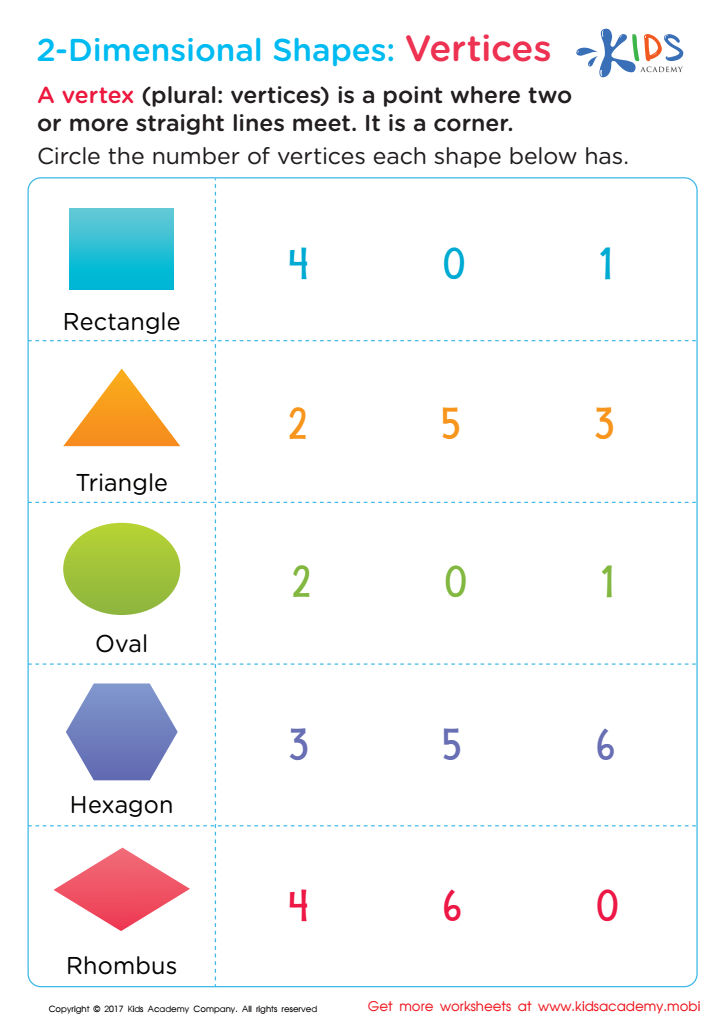
Two–Dimensional Shapes: Vertices Printable
This colorful worksheet teaches kids geometry by introducing them to two-dimensional shapes and vertices. Kids can practice counting vertices and learn an important new math term in an easy to understand way. Boost your child's knowledge of geometry today!
Two–Dimensional Shapes: Vertices Printable
Worksheet
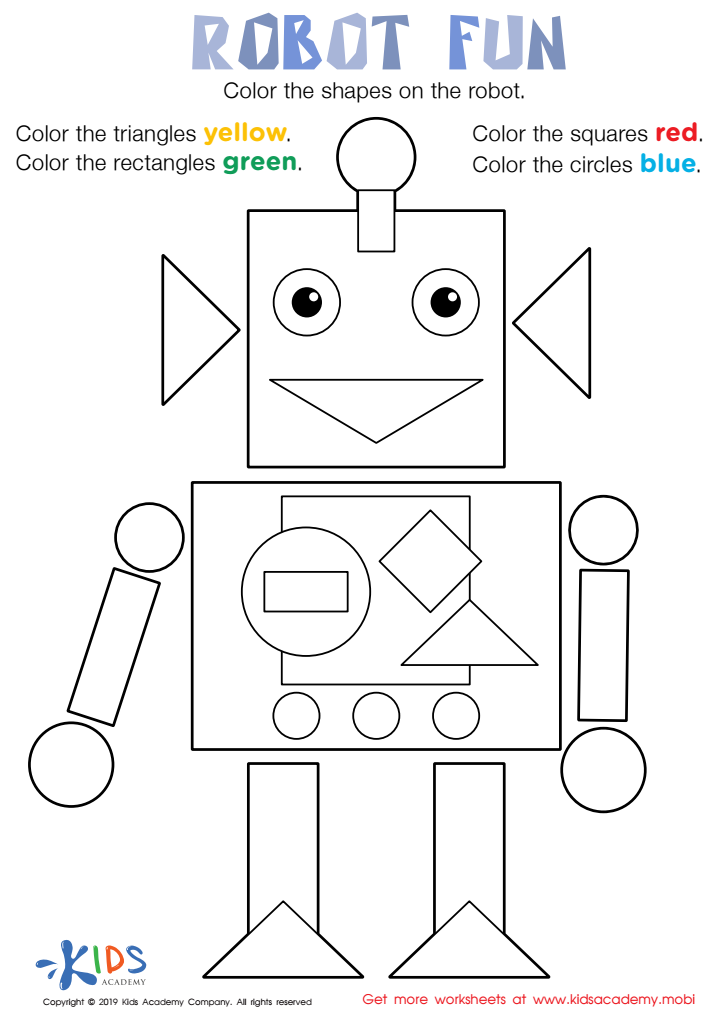
Robot Fun Worksheet
Help your child learn about basic shapes with this fun robot worksheet! Kids practice identifying circles, squares, rectangles and triangles, then color each shape according to directions. Make math practice enjoyable with this coloring page that teaches all four basic shapes - it's an important math skill!
Download (PDF)
 Assign to My Students
Assign to My Students
Robot Fun Worksheet
Worksheet
Join Kids Academy for Free
Who is primarily going to use this learning content?








Understanding and identifying shapes in Grade 2 is crucial for children's overall cognitive and academic development. Geometric shapes form the foundation for more advanced math concepts such as symmetry, spatial awareness, and area and perimeter calculations. Mastering these basic shapes strengthens children's abilities to recognize and categorize objects not only in math class but also in their daily environments.
Both parents and teachers should prioritize shape identification to nurture a child's logical thinking and problem-solving skills. Shapes help in developing visual-spatial skills, crucial for tasks like solving puzzles, discerning patterns, and understanding graphs and charts in later educational stages. Moreover, shapes correlate closely with language development as students learn descriptive vocabulary like "triangle," "circle," "square," and terms like "angles," "sides," and "edges."
When parents and teachers engage children with activities involving shapes, they bridge the gap between theoretical math and tangible experiences. For instance, playing with building blocks, drawing shapes, or identifying shapes in the surroundings makes learning engaging and practical. Such active participation not only solidifies math concepts but also boosts children's confidence and curiosity, laying a strong foundation for future learning. Precisely, attention to shape identification prepares children for an array of academic challenges and everyday problem-solving scenarios.