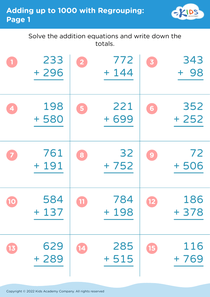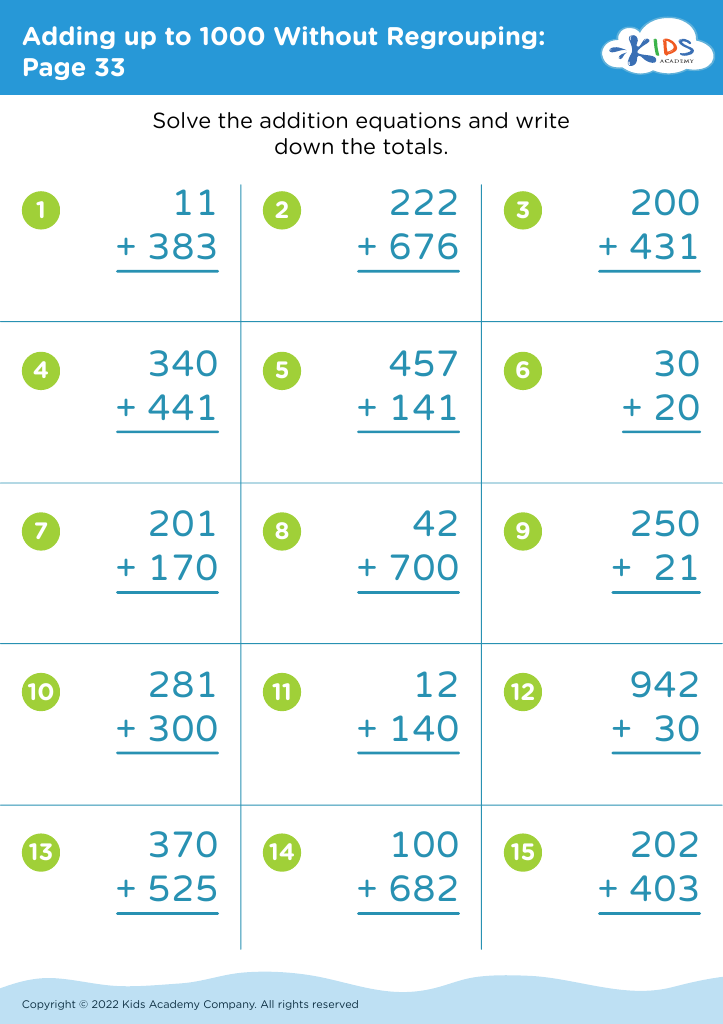



Understanding how to add up to 1,000 without regrouping is a fundamental skill for third-grade students and is crucial for several reasons. First, grasping this math concept enhances a child's number sense, allowing them to confidently manipulate and understand numbers up to 1,000. This strengthened competency in arithmetic lays a solid foundation for more complex mathematical concepts introduced in higher grades, such as multiplication, division, and problem-solving tasks.
Parents and teachers should note that exercises in addition help improve logical thinking and problem-solving skills. Mastering addition without regrouping instills a sense of accuracy and attention to detail in calculations, which is essential for students’ academic growth. Furthermore, these mathematical exercises help reinforce discipline and perseverance, as repeated practice is often necessary to achieve proficiency.
Additionally, showcasing competence in addition without regrouping can boost a student’s confidence in their overall math ability, fostering a positive attitude towards the subject. This can lead to increased engagement and participation in math lessons. Third-year math also intersects with daily life skills; having a strong grasp of arithmetic enables children to manage tasks like handling money, measuring ingredients in cooking, or even time management.
Overall, focusing on adding up to 1,000 without regrouping equips students with essential skills that are building blocks for future academic success and practical, everyday applications.