Develop counting skills Grade 3 Addition & Subtraction Worksheets
3 filtered results
-
From - To
Enhance your third grader's math proficiency with our engaging "Develop Counting Skills" worksheets focused on addition and subtraction! Designed to nurture foundational counting abilities, these worksheets incorporate fun activities that make learning enjoyable and effective. Students will practice counting forwards and backwards, gaining confidence in their arithmetic skills. With a variety of problems that cater to different learning styles, our resources are perfect for classroom or home learning. Watch as your child builds a strong mathematical foundation and develops essential problem-solving techniques. Simply download, print, and get started on the exciting journey toward mastering counting and basic operations!
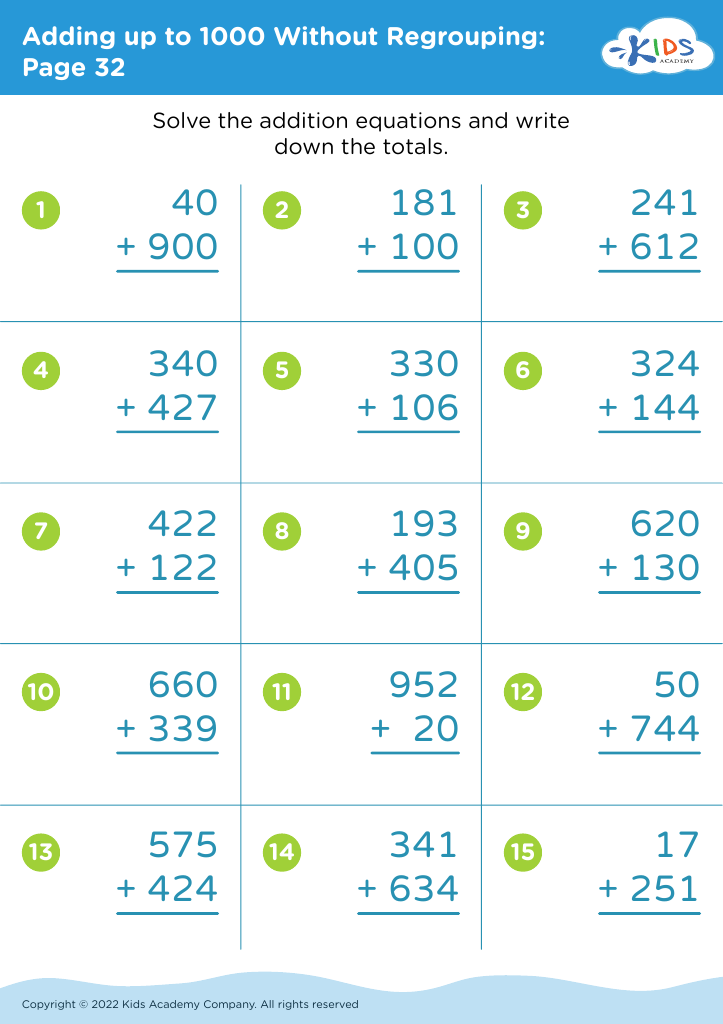
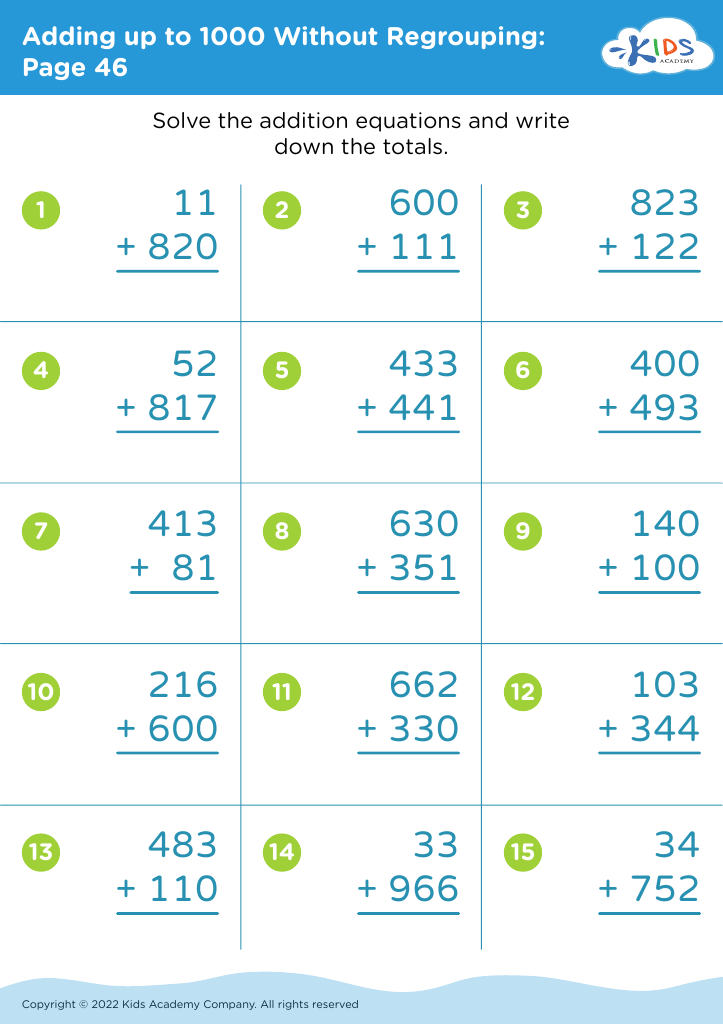
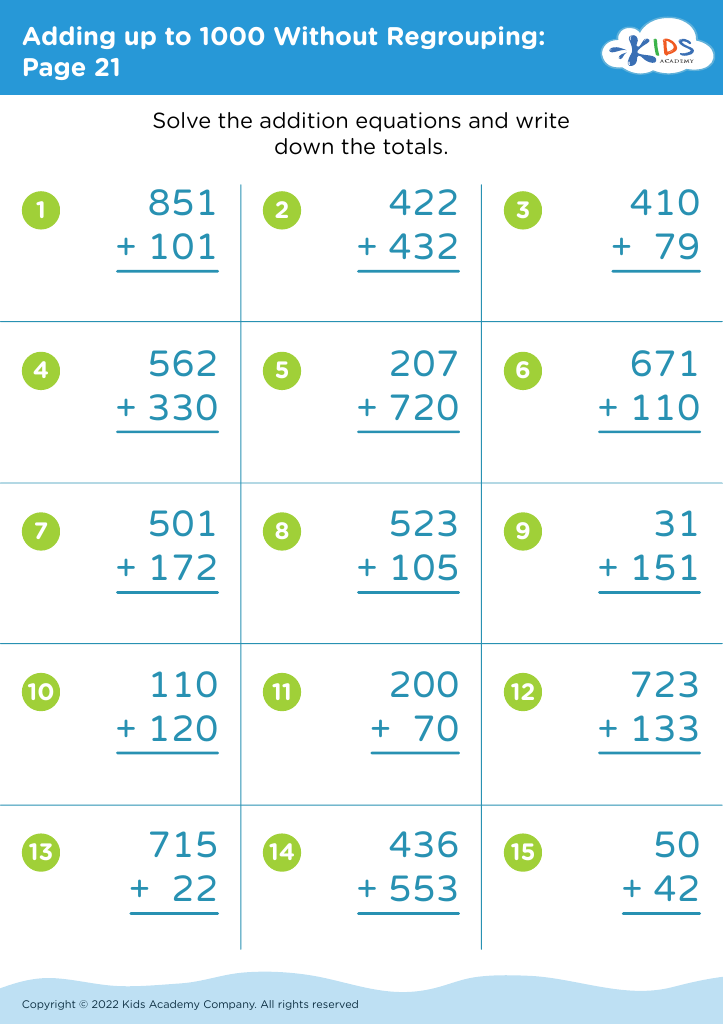








Developing counting skills in Grade 3 is essential for several reasons, particularly concerning addition and subtraction. At this stage, children transition from basic arithmetic to more complex mathematical concepts. Strong counting skills form the foundation for understanding numeracy, allowing students to perform calculations with confidence and accuracy.
Parents and teachers should prioritize these skills as they prepare kids for future mathematical learning. Mastering addition and subtraction not only enhances a child's ability to solve practical problems in everyday life, but also boosts cognitive development, critical thinking, and problem-solving abilities.
In efforts to foster a positive attitude towards math, early successful experiences with number management can mitigate anxiety and build resilience. Additionally, excellent counting skills support the development of other key mathematical concepts like multiplication, division, and fractions, which are introduced in later grades.
By engaging in activities that promote counting, such as games or real-world problem-solving, parents and teachers can create meaningful learning experiences that motivate students. Overall, nurturing these foundational skills is a shared responsibility that paves the way for lifelong mathematical proficiency and confidence.