Understand fractions Grade 3 Addition Worksheets
5 filtered results
-
From - To
Welcome to our "Understand Fractions Grade 3 Addition Worksheets" page! Here, young learners can strengthen their grasp of fractions through engaging activities tailored for third graders. Our carefully designed worksheets promote the understanding of fraction addition, helping students visualize and solve problems effectively. Each worksheet encourages hands-on practice, making the learning experience both enjoyable and educational. Ideal for reinforcing classroom lessons or for home study, these resources ensure students develop confidence in their mathematical skills. Join us in this fun and interactive journey to master fractions, building a strong foundation for future math successes! Explore our worksheets today!
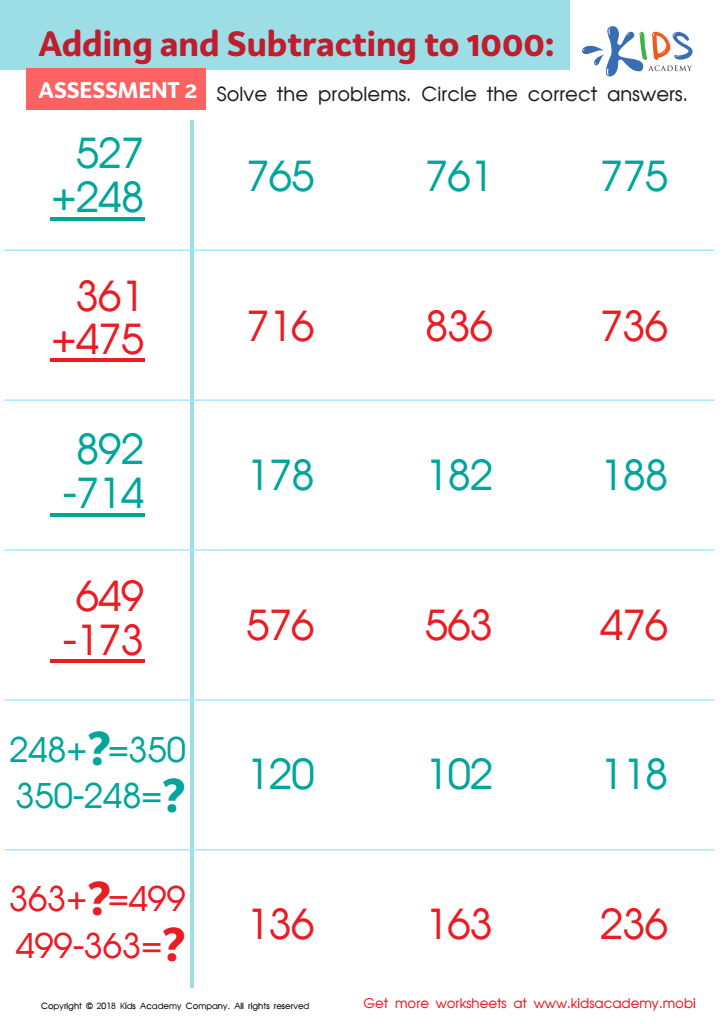
Adding and Subtracting to 1 Worksheet: Assessment 2
 Assign to My Students








Understanding fractions is a critical component of mathematics education, especially in Grade 3. Parents and teachers should prioritize this concept as it lays the groundwork for future arithmetic and problem-solving skills. Fractions introduce students to the idea of parts of a whole, which is essential in various real-life contexts, from cooking to sharing resources.
In Grade 3, students typically begin to explore addition with fractions, such as adding like fractions. This skill not only enhances their numerical fluency but also strengthens their understanding of equality and the relationship between different quantities. Mastering fraction addition equips students with the tools to tackle more complex mathematical operations in later grades.
Moreover, fostering an understanding of fractions promotes critical thinking, as students learn to visualize and manipulate portions of numbers. This skill translates to enhanced competency in algebra and beyond, all of which are essential for everyday tasks and future academic success. Lastly, fraction knowledge helps cultivate perseverance in problem-solving—an essential life skill—as students learn to approach challenges systematically. By engaging with fractions, children develop a robust mathematical foundation that serves them throughout their education and everyday life. Thus, it is crucial for parents and teachers to prioritize this fundamental concept.