Identifying fractions Grade 3 Math Worksheets
3 filtered results
-
From - To
Explore our engaging Grade 3 Math Worksheets focused on identifying fractions! These resources are designed to help young learners grasp the concept of fractions through fun and interactive activities. Each worksheet features vibrant visuals and relatable scenarios, making complex ideas more accessible. Students will practice identifying parts of whole numbers, as well as recognizing and comparing different fractions. Ideal for classroom use or at-home learning, our worksheets not only strengthen students' mathematical skills but also boost their confidence. Join us in fostering a deeper understanding of fractions as students embark on an educational journey filled with discovery and enjoyment!
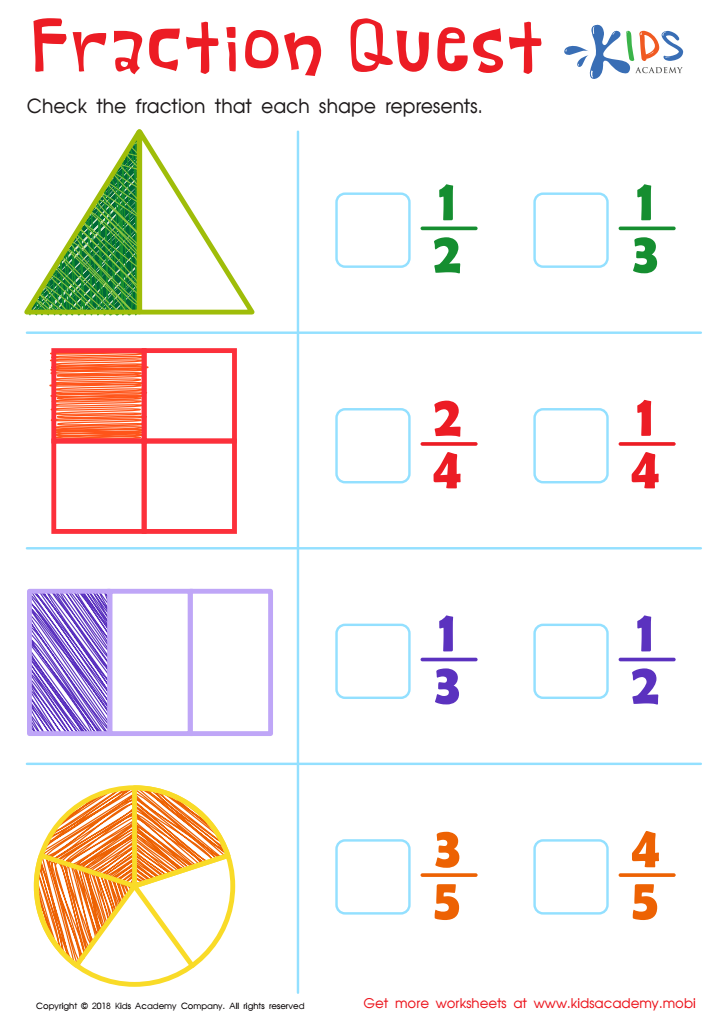
Fraction Quest Worksheet
 Assign to My Students






Identifying fractions is a crucial math concept for Grade 3 students that serves as a foundation for future mathematical learning. For parents and teachers, understanding and supporting this concept is essential for several reasons.
First, fractions help students grasp the idea of part-to-whole relationships. Recognizing these relationships fosters critical thinking and problem-solving skills, which are vital in all areas of learning. Understanding fractions prepares students for more complex math topics in higher grades, such as ratios and percentages.
Moreover, identifying fractions aids in various real-life applications. Whether it’s measuring ingredients for a recipe, dividing items among friends, or understanding time in terms of halves and quarters, fractions are everywhere in daily life. Encouraging proficiency in fractions helps students build confidence in their math abilities, which can enhance their overall attitude toward learning.
Lastly, engaging with fractions also promotes essential skills like collaboration and communication, especially when students work together on fraction challenges. Parents and teachers can cultivate a nurturing environment that emphasizes the relevance of fractions, ensuring that students not only grasp the concept but recognize its importance beyond the classroom. In nurturing these skills, they equip children for future academic success and practical life skills.