Understanding equations Grade 3 Math Worksheets
3 filtered results
Difficulty Level
Grade
Age
-
From - To
Subject
Activity
Standards
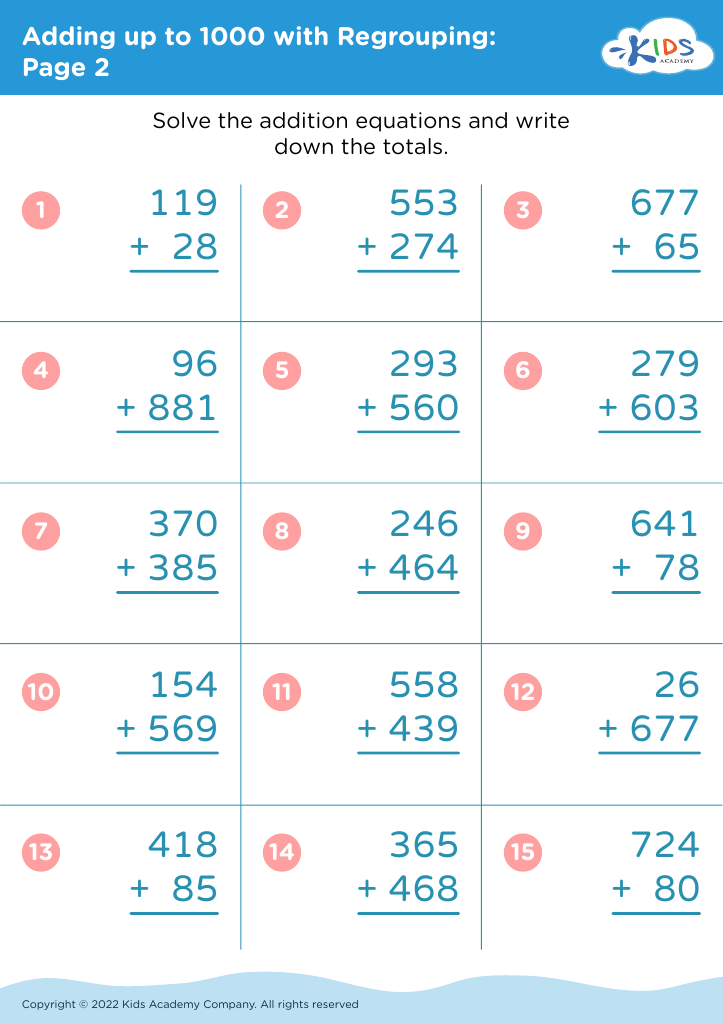
Dive into our "Understanding Equations" Grade 3 Math Worksheets, designed to enhance your child's mathematical skills. Our engaging worksheets make learning equations fun and accessible, helping students grasp essential concepts in a user-friendly format. Each worksheet focuses on building a solid foundation in understanding and solving basic equations, including addition, subtraction, and balancing. Ideal for classroom use or at-home practice, these resources encourage critical thinking and problem-solving skills. With various exercises, our worksheets cater to diverse learning styles, ensuring every student gains confidence in their math abilities. Download now and empower your child to master equations with ease!
Favorites
With answer key
Interactive
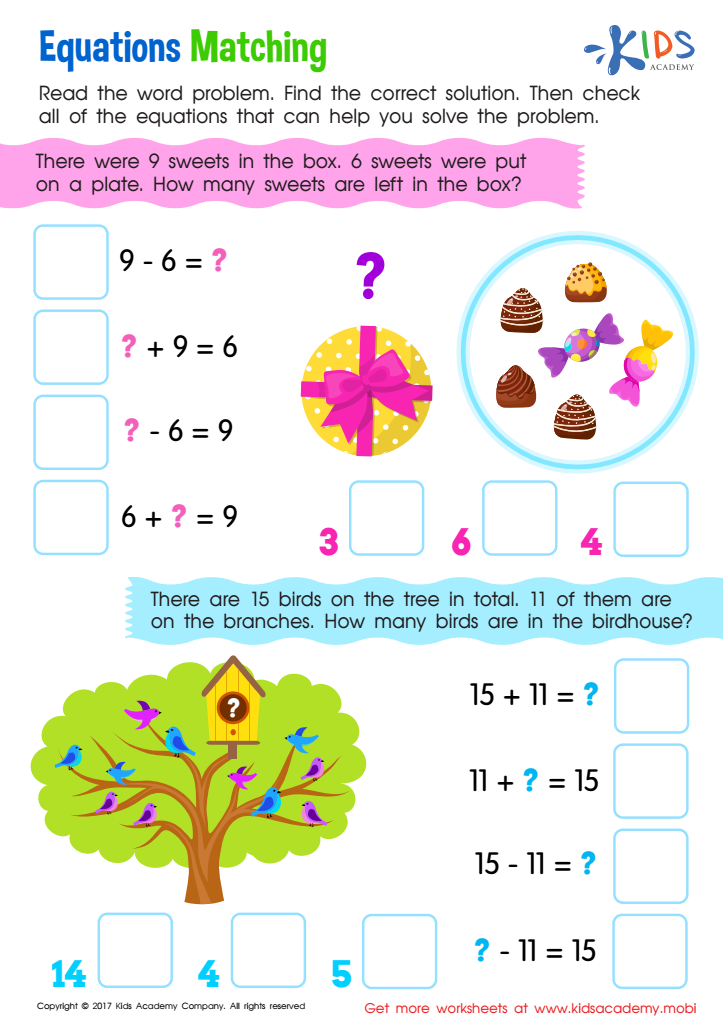
Equations Matching Word Problems Worksheet
Download this worksheet and give your young mathematician practice in solving equations using matching numbers and number family facts. They'll solve word problems, develop critical thinking and algebraic reasoning, and gain success with addition and subtraction.
 Assign to My Students
Equations Matching Word Problems Worksheet
Worksheet
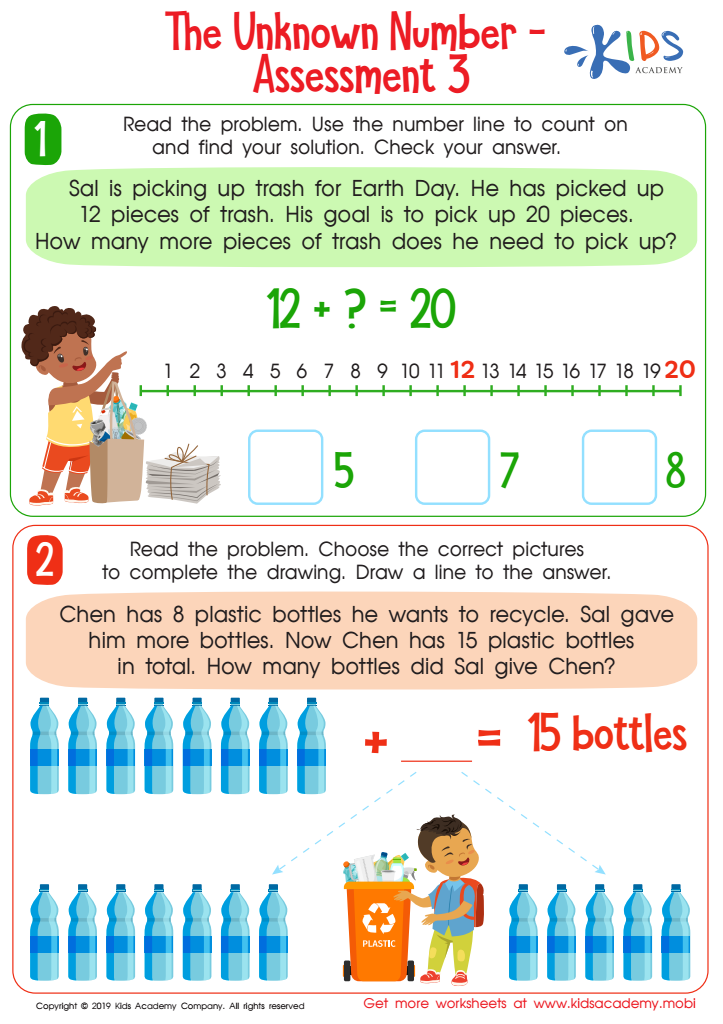
The Unknown Number - Assessment 3 Worksheet
Read the Earth Day-themed word problem aloud to your kids, pointing to the pictures as you go. Use the number line to help them count on and find the answer. Then check it together. Doing this can help them learn more about Earth Day and meet other children who are doing their part to keep it clean.
The Unknown Number - Assessment 3 Worksheet
Worksheet
Join Kids Academy for Free
Who is primarily going to use this learning content?


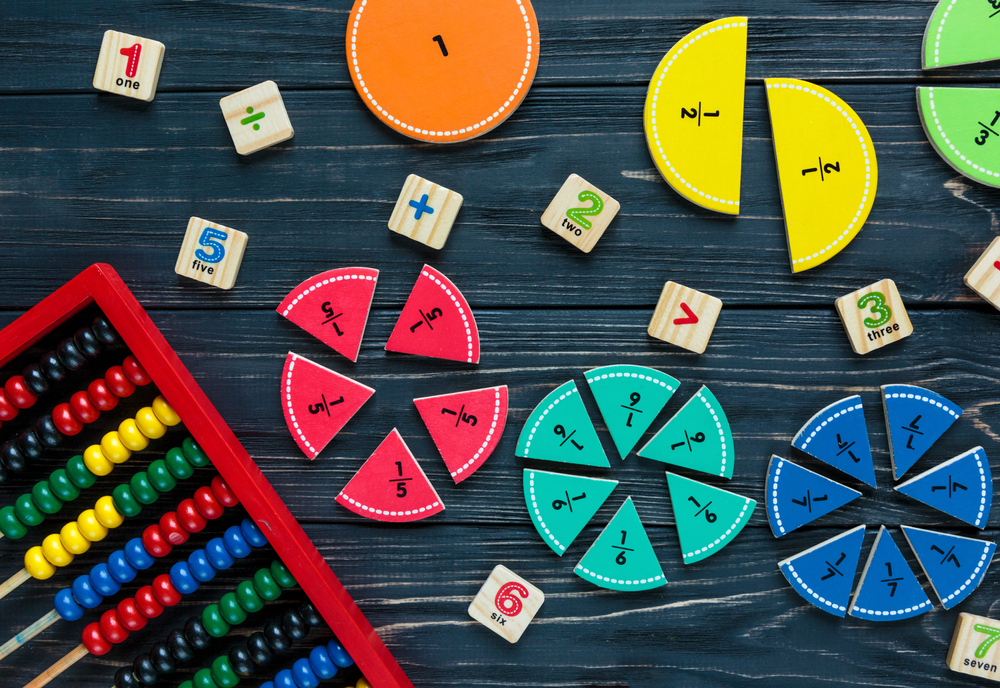





Understanding equations in Grade 3 math is crucial for both parents and teachers as it lays the foundation for children's mathematical reasoning and problem-solving skills. At this stage, students begin to grasp the concept of using numbers and symbols to represent relationships and solve problems. This foundational knowledge not only supports their current curriculum but also prepares them for more complex concepts in higher grades, such as algebra and geometry.
Parents and teachers should care because fostering a strong understanding of equations can enhance a child's confidence in math. When kids comprehend how to manipulate equations and use them to find unknown values, they develop critical thinking and logical reasoning skills essential for everyday decision-making.
Moreover, encouraging this understanding helps create a constructive learning environment where students can express curiosity and ask questions. It also promotes engagement in homework and collaborative group work, reinforcing teamwork and communication skills.
Ultimately, investing time in helping children understand equations can nurture a positive attitude toward math, ensuring they build the skills needed not just for academics, but for life beyond the classroom. Engaged parents and teachers can play a pivotal role in making math a subject of interest rather than a challenge, setting the stage for lifelong learning.