Understanding quadrilaterals Grade 3 Math Worksheets
4 filtered results
-
From - To
Explore our comprehensive "Understanding Quadrilaterals" Grade 3 Math Worksheets, designed to help young learners grasp the fundamental concepts of quadrilaterals. These engaging worksheets offer vibrant illustrations and interactive activities that introduce students to various types of quadrilaterals, including squares, rectangles, rhombuses, trapezoids, and parallelograms. With a focus on shape recognition, characteristics, and real-world applications, our resources aim to reinforce essential geometric skills while making learning enjoyable. Perfect for classroom use or at-home practice, these worksheets provide ample opportunities for students to enhance their understanding and confidence in geometry. Start your quadrilateral journey today with our fun and educational worksheets!
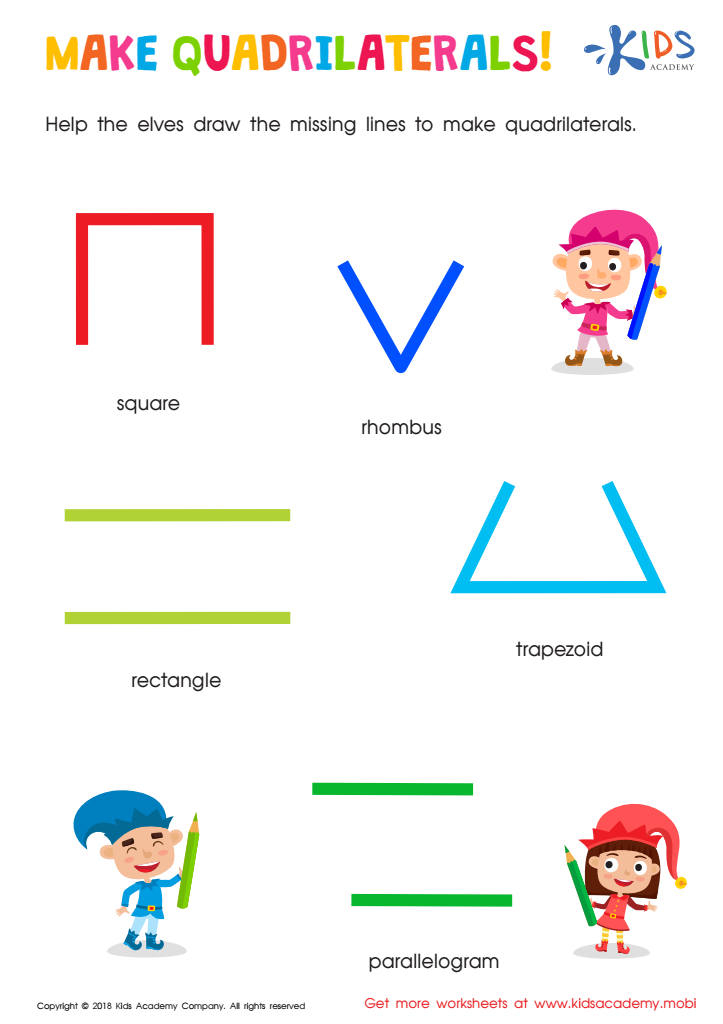
Make Quadrilaterals Worksheet
 Assign to My Students
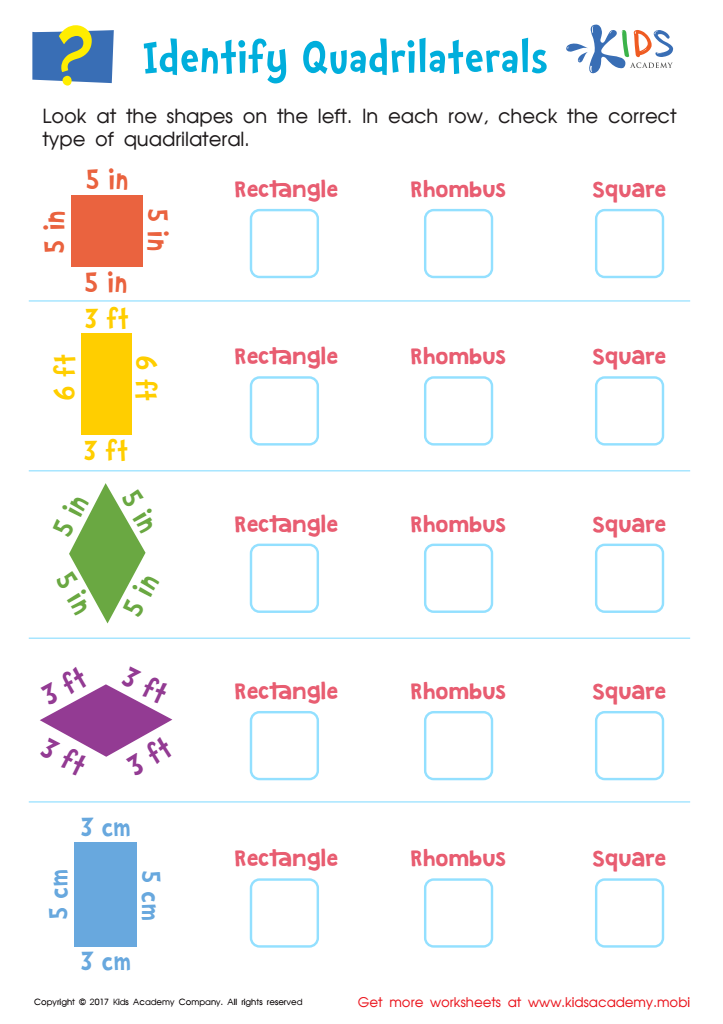
Identify Quadrilaterals Worksheet
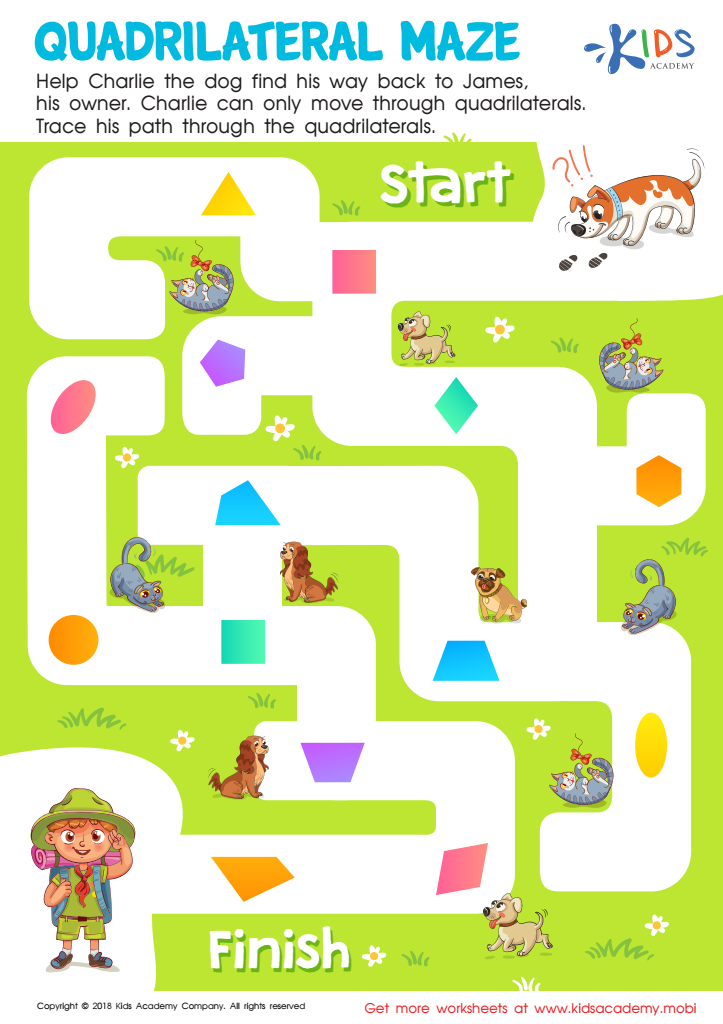
Quadrilateral Maze Worksheet
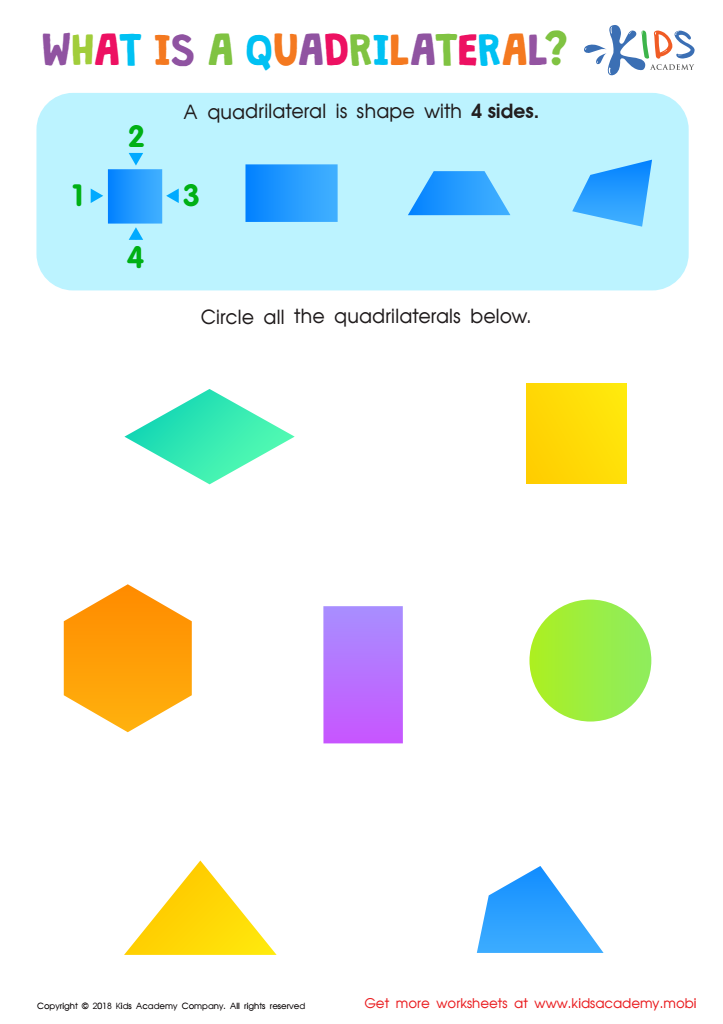
What Is a Quadrilateral? Worksheet







Understanding quadrilaterals is essential for Grade 3 students as they form a fundamental aspect of geometry that lays the groundwork for more advanced mathematical concepts. Parents and teachers should prioritize this learning because it enhances critical thinking and problem-solving skills. Working with quadrilaterals—shapes with four sides and angles such as squares, rectangles, and trapezoids—allows students to recognize and categorize these shapes in their environment, fostering spatial awareness.
Moreover, learning about quadrilaterals helps students develop basic measurement skills, such as understanding perimeter and area, which are foundational for later mathematical studies. By engaging with this topic, children can also improve their communication skills as they learn to describe and compare shapes using appropriate vocabulary.
Furthermore, parents and teachers can use the study of quadrilaterals as an opportunity to integrate mathematics with art and science, promoting cross-disciplinary learning. Overall, emphasizing the understanding of quadrilaterals enriches students' mathematical foundation, connects classroom learning to the real world, and cultivates a sense of curiosity and a love for learning in young minds. Supporting this exploration ensures that children build confidence and competence in math at an early age, setting them up for future academic success.