Understanding Sequences Grade 3 Math Worksheets
7 filtered results
-
From - To
Boost your child's math proficiency with our "Understanding Sequences Grade 3 Math Worksheets" from Kids Academy. These engaging worksheets are designed to help third graders grasp the concept of numerical sequences through varied and stimulating exercises. Your young learners will explore patterns, predict future numbers, and understand sequence rules in a fun and interactive way. Perfect for at-home practice or classroom activities, these printable worksheets support critical thinking and problem-solving skills. Start fostering a deeper understanding of sequences and help your child excel in math with our expertly crafted resources.
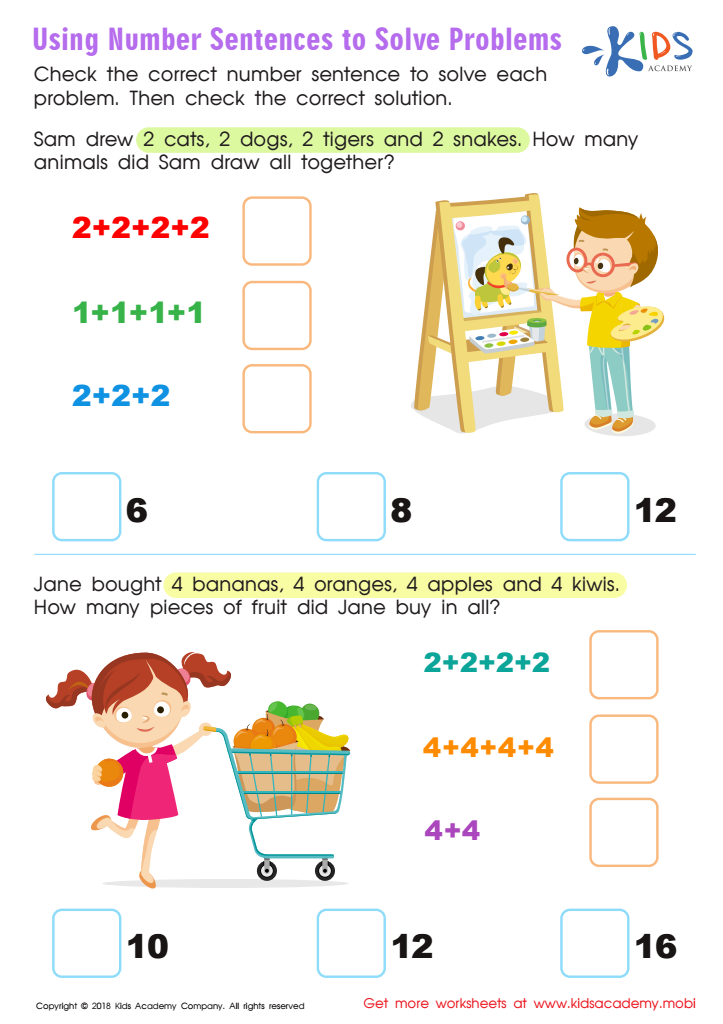
Using Number Sentences to Solve Problems Worksheet
 Assign to My Students
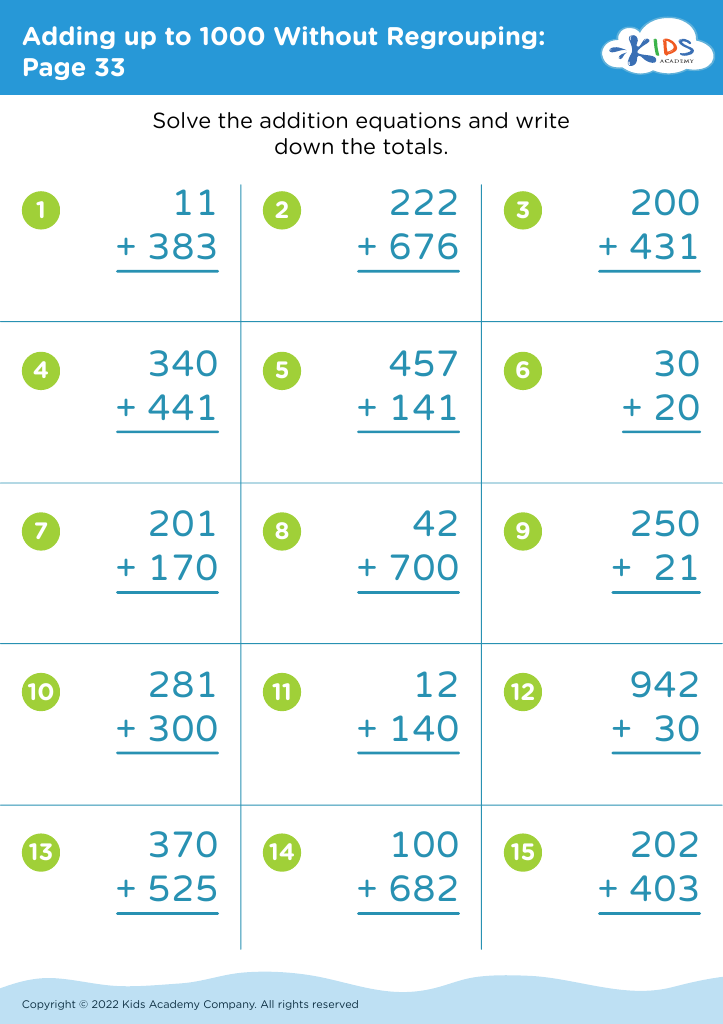






Understanding sequences is a crucial part of Grade 3 math that forms the foundation for future mathematical learning. For parents and teachers, prioritizing this concept helps children develop critical thinking skills and enhances their ability to recognize patterns—an essential component of higher-order math problems and everyday logic.
Sequences teach children how to predict and extend patterns, which directly applies to many areas of mathematics, including addition, multiplication, fractions, and geometry. For instance, understanding numerical sequences such as 2, 4, 6, 8 fundamentally demonstrates even numbers and sets the stage for grasping more intricate arithmetic operations later on.
Furthermore, sequences nurture organizational skills and systematic thinking. By recognizing and creating patterns, children learn how to approach problems methodically, a skill benefiting all academic disciplines and real-life scenarios, from sorting objects to planning tasks.
Socially, mastering sequences also boosts a child's confidence, promoting a positive attitude toward math and learning in general. As these young learners share and discuss patterns, they also enhance their communication and collaborative skills.
In essence, understanding sequences is not just about learning numbers; it’s about equipping children with a toolkit for logical reasoning, confidence-building, and a lifelong appreciation for math. Hence, parents and teachers should foster this understanding with enthusiasm.