Understanding sequencing Grade 3 Math Worksheets
3 filtered results
-
From - To
Understanding sequencing is crucial for third-grade math success. Our Grade 3 Math Worksheets are designed to help students master this essential skill. These printable worksheets from Kids Academy introduce and reinforce sequencing through engaging activities and exercises. Students will practice arranging numbers, events, or steps logically, enhancing their problem-solving and critical thinking abilities. With a variety of tasks tailored for young learners, these resources make learning sequencing fun and effective. Perfect for classroom use or at-home practice, our worksheets support education while keeping students motivated and confident in their math journey. Start enhancing your child's sequencing skills today!
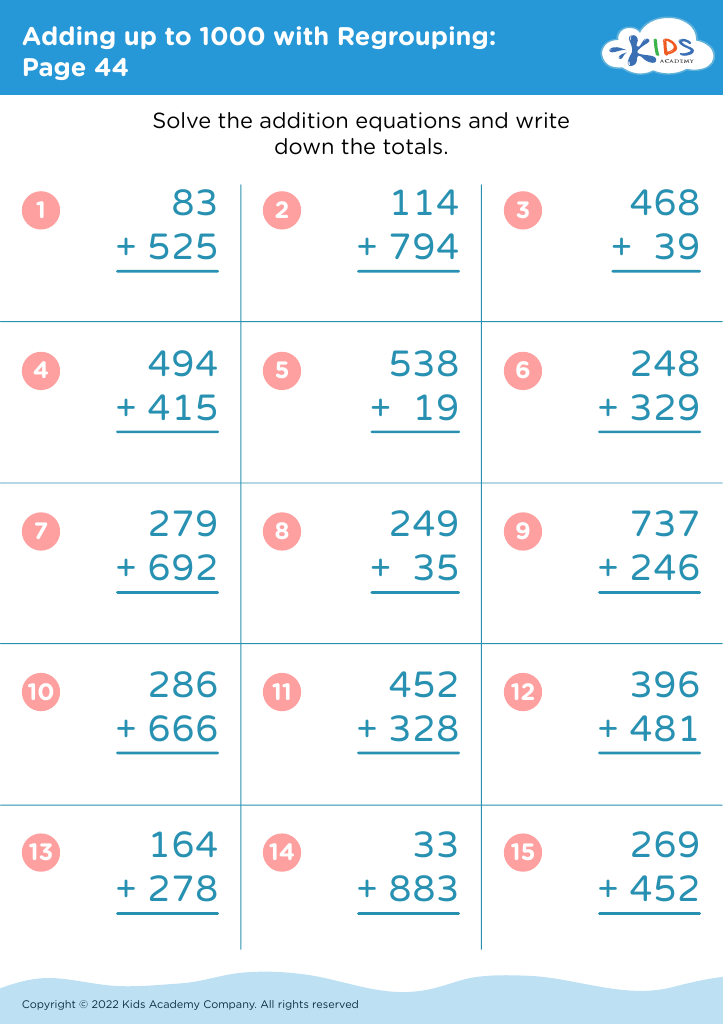








Understanding sequencing is foundational for Grade 3 students because it underpins many higher-order math skills. Sequencing, which involves understanding and organizing events or numbers in logical order, is not only crucial for math but also for day-to-day problem-solving and critical thinking. Mastery of sequencing helps students grasp concepts like the number line, order of operations, and patterns, which are essential for advanced math topics.
For parents and teachers, fostering this skill means they are preparing children for future academic success. When students understand how things follow a specific order, they can better decode mathematical problems, whether solving equations, telling time, or measuring ingredients for a recipe. It also enhances their ability to follow multi-step instructions, a key component in both academic settings and everyday activities.
Encouraging sequencing bolsters comprehension in subjects beyond math, such as reading, where understanding the sequence of a story aids in comprehension and retention. Moreover, it improves cognitive abilities like memory and attention to detail. Recognizing these wide-ranging benefits, parents and teachers should emphasize sequential learning to build a strong educational foundation that enables children to excel across numerous aspects of their lives.