Mental arithmetic skills Grade 3 Multiplication Worksheets
4 filtered results
Difficulty Level
Grade
Age
-
From - To
Subject
Activity
Standards
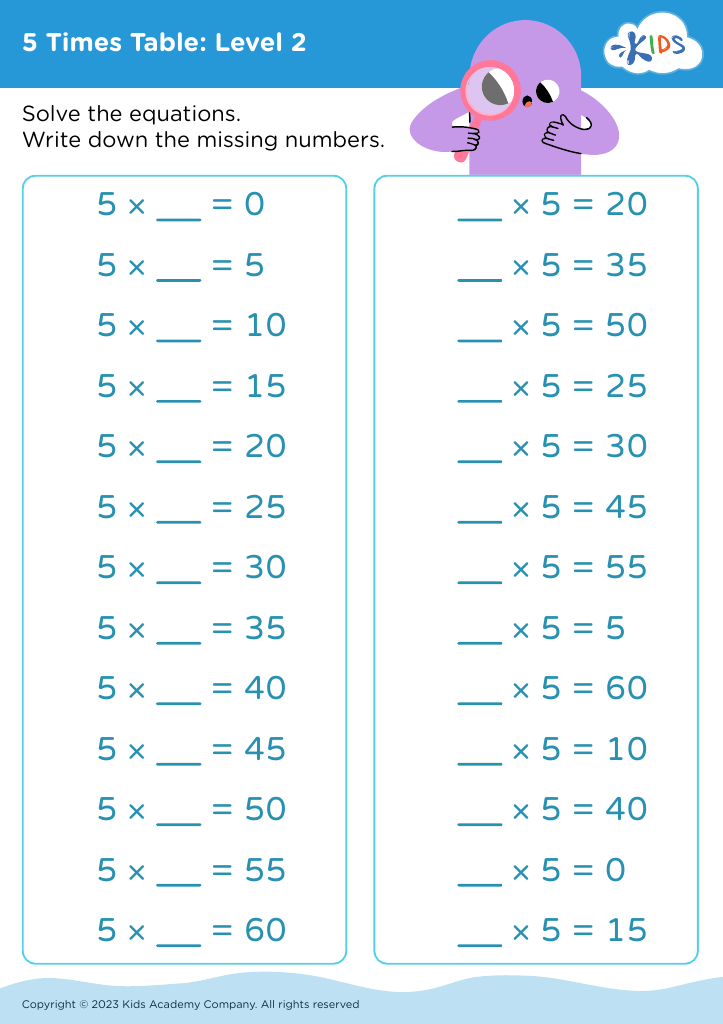
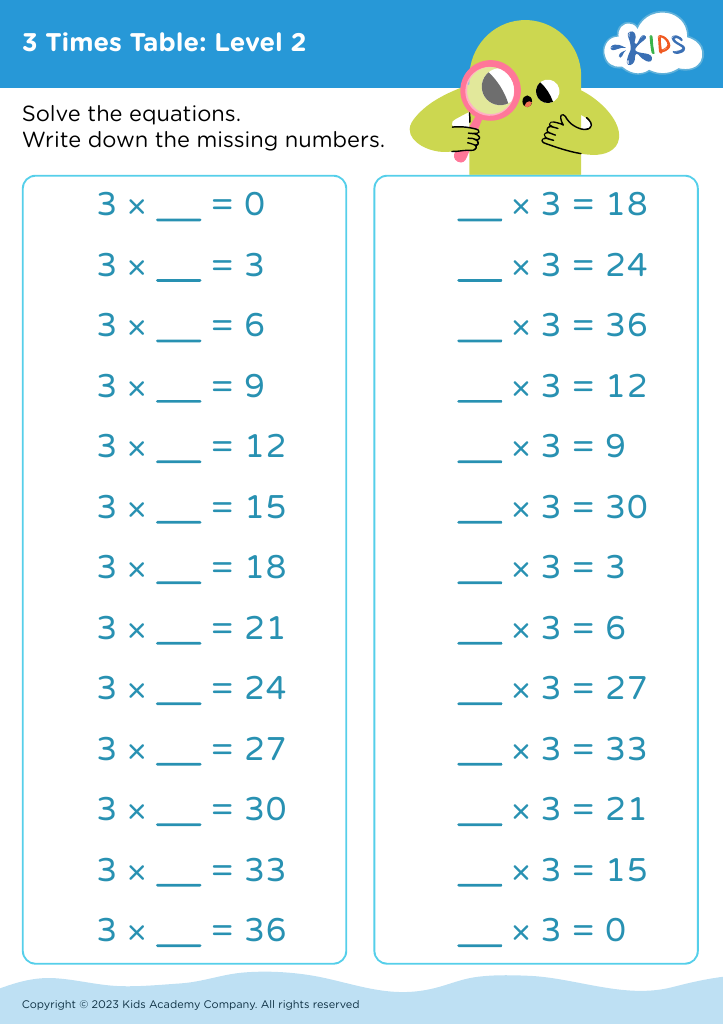
Unlock your child's potential with our Grade 3 multiplication worksheets focused on enhancing mental arithmetic skills! Designed to make learning engaging and effective, these printable resources feature a variety of problems that challenge students to practice multiplication in a fun, interactive way. Our worksheets encourage children to perform calculations mentally, building confidence and agility in math. Ideal for reinforcing classroom lessons or providing additional practice at home, these resources cater to different learning styles and paces. Help your student master multiplication concepts with our expertly crafted worksheets, ensuring they develop a strong foundation for future math success! Start their mental math journey today!
Favorites
With answer key
Interactive
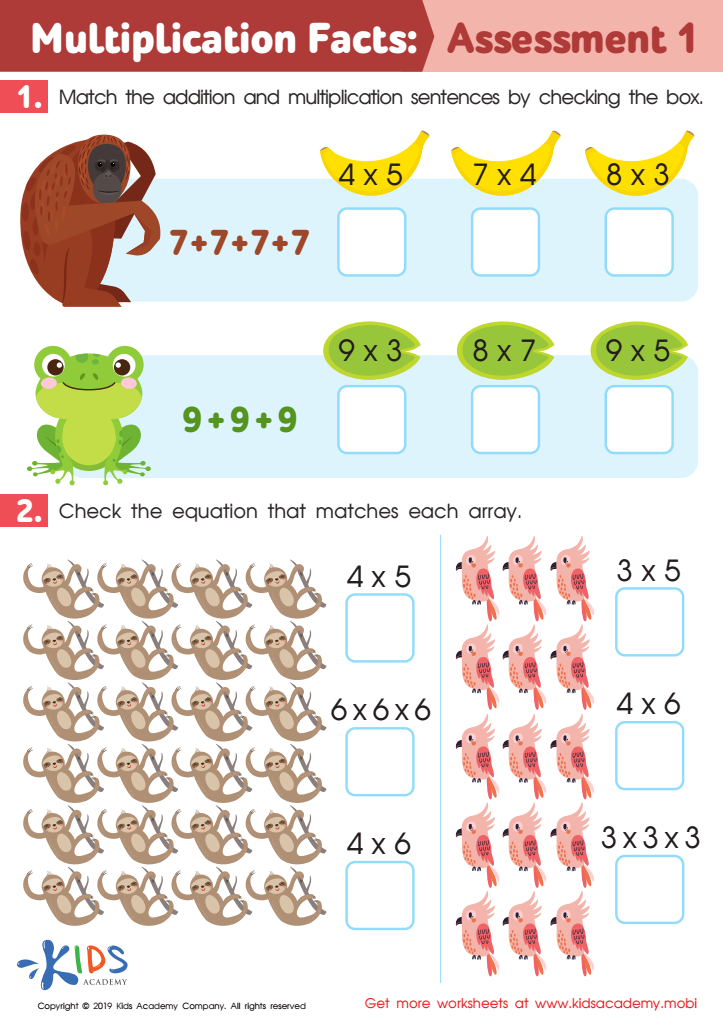
Multiplication Facts: Assessment 1 Worksheet
Teach your kids math with diligence, patience and practice. This colorful worksheet helps by matching addition and multiplication sentences, then checking the equation that matches each array. Perfect for kids having difficulty or to give extra practice. Help your little ones master mathematics with this printout.
 Assign to My Students
Multiplication Facts: Assessment 1 Worksheet
Worksheet
Join Kids Academy for Free
Who is primarily going to use this learning content?







Mental arithmetic skills, particularly in multiplication, are crucial for third graders as they form the foundation for more advanced mathematical concepts. First, developing strong multiplication skills enhances students' numerical fluency, making them confident in tackling math problems both in the classroom and in real-life situations. This confidence can foster a growth mindset, encouraging children to embrace challenges rather than shy away from them.
Moreover, mental arithmetic helps students enhance their problem-solving abilities and computational skills, which are vital across the entire curriculum, not just in math. When children practice mental multiplication, they learn to recognize patterns, understand relationships between numbers, and develop logical thinking processes.
Additionally, strong multiplication skills can improve standardized test performance and academic assessments, ultimately contributing to better educational outcomes. When students can solve multiplication problems quickly and accurately, they are more likely to engage in collaborative problem-solving and critical thinking activities that require more than just rote calculation.
Finally, parents and teachers who emphasize mental arithmetic understand its role in shaping responsible and independent learners. By nurturing these skills in young students, adults equip the next generation with essential life skills and foster a stronger mathematical foundation for future learning.