
Extra Challenge Phonics worksheets activities for Ages 4-8
3 filtered results
Difficulty Level
Grade
Age
-
From - To
Subject
Activity
Standards
Discover our Extra Challenge Phonics worksheets, designed for children aged 4-8! These engaging activities enhance phonics skills through fun and interactive exercises. Tailored to stimulate young learners, our worksheets cover essential phonics concepts while challenging their understanding. From blending sounds to identifying letter patterns, each activity reinforces foundational reading skills in an enjoyable way. Perfect for parents and teachers seeking to enrich literacy instruction, these worksheets help children gain confidence in their reading abilities. Download and print the resources today to support your child's educational journey with extra challenging phonics practice that makes learning exciting!
Favorites
With answer key
Interactive
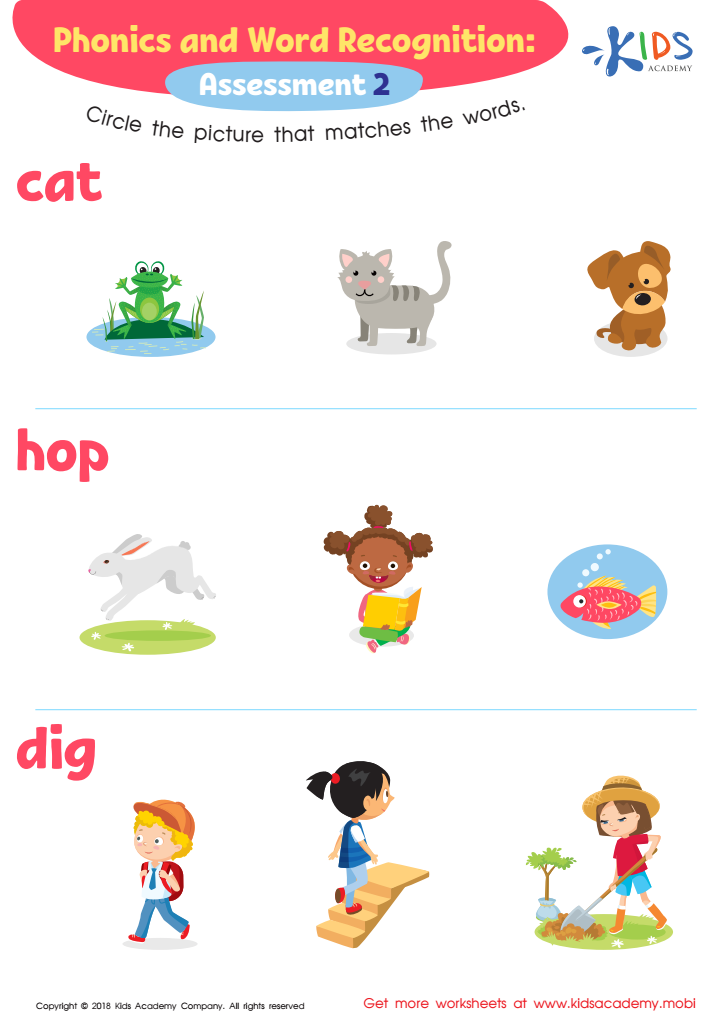
Phonological Awareness: Assessment 2 ELA Worksheet
This free worksheet assesses your emerging reader's ability to decode and match closed-syllable high-frequency words to the appropriate picture. The pictures are cheery and easy to identify, so your child will have fun and find success with decoding and matching.
 Assign to My Students
Phonological Awareness: Assessment 2 ELA Worksheet
Worksheet
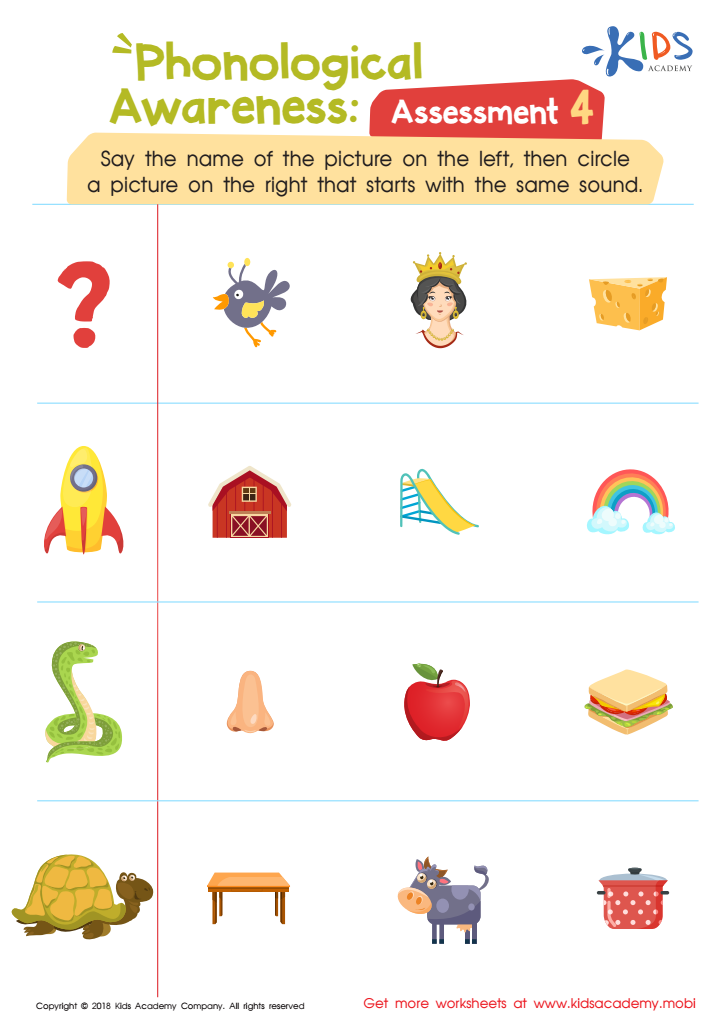
Phonological Awareness: Assessment 4 Worksheet
It can be tricky for young readers to differentiate between sounds in words. Make it fun with this downloadable worksheet! Ask your child to name each picture on the left and match the starting sound with an image on the right. This helps assess their phonics skills and make learning enjoyable.
Phonological Awareness: Assessment 4 Worksheet
Worksheet
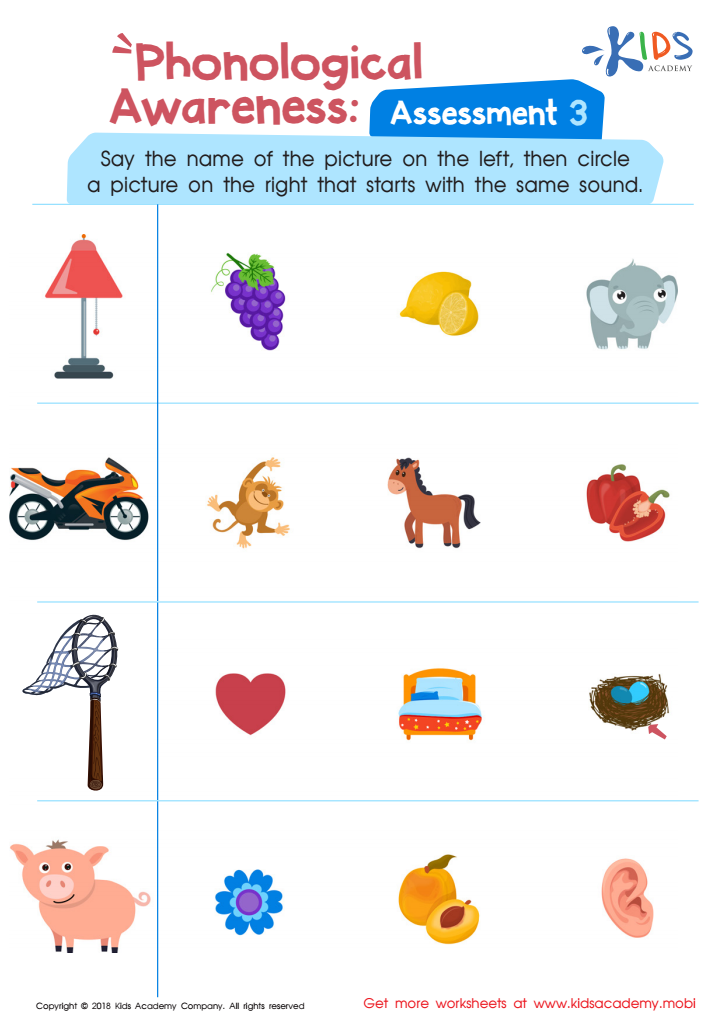
Phonological Awareness: Assessment 3 Worksheet
Test kids' reading readiness with a phonological awareness worksheet! With this PDF exercise, encourage children to name each picture aloud and match left to right. Help them learn to recognize word sounds at the start, middle and end of words. They'll be sure to remember that lamp doesn't sound like elephant!
Phonological Awareness: Assessment 3 Worksheet
Worksheet
Join Kids Academy for Free
Who is primarily going to use this learning content?








Extra Challenge Phonics activities for children aged 4-8 are vital in fostering early literacy skills. Understanding phonics—the relationship between sounds and their corresponding letters—is foundational for reading success. When parents and teachers engage children in stimulating phonics activities, they enhance their ability to decode words, ultimately boosting reading fluency and comprehension.
These extra challenge activities cater to different learning styles, promoting active engagement and helping children apply their knowledge in varied contexts. They can assist in identifying and addressing gaps in a child’s phonics understanding, ensuring that each student progresses at their own pace while being adequately challenged. Moreover, these activities often incorporate games and interactive tasks, making learning enjoyable and promoting a positive attitude toward reading.
By focusing on phonics, caregivers can support the development of critical thinking and problem-solving skills, which are essential throughout a child's educational journey. Early investment in phonics not only prepares young learners for more complex literacy tasks but also builds their confidence. A strong foundation in phonics is crucial as it sets the stage for future academic success, which aligns with the goals of parents, teachers, and the students themselves.








